
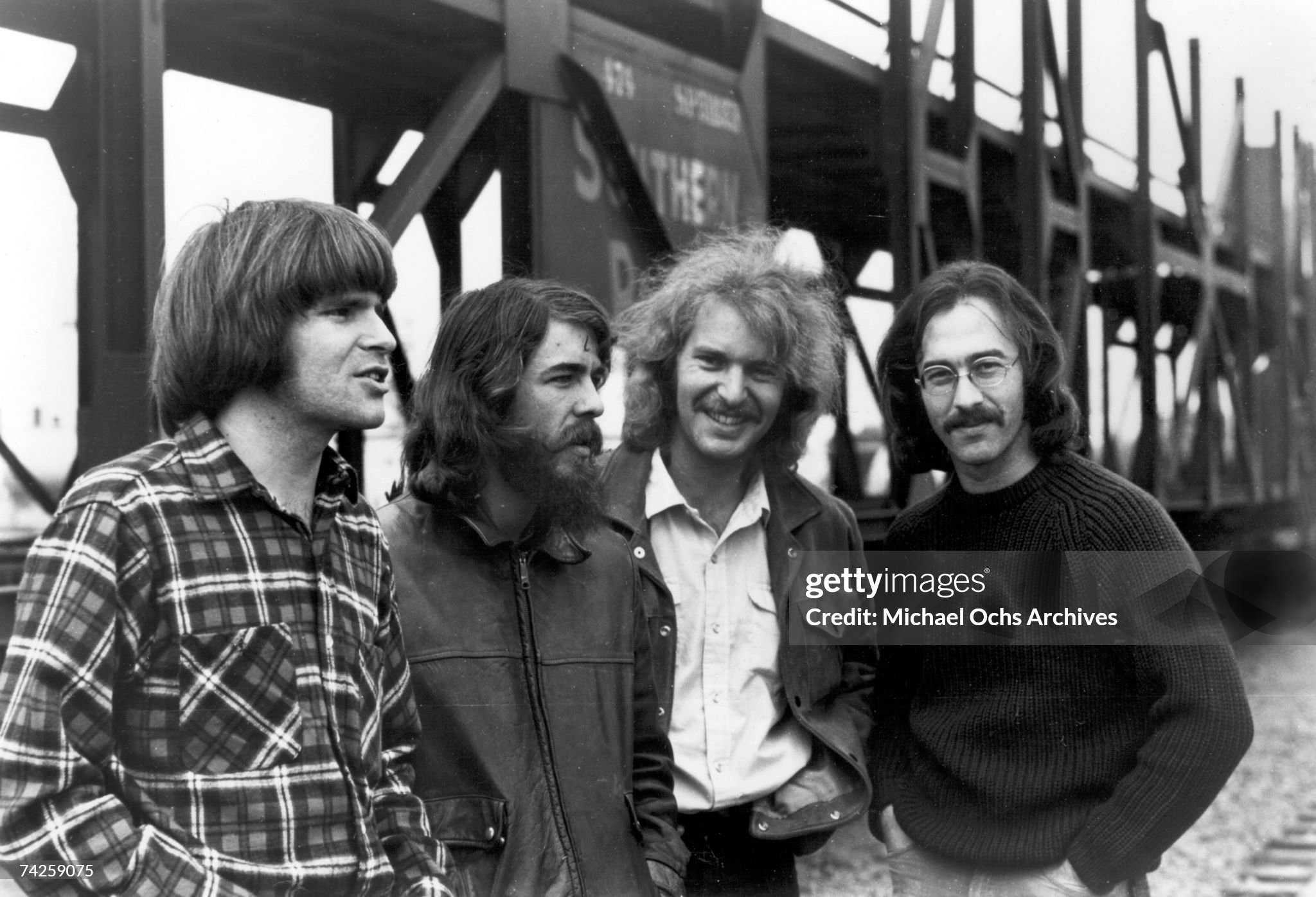
“Travelin’ Band” is the bright, breathless roar of life on the road—two minutes of jet-engine momentum hiding a tired human heart that rarely gets to come down to earth.
In January 1970, Creedence Clearwater Revival kicked open the year with a record that sounded like it was already mid-flight: “Travelin’ Band”, issued as a double A-side with “Who’ll Stop the Rain” on Fantasy Records, written (and produced) by John Fogerty. On the Billboard Hot 100, the single debuted on January 31, 1970, and ultimately climbed to a familiar CCR destination—No. 2, with a peak date of March 7, 1970. It’s one of those chart stories that feels almost poetic in hindsight: CCR were everywhere, and yet the summit kept just out of reach—this time blocked during the era’s towering run of “Bridge Over Troubled Water” at No. 1.
The song would later sit inside the band’s landmark album Cosmo’s Factory, released July 8, 1970—an album that spent nine consecutive weeks at No. 1 on the Billboard 200 and somehow turned relentless work ethic into pop perfection. But “Travelin’ Band” belongs emotionally to the months before that victory lap: it’s the sound of a group still running on adrenaline, still proving they can out-rock anyone while keeping their songs tight enough to fit between radio commercials.
Fogerty built “Travelin’ Band” like a loving impersonation of 1950s rock ’n’ roll, explicitly inspired in feel and vocal attack by Little Richard—all rasp, shout, and swagger, like you’re trying to sing over screaming fans and a backline that’s already too loud. Yet underneath the throwback thrill is something very modern for 1970: the speed of the touring machine. The opening line—“Seven-thirty-seven coming out of the sky”—isn’t metaphor; it’s the Boeing 737, a then-new symbol of short-haul jet travel and the shrinking of distance. In one phrase, the song nails the strange miracle of that moment in pop history: you could be in one city at dinner and another by breakfast, your life packed into flight cases and hotel keycards.
That is the song’s real meaning—fame as motion. The lyric isn’t romantic about the road so much as hooked on it, like someone who can’t deny the rush even while admitting the cost. There’s a wonderful, slightly desperate comedy in how it lists the moving parts: planes, towns, crowds, noise, the constant sense of arriving and leaving before you’ve even learned the shape of the place. “Travelin’ Band” turns touring into a carnival that never ends, and the band into workers inside the spectacle—smiling, shouting, surviving.
Even its controversies tell you how closely it hugged its influences. In 1972, a publisher connected to “Good Golly, Miss Molly” felt “Travelin’ Band” was similar enough to warrant a lawsuit, later settled out of court. That history doesn’t diminish the track; it underlines what Fogerty was aiming for: not reinvention, but ignition—lighting the old rock ’n’ roll fuse and letting it burn with late-’60s urgency.
What lingers, decades later, is how short the song is—about two minutes—and how complete its world feels anyway. Like the best road stories, it doesn’t explain everything. It just throws you into the middle of the blur and dares you to keep up. And maybe that’s why “Travelin’ Band” still hits so hard: it captures a truth many people know in different forms—that sometimes life moves so fast you don’t have time to feel what it’s doing to you… until the noise stops, and you realize you’ve been living in transit.