
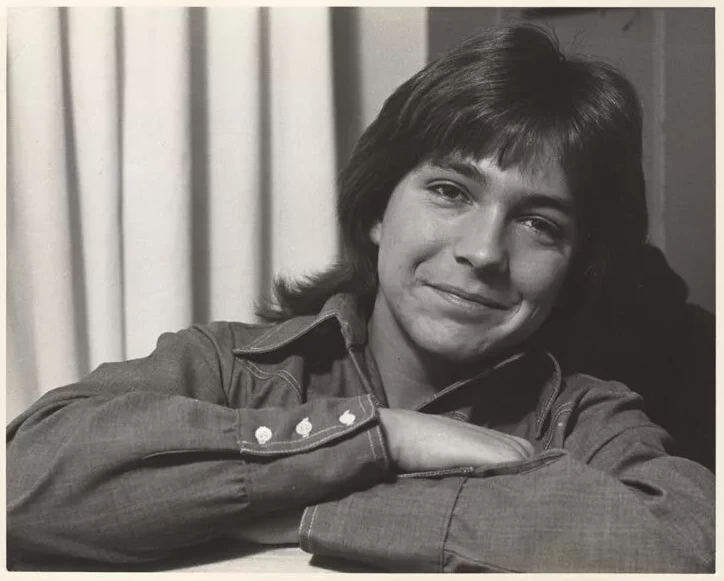
A shy, physical kind of tenderness—“All I Wanna Do Is Touch You” lives on the flip side of fame, where longing is simpler than promises and closeness is the whole point.
“All I Wanna Do Is Touch You” isn’t remembered as a chart-topping “A-side moment,” and that’s precisely why it feels so intimate today. It was released in late 1971 as the B-side to David Cassidy’s breakout solo single “Cherish” on Bell Records—a record that gave him his defining U.S. pop breakthrough. The A-side tells the headline story: Cassidy’s “Cherish” reached No. 9 on the Billboard Hot 100 and hit No. 1 on Billboard’s Adult Contemporary chart, with its chart run spanning 1971–72. But if you turned the 45 over—if you wanted to hear what was not being sold as the big public statement—you found “All I Wanna Do Is Touch You.”
Even the release date carries that familiar early-’70s discography blur: Wikipedia dates the single to October 1971, while a dedicated Cassidy discography page lists September 1971. That small discrepancy feels oddly fitting for a B-side—music that often existed a little off the official record, living instead in bedrooms, on portable turntables, in the private economies of crushes and replay buttons.
Here are the most concrete credits we can hold onto. “All I Wanna Do Is Touch You” is credited to songwriters Irwin Levine and L. Russell Brown, produced (like the A-side) by Wes Farrell, and it runs about 2:54—a compact little capsule of yearning. And while “Cherish” later appeared on Cassidy’s solo album Cherish (issued in 1972), the Cassidy discography notes that “All I Wanna Do Is Touch You” did not appear on an album at the time—another reason it felt like a secret you had to own on the single to keep.
So what is the song, emotionally?
It’s the sound of desire trying to behave. The title itself draws a boundary that’s almost old-fashioned in its restraint: not “I want to change you,” not “I want to keep you,” not even “I want to claim you”—just touch. That word carries a whole world: the quick brush of a hand, the proof that someone is real, the reassurance that closeness can exist without speeches. It’s a sentiment that suits the era’s teen-pop innocence, yes—but it also cuts deeper than innocence. Because when people feel uncertain, they often reach for the simplest certainty available: physical nearness, that unmistakable human warmth.
Placed beside “Cherish,” the contrast becomes quietly moving. “Cherish” is a declaration meant for the room—big, openly romantic, designed to travel far, and it did. “All I Wanna Do Is Touch You” feels like the moment after the room empties, when the performer’s voice no longer has to project and can simply admit what it wants. That’s the hidden genius of the 45 format: one side for the world, one side for the self.
Decades later, when archival releases started treating Cassidy’s Bell-era work with more care, “All I Wanna Do Is Touch You” resurfaced as a bonus track—listed, for example, on Cherry Red’s David Cassidy: The Bell Years 1972–1974 box set tracklist, where it appears as the Disc One bonus after “Ricky’s Tune.” Even there, it’s still framed as what it always was: an extra, a flip-side treasure, a little piece of the story that wasn’t fully “official” until later.
Listening now, you can hear why it endures for those who stumble upon it. David Cassidy was often marketed in bright colors and easy slogans, but his best recordings—especially in that early solo window—hint at a more complicated sensitivity underneath. A song like “All I Wanna Do Is Touch You” doesn’t require him to be “larger than life.” It asks him to be close. And closeness, in pop music, is a powerful illusion: a voice in your ear that makes you feel, for a few minutes, less alone.
That’s the lasting meaning of this B-side. It’s not about conquest; it’s about contact. It doesn’t chase forever; it cherishes the moment. And in its modest, nearly-hidden way—pressed into vinyl beneath a hit—it reminds us how so many real feelings lived in that era: not always shouted from the A-side, but waiting patiently on the other side, where only the truly curious would find them.