
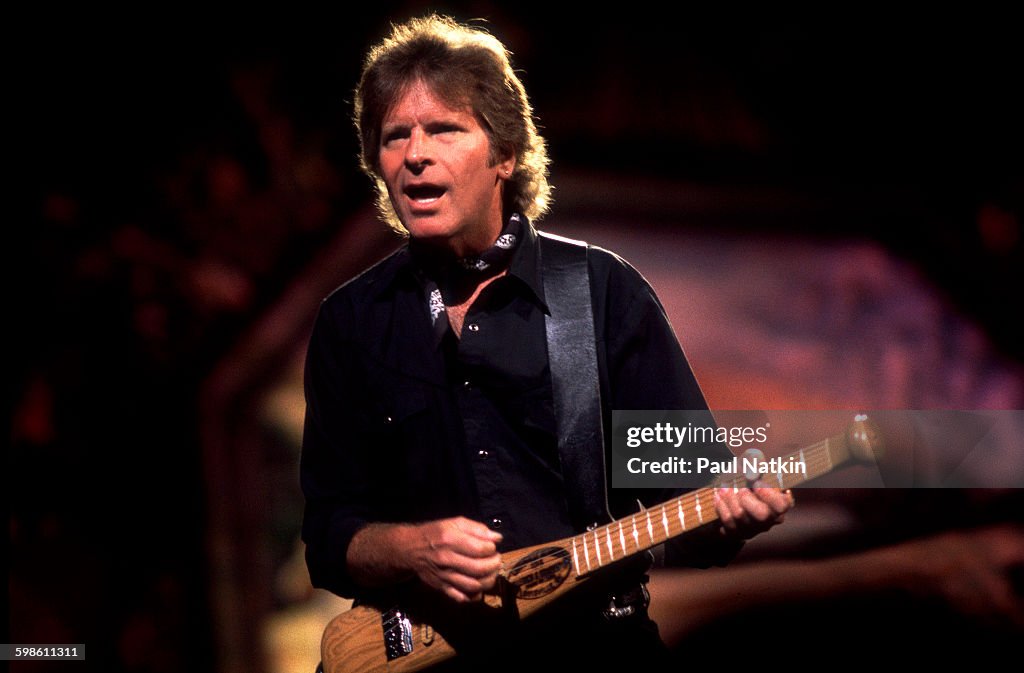
“Long As I Can See the Light” becomes a shared lantern here—John Fogerty and My Morning Jacket turning a 1970 goodbye into a grown-up promise to find the way home.
John Fogerty – “Long As I Can See the Light (with My Morning Jacket)” arrives with a very specific kind of “debut”: not as a standalone single chasing radio, but as track 7 on Fogerty’s collaboration album Wrote a Song for Everyone (released May 28, 2013). The album itself made a strong first impression—debuting at No. 3 on the Billboard 200, Fogerty’s highest-charting debut in decades. That chart moment matters, because it frames this performance as more than a novelty duet: it was part of a major late-career statement, a public re-introduction of songs that never stopped traveling through American life.
But the emotional gravity of this version comes from the song’s original life. “Long As I Can See the Light” first appeared in 1970 as the closing track on Creedence Clearwater Revival’s landmark album Cosmo’s Factory—a record often cited as released July 16, 1970 (and widely recognized as a blockbuster that would go on to dominate the album chart). In the U.S., it also rode into the charts on the flip side of the double-sided hit “Lookin’ Out My Back Door / Long As I Can See the Light.” On the Billboard Hot 100, that single entered at No. 56 (week ending August 8, 1970) and ultimately peaked at No. 2 (with its Hot 100 top-ten presence noted for October 3, 1970). Meanwhile, Cosmo’s Factory began a nine-week run at No. 1 on the Billboard 200 starting August 22, 1970, turning the song into the quiet candle at the end of one of rock’s most relentless winning streaks.
That’s the “behind the song” truth: “Long As I Can See the Light” has always been a closer, a leaving song—music for the moment after the party ends, when your feet finally point toward the door. Even critics have long heard it that way: a comforting, elegiac homeward drift after an album packed with stress, velocity, and swagger. The lyric’s simple image—put a candle in the window—isn’t just pretty writing. It’s the oldest kind of signal: I’m coming back. Keep something lit for me.
So what changes when My Morning Jacket steps into the room?
A lot—and yet, somehow, nothing essential. Wrote a Song for Everyone was built on a powerful idea: Fogerty’s catalog doesn’t belong to one era; it belongs to the bloodstream of American music, flexible enough to be re-voiced by wildly different artists. With My Morning Jacket (and especially their singer Jim James), the song becomes a conversation between generations rather than a reenactment. One review singled this track out as the album’s standout, noting how James’ voice can feel like a younger reflection of Fogerty’s spirit, while the arrangement nods respectfully to the original’s piano/organ color and steady, unshowy groove.
And that’s exactly why it hits: because the duet isn’t trying to “improve” a classic. It’s trying to reaffirm it.
Fogerty has always been a writer of movement—rivers, roads, rain, back doors, front porches. Here, movement is not escape; it’s return. The narrator isn’t dreaming of reinvention. He’s dreaming of arrival. In the duet setting, that longing feels broader, almost communal: not just my home, but the idea of home as the final mercy, the place where you can stop being sharp-edged and simply be received.
There’s a special poignancy in hearing this song reborn on a 2013 album that itself debuted so high on the charts. It suggests that even in a changed music world, a plain human message can still rise: leave a light on—someone you love is trying to find the way back. And in the hands of John Fogerty with My Morning Jacket, that message doesn’t sound like nostalgia. It sounds like lived wisdom—soft, steady, and bright enough to see by.