
A wish sung out loud becomes a kind of shelter—proof that, even in a loud world, hope can still sound gentle and believable.
When “When You Wish Upon a Star” floated out of Linda Ronstadt’s mouth on The Tonight Show Starring Johnny Carson on October 17, 1986, it wasn’t just a nostalgic flourish—it was a carefully chosen statement from an artist deep into her “standards” era. That night, with Johnny Carson at the desk, Ronstadt performed three songs: “Am I Blue?”, “When You Wish Upon a Star,” and “My Funny Valentine.”
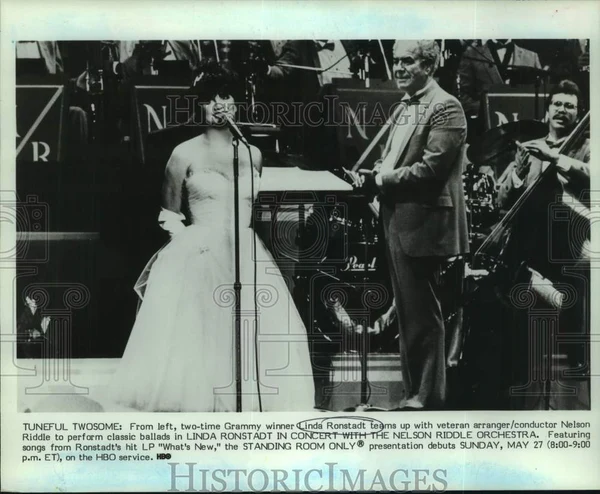
By then, the song had already taken on a fresh, chart-visible life in her hands. Ronstadt had recorded it for For Sentimental Reasons, her third collaboration with Nelson Riddle, released in late 1986; and the album’s lead single release, “When You Wish Upon a Star,” reached No. 32 on Billboard’s Adult Contemporary chart. That is a modest peak on paper—but emotionally, it tells you something profound: in the middle of the glossy 1980s, a song about quiet wishing still found a place to land.
The deeper story, of course, begins long before 1986—back in 1940, when “When You Wish Upon a Star” was written by Leigh Harline and Ned Washington for Pinocchio, sung onscreen by Cliff Edwards as Jiminy Cricket. It won the 1940 Academy Award for Best Original Song, and over time it became the signature musical calling card of the The Walt Disney Company—a melody so widely known it can feel like it’s always been in the air.
That history matters because Ronstadt did not approach the song as “cute.” She approached it as a standard—something with weight, with lineage, with a responsibility to sing it straight. By 1986 she had already proven she could step into older repertoire without sounding like she was visiting a museum: her voice had the clarity to honor a melody and the emotional grain to make it feel newly personal. So when she chose this Disney hymn of longing for late-night television, it didn’t come across as a novelty request—it came across as a confession dressed in formalwear.
Part of the magic is that the lyric offers comfort without pretending life is simple. It doesn’t promise you’ll get everything you want. It says something more subtle—and, in its way, more merciful: wishing is a human right. Not the childish kind of wishing for a toy, but the adult kind—wishing for peace in the house, for a phone to ring, for a hard season to soften. The song’s genius is its lack of bitterness. It refuses the modern impulse to roll the eyes at hope. Instead, it treats hope as dignified—something “fate” might still respect, if you keep your heart open long enough.
That’s why the 1986 performance sits so beautifully in memory. Late-night TV can be a strange place for sincerity: a bright set, quick jokes, applause on cue. Yet Ronstadt’s presence had a way of quieting the room. She didn’t need to “sell” the emotion with theatrics. She let the melody do what it has always done—move forward like a small lantern in the dark. And because her tone could be simultaneously strong and tender, the song stopped being a cartoon’s promise and became something closer to a lullaby for grown lives: close your eyes; keep wishing; the world is still capable of turning toward the light.
There’s also a poignant artistic logic to which version of Ronstadt we meet here. For Sentimental Reasons is steeped in Old Hollywood atmosphere—romance remembered rather than chased, elegance worn like a well-kept coat. In that setting, “When You Wish Upon a Star” feels less like “Disney” and more like “American songbook”—a tune that belongs beside torch songs and midnight ballads because it understands a truth those songs have always carried: longing is not weakness; longing is proof we still feel.
And perhaps that is the lasting meaning of Ronstadt’s 1986 moment on The Tonight Show Starring Johnny Carson. It’s not only that she sang a beloved classic beautifully. It’s that she reminded us what the classic is really for. Not for childhood alone. Not for brand logos. But for the private, half-spoken wish each of us keeps somewhere safe—waiting for a voice, steady and unafraid, to sing it back to us as if it still matters.