
A “solitary man” isn’t simply alone—he’s armoring himself against disappointment, until one night the armor turns into a song and the crowd finally understands what he can’t say outright.
When you hear Neil Diamond sing “Solitary Man” (Live at the Greek Theatre, Los Angeles/1972), you’re not just hearing a “hit performed live.” You’re hearing a man circle back to his own beginning—then sing it with the weight of everything that happened after. The performance comes from Hot August Night, recorded at The Greek Theatre in Los Angeles during Diamond’s run of ten sold-out shows and captured specifically on August 24, 1972—a concert that became one of the defining live documents of its era.
That context matters, because Hot August Night wasn’t some casual tour souvenir. It was an event, released in 1972 on the newly formed MCA Records, with Tom Catalano producing—an album that treats the stage like a living room with stadium volume: intimate storytelling, then sudden eruptions of communal joy. And right there in that set list—after the big opening sweep—“Solitary Man” arrives as a reminder that even the most confident performer still carries an early wound in his pocket. Track listings for the Greek Theatre recording place “Solitary Man” early in the show (around the first stretch of songs), running roughly 3:14 in this live rendition.
Now, the song’s “birth certificate” is even older—and crucial to the meaning. “Solitary Man” was originally released on April 4, 1966, on Bang Records, produced by Jeff Barry and Ellie Greenwich, and it first peaked at No. 55 on the Billboard Hot 100. That’s the humble beginning: not yet the household name, not yet the arena figure—just a young songwriter stepping forward and admitting, in plain language, that love has left him cautious. Then came the second life: after Diamond found major success later in the decade, Bang re-released the single, and it climbed much higher—No. 21 on the Hot 100 in 1970, and No. 6 on Billboard’s Easy Listening chart.
So by the time he reaches the Greek Theatre in August 1972, “Solitary Man” is no longer a diary entry. It’s a chapter of autobiography the audience already knows by heart. That changes everything. The lyric—those names and those small betrayals—doesn’t feel like youthful melodrama anymore. It feels like the first scar you can finally speak about without flinching. The song’s narrator isn’t bragging about being alone; he’s explaining how he got there. And live, Diamond can lean into the bitter smile of it: the way people build independence out of necessity, then later discover the independence has built walls.
The Greek Theatre performance also reframes the phrase “solitary man” itself. In 1966, it’s a self-description that sounds almost defensive: I’m better off alone. In 1972, with thousands listening—and responding—“solitary” becomes something else: a shared recognition. The audience doesn’t pity him; they recognize themselves. That’s the quiet miracle of great live recordings: they turn private insecurity into public communion.
And let’s not overlook how perfectly the timing aligns with Diamond’s career arc. Hot August Night sits in the same period as his early-’70s surge—songs like “Song Sung Blue” and “Cracklin’ Rosie” already part of the culture—yet he still makes room for the earliest identity statement that started it all. It’s as if he’s saying: Before the spotlights, before the singalongs, there was this one lonely truth—and it’s still true enough to sing.
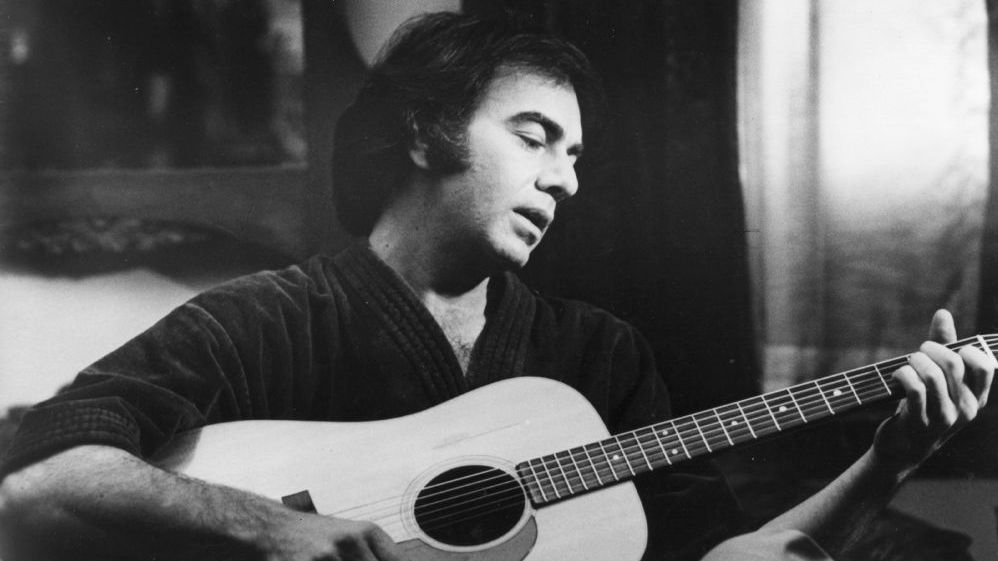
That’s why “Solitary Man (Live at the Greek Theatre, Los Angeles/1972)” lingers. It doesn’t just revive an old hit; it lets you hear the years inside the voice. It’s the sound of a man who learned how to fill a theatre—and still remembers what it felt like to sit alone with a guitar and a doubt. In the end, the “solitary man” isn’t conquered by fame. He’s simply understood, for a few minutes, by a crowd that has carried its own versions of solitude into the night.