
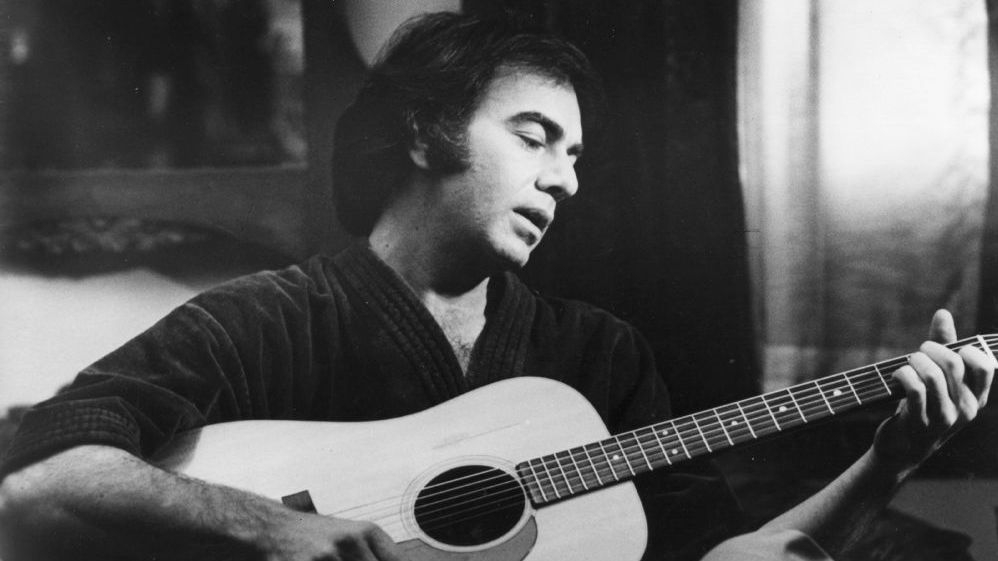
“The Last Thing on My Mind” is a goodbye spoken too late—Neil Diamond turning remorse into a soft confession that lingers long after the door has closed.
There’s a particular kind of heartbreak that doesn’t explode. It simply arrives, quietly, when the person you love is already halfway gone—when you realize the tenderness you assumed would always be there has been wearing thin for a long time. Neil Diamond’s “The Last Thing on My Mind” lives in that hushed space. His version first appeared on his 1971 studio album Stones (released November 5, 1971), and later re-emerged in a new commercial life when it was issued as a U.S. single in 1973—credited as coming from his compilation Rainbow.
That 1973 single has a very specific chart story—modest, but meaningful in the way adult heartbreak songs often are. On the Billboard Hot 100, “The Last Thing on My Mind” debuted at No. 84 on August 25, 1973, and peaked at No. 56 on September 22, 1973. It also found a warmer home on softer radio, reaching No. 15 on Billboard’s Adult Contemporary chart. These numbers don’t read like a conquest; they read like a slow recognition—listeners meeting a song that doesn’t beg for attention, but earns it with sincerity.
The deeper story begins long before Diamond. “The Last Thing on My Mind” was written by Tom Paxton and first recorded by him in 1964 for his album Ramblin’ Boy on Elektra. Paxton’s composition is rooted in traditional lament lineage—often noted as drawing from “The Leaving of Liverpool”—and it carries that folk-world gift: simple language that cuts straight to the bone.
What makes Neil Diamond such an effective messenger for this song is that he doesn’t sing it like an “old folk tune.” He sings it like a man standing in the wreckage of a conversation he wishes he’d had sooner. There’s no melodramatic pleading here—just regret that feels frighteningly believable. The lyric’s central ache is not merely “don’t go.” It’s the heavier admission underneath: I could have loved you better, and I didn’t. That’s the kind of line you don’t sing convincingly unless you understand how often love fails not through cruelty, but through neglect—through distraction, pride, and the lazy assumption that time will always forgive you.
On Stones, Diamond was in a phase where his voice could sound both intimate and enormous—capable of stadium grandeur, yet still able to lean close to the microphone and make you feel like you’re the only person in the room. His reading of “The Last Thing on My Mind” has that late-night quality: steady tempo, unforced emotion, the sense of someone trying to remain composed because breaking down won’t change anything now. And that restraint is exactly what makes it heartbreaking. You can hear a man keeping his dignity while his heart quietly panics.
The 1973 reappearance via Rainbow adds another layer of meaning. Rainbow is a compilation that gathers songs from Diamond’s earlier Uni-era albums (the track listing even notes “The Last Thing on My Mind” as originating from Stones). In other words, the industry effectively re-framed this song for a wider audience: not a new confession, but a confession worth hearing again—proof that some emotions don’t expire when a release cycle ends.
Ultimately, “The Last Thing on My Mind” endures because it tells a truth most of us learn the hard way: love is not only a feeling; it’s an attention you must keep paying. Neil Diamond doesn’t sing from the heroic side of romance—he sings from the human side, where people miss their chance, then live with the echo. And if the song still stirs something years later, it may be because it doesn’t just describe someone leaving. It describes the moment you realize that what hurts most is not the goodbye itself… but everything you didn’t do before it.