
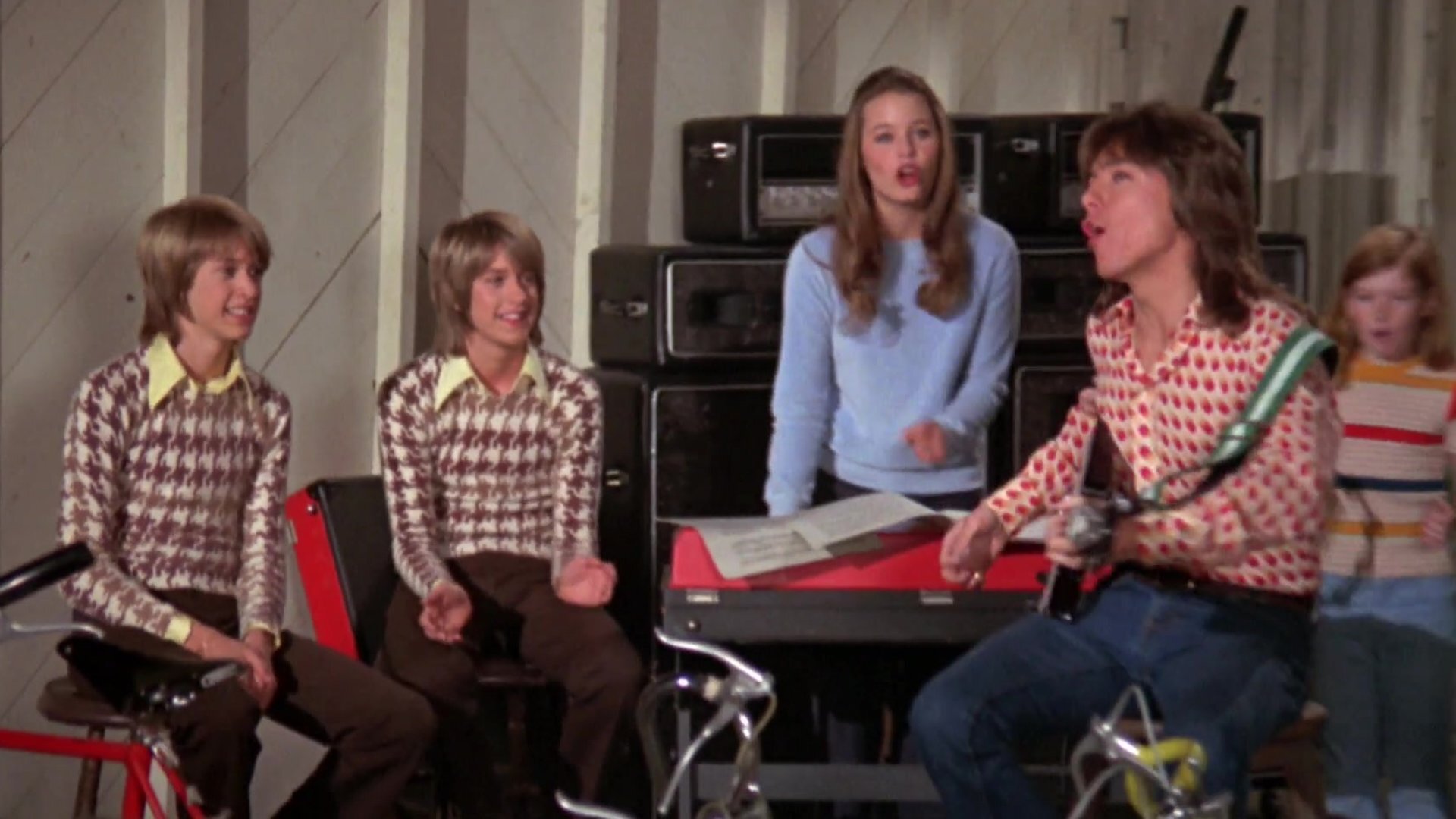
A tender song about letting go with grace, “Take Good Care of Her” reveals how The Partridge Family could sound far more reflective and emotionally mature than many listeners remember.
Among the brighter, radio-friendly recordings associated with The Partridge Family, “Take Good Care of Her” stands apart for its quiet dignity. Released as part of the 1972 album Notebook, the group’s version was not pushed as one of their major Billboard singles, so it did not earn a separate Hot 100 chart peak of its own. But the song already carried chart history before the family-pop machine ever touched it. Written by Eddie Rabbitt, it had first become a hit for Bobby Vinton in 1968, reaching No. 33 on the Billboard Hot 100 and No. 14 on the Easy Listening chart. That earlier success gave the tune a solid emotional pedigree, yet The Partridge Family reshaped it in a way that feels gentler, sunnier, and somehow more wistful.
What makes “Take Good Care of Her” so memorable is not grand drama, but restraint. The lyric is built on a simple, aching idea: if she is no longer mine, then please be kind to her. It is one of the most generous premises in popular song. There is no bitterness here, no urge to settle a score, no theatrical collapse. Instead, the narrator offers a blessing. That emotional choice gives the song its staying power. It speaks to that strange human moment when love has changed shape, but tenderness remains. In lesser hands, such a lyric could have turned sentimental. In the hands of The Partridge Family, it becomes soft, polished, and unexpectedly moving.
By the time this recording appeared on Notebook, the group had already proven they were more than a novelty tied to television. Yes, the series gave the music its first burst of familiarity, and yes, the image was bright, colorful, and accessible. But the records often contained more feeling than the sitcom frame suggested. “Take Good Care of Her” is a perfect example. It is not built like a sugar-rush hit. It breathes more slowly. The arrangement leaves space for the lyric to settle. The rhythm is measured, the melody unforced, and the emotional temperature is warm rather than flashy.
Much of that effect comes from the lead vocal, most closely associated with David Cassidy, whose voice had the rare ability to sound youthful and world-weary at the same time. That blend matters here. A fully hardened voice might have made the song sound defeated. A voice that was too innocent might have made it feel lightweight. Cassidy sat in the middle, which is exactly why the performance works. He does not oversing the regret. He lets the line do its work. When a singer trusts a song this much, the listener leans in rather than being pushed.
There is also something revealing about The Partridge Family choosing this material at all. Their best-known recordings are often remembered for hook, cheer, and momentum. Songs like “I Think I Love You” or “Doesn’t Somebody Want to Be Wanted” carried immediate pop sparkle. “Take Good Care of Her” belongs to another emotional shelf. It is about release, not pursuit; memory, not excitement; grace, not conquest. In that sense, it broadens the group’s legacy. It reminds us that behind the polished harmonies and television familiarity was a repertoire that occasionally reached for something more enduring than teenage rush.
The song’s deeper meaning lies in its emotional generosity. So many love songs are written from the viewpoint of possession: come back, stay with me, choose me. This one does the opposite. It asks for care, not victory. It turns heartbreak into a final act of kindness. That is why the song feels older than its pop packaging. Its wisdom is not loud. It arrives quietly, with the hard-earned understanding that love can remain real even after it no longer belongs to us in the same way.
That quality may also explain why the recording lingers so well in memory. A lot of early-1970s pop was designed for immediate response, and there is nothing wrong with that. But some songs live longer because they speak to feelings that grow clearer over time. “Take Good Care of Her” is one of those songs. The first time through, it sounds sweet. A few decades later, it sounds brave. It is the voice of someone trying to keep tenderness alive even while stepping aside. That is not only good songwriting; it is emotional maturity wrapped in melody.
In retrospect, the The Partridge Family version deserves more attention than it usually gets. It may not carry the chart glory of the group’s biggest singles, and it may not be the first title people name when recalling their catalog, but that is precisely what gives it a special glow. Hidden a little deeper in the discography, it rewards listeners who return not just for nostalgia, but for feeling. On Notebook, it stands as a reminder that pop music can be tender without being frail, polished without being empty, and sentimental without losing its intelligence.
There are songs that grab the room instantly, and there are songs that stay behind after the room grows quiet. “Take Good Care of Her” belongs to the second kind. In the world of The Partridge Family, that makes it not an outlier, but one of the clearest signs that beneath the bright television colors and familiar choruses, there was always room for a more thoughtful heart.