
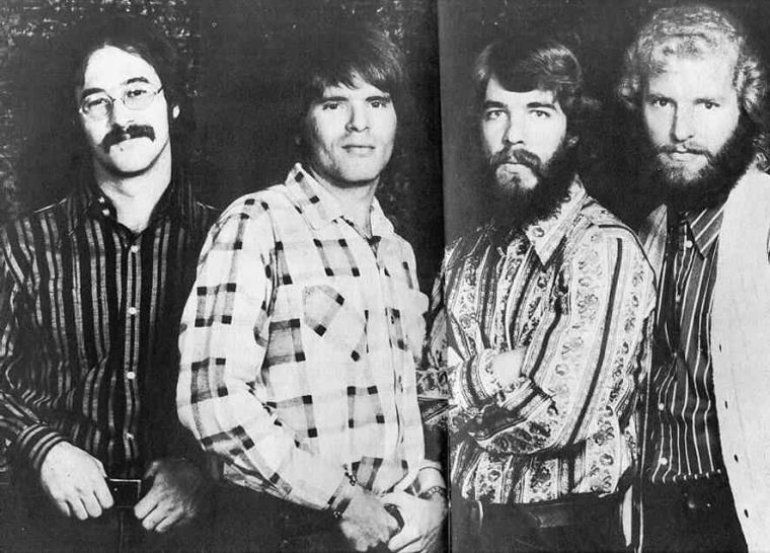
Tearin’ Up the Country captures Creedence Clearwater Revival at a rare moment when the road, the groove, and the changing balance inside the band all met in one unpolished, revealing song.
When Creedence Clearwater Revival released Mardi Gras in April 1972, the group was already standing in a very different light from the one that had made them one of America’s defining bands of the late 1960s. For listeners who had followed the unstoppable run of Bayou Country, Green River, Willy and the Poor Boys, and Cosmo’s Factory, this album sounded like a crossroads. And tucked inside that final studio album was “Tearin’ Up the Country”, one of the tracks that most clearly showed how much had changed.
First, the important chart fact: “Tearin’ Up the Country” was not a major standalone hit single, so it did not become a Billboard Hot 100 chart entry in the way songs like “Proud Mary”, “Bad Moon Rising”, or “Have You Ever Seen the Rain” did. But its parent album, Mardi Gras, still reached No. 12 on the Billboard 200, a respectable placing that also reflected just how strong the band’s name still was in 1972. Even so, the album’s reputation has long been complicated, and “Tearin’ Up the Country” sits right at the center of that conversation.
One of the most significant details behind the song is authorship. Unlike the classic CCR records, which were overwhelmingly driven by John Fogerty as principal songwriter, lead singer, and musical architect, Mardi Gras opened the door for the other members to write and sing more of the material. “Tearin’ Up the Country” was written and sung by Doug Clifford, the band’s drummer. That alone makes the song historically important. It is not simply another album track; it is evidence of a band trying, perhaps a little awkwardly, to redistribute its identity.
And that is exactly why the song remains so interesting. If one listens to “Tearin’ Up the Country” expecting the tight, swampy authority of vintage Fogerty-era CCR, the track can feel rough around the edges. But if one listens to it as a document of a real band in transition, it becomes much more moving. The song leans into a loose, good-time blend of country-rock, barroom rhythm, and road-band energy. It is less mysterious than classic Fogerty songs, less mythic, less haunted by Southern imagery or American unrest. Instead, it feels open, dusty, direct, and human. It sounds like musicians trying to catch joy in motion, even as the structure around them is shifting.
Lyrically, “Tearin’ Up the Country” is not built around elaborate metaphor. Its meaning is carried more by attitude than by literary complexity. The title itself suggests movement, speed, release, and the restless freedom that runs through so much American rock and country music. There is a familiar pleasure in that idea: the band on the move, the amplifier buzzing, the road stretching ahead, and ordinary life briefly lifted by music. In that sense, the song carries a classic roots-rock spirit. But knowing where it appears in the CCR story gives it a second meaning. It also sounds like a band trying to keep rolling forward by feel, even when the old center of gravity was no longer fully holding.
That background matters. By the time of Mardi Gras, tensions within Creedence Clearwater Revival had become difficult to ignore. The album is often discussed because it reflects a compromise: less dominance from John Fogerty, more participation from Stu Cook and Doug Clifford. For some fans, that change made the record feel uneven. For others, it gave the album an honesty that polished legacy pieces sometimes lack. “Tearin’ Up the Country” may not be a forgotten chart giant, but it is one of the clearest windows into that late-period experiment.
There is also something endearing about the performance itself. Doug Clifford does not sing like John Fogerty, and the song does not pretend otherwise. That contrast is part of its value. The vocal has a workmanlike, lived-in quality, and the arrangement carries the kind of plainspoken drive that feels at home in a roadside dance hall rather than in a grand rock monument. It is CCR from a different angle: less iconic, more communal. Not every listener wants that from this band, of course, but that is precisely why the song still sparks conversation. It asks a quiet question: what happens when a legendary group stops sounding inevitable and starts sounding vulnerable?
Over time, that vulnerability has become part of the song’s appeal. Many listeners return to “Tearin’ Up the Country” not because it outshines the great CCR classics, but because it reveals the group in a way the classics do not. It is a backstage photograph rather than a formal portrait. It reminds us that even the most celebrated bands were made of individual personalities, ambitions, frustrations, and attempts at reinvention. In that sense, the song has aged into something more poignant than a simple deep cut. It has become a small but telling chapter in the story of how Creedence Clearwater Revival sounded when certainty gave way to change.
So no, “Tearin’ Up the Country” was not the song that defined the band’s peak years. But it remains worth hearing, and worth hearing carefully. On a record that many people still debate, it offers a raw and revealing glimpse of Creedence Clearwater Revival in their final studio era: still rooted in American rhythm, still capable of lift and motion, but already sounding like a band whose legend was becoming more complicated, and perhaps more human, with every mile.