
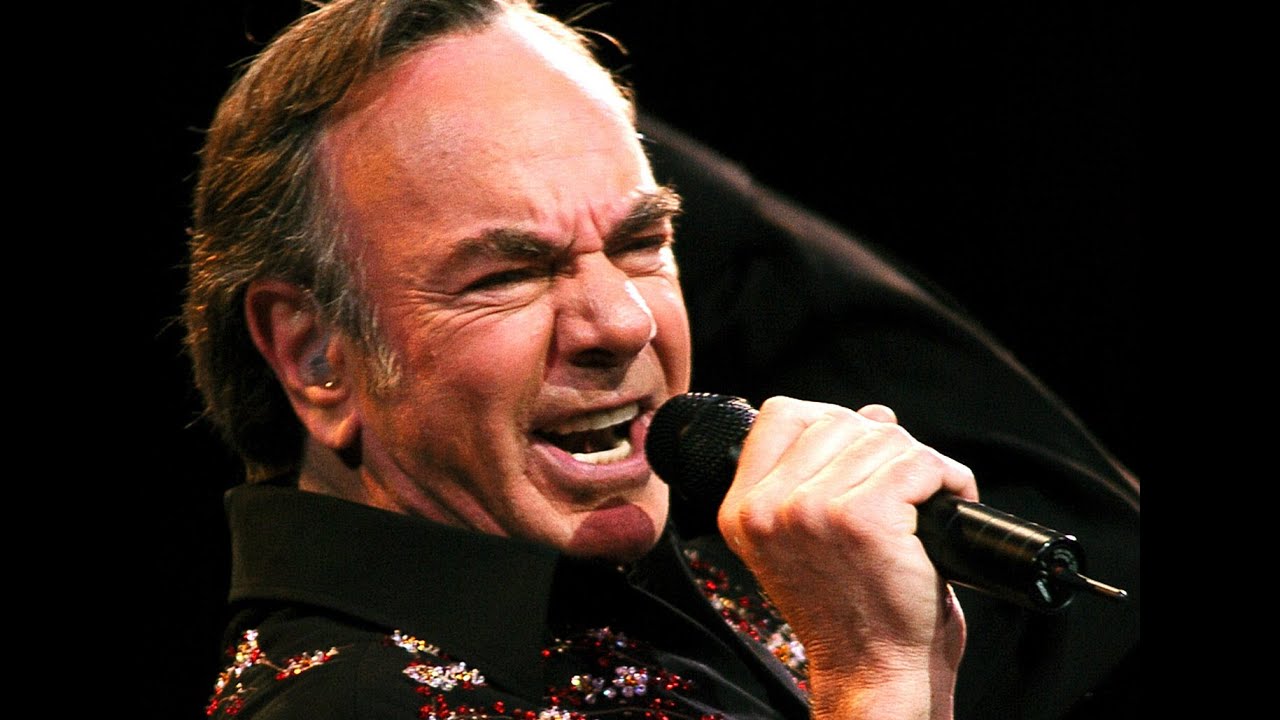
In “Act Like a Man,” Neil Diamond takes an old command and makes it uneasy again. What sounds at first like advice, or even discipline, slowly begins to feel like pressure—the kind that asks men to stand upright while quietly teaching them what not to show.
There is something instantly arresting about a title like “Act Like a Man.” It lands almost before the melody does. It sounds firm, familiar, and a little dangerous, the kind of phrase many people have heard in one form or another long before they ever stopped to ask what it was really demanding. That is why the hook is so immediate. Neil Diamond does not need a complicated opening image here. The title itself is already carrying a whole history of expectation—pride, toughness, self-command, emotional restraint. And because the song appears on Home Before Dark, released in May 2008, it arrives inside one of the most inward-looking records of his later life, an album produced by Rick Rubin that went to No. 1 in the United States, the United Kingdom, and New Zealand. On that record, “Act Like a Man” is not a throwaway phrase tossed into a louder album. It is the seventh track in a body of work widely heard as intimate, personal, and stripped back.
That context matters, because the song’s power comes not from swagger but from tension. Home Before Dark was praised on release as a deeply personal late-career statement, with critics noting its plain-spoken emotional candor and its continuation of the artistic resurgence that had begun with 12 Songs. In that setting, “Act Like a Man” does not sound like a simple anthem of masculine certainty. It sounds more complicated than that—like a man talking to himself, measuring himself, perhaps even reproaching himself. One contemporary review put it very neatly: Diamond is “his own worst critic” on “Act Like a Man.” Another described the album as an “intimate portrait of a man,” which is useful here because it helps explain why the song feels confrontational without ever becoming cartoonishly macho. The challenge is there, yes—but it is turned inward.
That is why the song still stirs debate about pride, toughness, and what men were told to hide. The phrase “act like a man” has always carried a double edge. On one side, it can sound like a call to courage, steadiness, endurance. On the other, it can sound like an old social order speaking through the family room, the schoolyard, the locker room, the mirror—telling a boy, and later a man, which feelings are acceptable and which must be swallowed. Diamond, by putting that phrase into a reflective, late-career song on such an introspective album, gives it a different weight. He does not seem to be celebrating the command so much as wrestling with it. Even the available commentary around the track suggests exactly that: a kind of pep talk, yes, but one edged with self-scrutiny rather than easy triumph.
And perhaps that is what makes the song more provocative than it first appears. Neil Diamond had spent decades writing songs of longing, confidence, devotion, loneliness, hunger, and self-invention. But “Act Like a Man” catches something thornier. It asks what remains when a man has spent long enough inside that old instruction. Does the phrase still sound noble? Or does it begin to reveal its cost? Because the song sits on Home Before Dark, a record whose whole atmosphere is one of late-hour reflection, the answer is not simple. The album’s broader tone suggests reckoning rather than performance. This is not a young man trying to look strong. This is an older artist, long past the need to prove his masculinity to anyone, returning to the phrase and hearing the pressure inside it more clearly.
The beauty of the song is that it never has to overexplain itself. The title does the heavy lifting. “Act Like a Man” is one of those phrases that opens a whole emotional world in four words. That is why the hook feels instant. We recognize the command before we even decide whether we agree with it. We have heard it in culture, in memory, in expectation. Diamond’s gift is that he takes that old command and places it inside a quieter, more vulnerable musical frame. The result is not bluster. It is friction. The song keeps its dignity, but the dignity feels hard-earned, not inherited.
So yes, “Act Like a Man” still stirs debate because it touches a nerve that never quite went away. It is not just about toughness. It is about the script behind toughness—the old lesson that composure is virtue, that pain should be managed, that uncertainty should be hidden, that manhood is something one performs correctly or risks losing. In Neil Diamond’s hands, that script does not come back as a slogan. It comes back as a question. And that is why the song lingers. The hook is instant, but the unease underneath it lasts much longer. On a late album full of reflection, “Act Like a Man” sounds less like a commandment than a wound dressed up as advice—and that is what makes it so hard to ignore.