
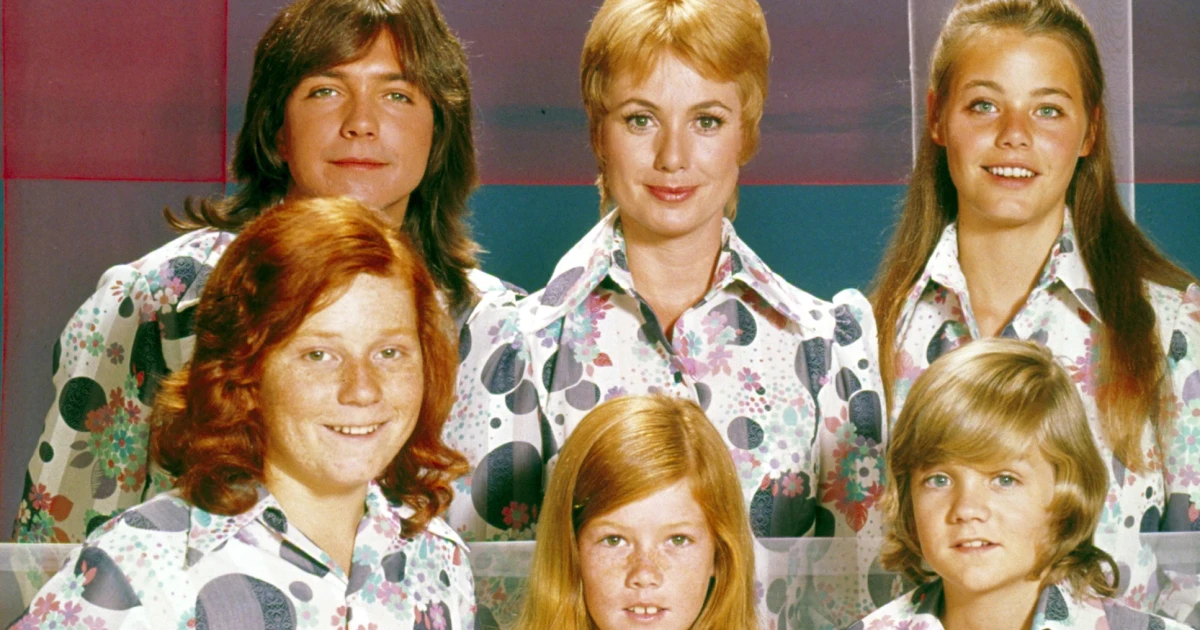
“Come On Get Happy” is less a “theme song” than a little burst of emotional sunlight—an invitation to step inside a kinder world, even if only for a minute.
There are television openings that simply introduce a cast, and then there’s “Come On Get Happy”—a tune that felt like it introduced an era. First heard as the opening theme when The Partridge Family premiered on September 25, 1970, it became a weekly ritual: the bus, the harmonies, that bright command to shake off the day and sing along.
What often gets overlooked is how deliberately compact and purpose-built the song is. The canonical version most listeners know runs barely over a minute—1:05 on later official releases—like a musical postcard rather than a full radio track. That brevity is why it didn’t arrive with a neat “debut position” on the Billboard Hot 100 the way “I Think I Love You” did; “Come On Get Happy” wasn’t rolled out as a standard commercial single in its original form. Its “chart life,” such as it is, happened in living rooms, not countdown shows—repeated weekly until the melody felt stitched into memory.
The songwriting credit tells you something important about its sparkle. The theme is credited to Wes Farrell and Danny Janssen—with Farrell also the key musical architect behind the Partridge sound. And that sound, despite the on-screen illusion of a family band, was built with serious studio muscle: David Cassidy as lead singer, Shirley Jones present on recordings, backed by elite session players and professional vocal ensembles (including members of the Ron Hicklin Singers) under Farrell’s production. The result is bubblegum pop that’s deceptively well-made—bright as candy, but tight as clockwork.
Now—what does “Come On Get Happy” mean?
On the surface, it’s pure optimism: “Hello world, hear the song that we’re singing.” But listen like a late-night radio storyteller, and you’ll hear the deeper psychology of why it worked. The lyric doesn’t promise that life is easy; it simply offers a choice: step onto the bus, join the chorus, let music reframe the day. That’s a very American kind of comfort—hope not as a grand philosophy, but as a practical habit. A sing-along as survival.
And there’s a bittersweet twist in that cheerfulness, one that time only amplifies. “Come On Get Happy” is the sound of an invented family selling the dream of togetherness—yet the feeling it triggers in listeners is real. That’s the paradox of pop culture at its best: it can be manufactured and still be true in the place that matters. The bus rolling down the street becomes a symbol—of motion, of community, of the idea that you don’t have to solve everything before you’re allowed to smile.
It also helps that David Cassidy sings it with a kind of open-throated sincerity that never winks at the camera. He doesn’t sound like he’s advertising happiness; he sounds like he’s asking for it, too—like he’s inviting you into a small pocket of warmth where the world can’t reach for a moment. And because the tune is so short, it never overstays. It arrives, lifts you, and disappears—leaving behind that odd, lovely afterglow: the sense that maybe joy can be simple, maybe it can be shared, maybe it can be summoned with nothing more than a chorus and a beat.
So when “Come On Get Happy” plays today, it isn’t just nostalgia. It’s a tiny ceremony. A reminder that sometimes the brightest songs aren’t the ones with the biggest chart statistics—they’re the ones that taught us how to enter a memory, like opening a familiar door and hearing laughter somewhere inside.