
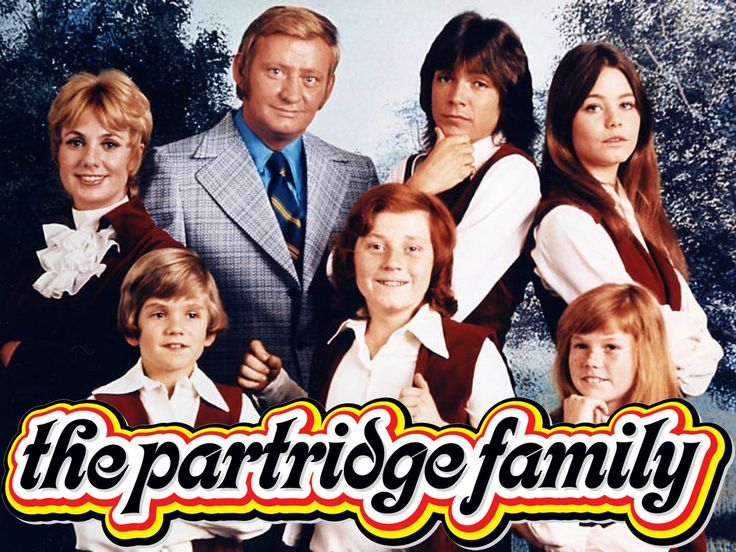
“White Christmas” in The Partridge Family’s hands is a gentle television-era dream: bright, comforting, and a little wistful—like a living-room glow trying to keep winter from feeling too lonely.
The key facts belong up front, because this recording is often remembered as “just another Christmas standard,” when it actually had a very specific place in their early-’70s pop story. The Partridge Family recorded “White Christmas” on August 25, 1971, and released it on their holiday LP A Partridge Family Christmas Card in November 1971 on Bell Records, produced by Wes Farrell. That album mattered commercially: it was reported as the best-selling Christmas album in the United States for the 1971 Christmas season, and it held No. 1 on Billboard’s special Christmas Albums sales chart for all four weeks that year.
Unlike many of the group’s pop singles, “White Christmas” didn’t become famous because it fought weekly battles on the Hot 100. Its impact was seasonal and album-driven—something families replayed in December rather than something that demanded chart placement to prove its worth. Still, it did have a single-era life: Discography listings document a 1971 single pairing “White Christmas” / “Jingle Bells” (on Bell) in some markets and pressings. That’s important context: the song was close enough to “single material” to be issued on 7-inch, yet it ultimately lived best as part of the album’s cozy sequence—where it arrives early, like the first snowflake in a familiar storybook.
Now, the deeper story: “White Christmas” is, of course, the Irving Berlin standard—one of the most emotionally loaded holiday songs ever written. But what makes the Partridge version distinctive is the lens it uses. The Partridges were never a gritty bar band; they were a carefully produced, harmonized pop family for the television age. On A Partridge Family Christmas Card, the lead vocals are generally associated with David Cassidy, with Shirley Jones taking the lead notably on “The Christmas Song.” That matters because their “White Christmas” doesn’t sound like a weary adult looking back on lost worlds; it sounds like a young voice trying to keep the world gentle—trying to hold onto the idea that the holidays can still feel uncomplicated.
And that’s where the nostalgia gets interesting. “White Christmas” is already a song about longing for an earlier, softer version of life. When The Partridge Family sing it in 1971—an era itself now soaked in memory—it becomes a double exposure: a 1940s dream reframed through 1970s warmth, then carried forward into our own time as a memory of both decades at once. You hear the smoothness of the arrangement, the friendly pacing, the almost polite optimism—and underneath it, that quiet ache Berlin always planted: the knowledge that what we’re dreaming of might be gone, or might never have existed quite the way we remember.
What gives their performance its particular meaning is how it treats “white Christmas” less as a meteorological wish and more as a symbol of order. White snow covers the messy parts of the world. It makes the street look clean again. It makes the night feel hushed, as if trouble has been asked to wait outside until morning. In a time when people wanted their holidays to feel safe—when the television was still a hearth—this version offers exactly that: a soft blanket of sound, familiar enough to trust.
And yet, there’s a bittersweet truth that slips in if you listen closely: because the Partridge sound is so polished, it also reminds you how much of holiday happiness is something we stage. We put up lights. We play the same records. We repeat the same phrases. We try, year after year, to recreate a feeling we once had naturally. “White Christmas” is the anthem of that human effort—our sweetest attempt to summon comfort on command. The Partridge Family deliver it with a kind of innocent sincerity that makes the effort feel tender rather than sad.
So if you play “White Christmas” by The Partridge Family today, you’re not just hearing a standard. You’re hearing November 1971—a carefully made seasonal album, a TV-era musical family, and a pop production style built to soothe. And you’re hearing something else, too: the enduring wish at the center of the song itself—that for one night, at least, the world might be quiet, bright, and kind enough for us to believe in the dream again.