
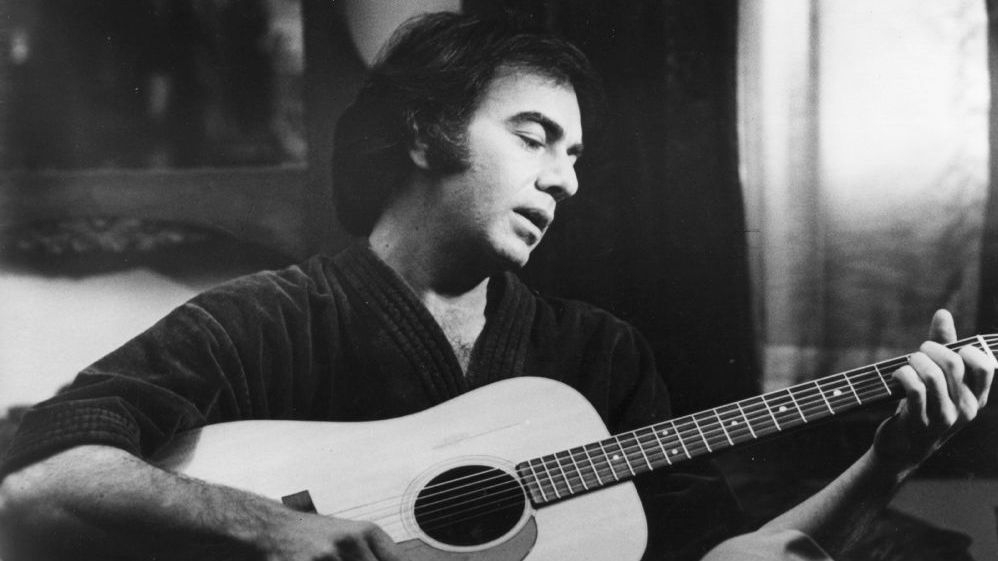
“I (Who Have Nothing)” in Neil Diamond’s voice is a late-night confession: when pride finally gives way, and love is offered not as a bargain—but as the only treasure left.
The key facts sit close to the surface, and they matter because they explain why this performance feels so deliberate. Neil Diamond recorded “I (Who Have Nothing)” for his 1993 covers album Up on the Roof: Songs from the Brill Building, released August 31, 1993 on Columbia Records, produced by Peter Asher. On that album, “I (Who Have Nothing)” appears as track 7, running 4:05—a dramatic centerpiece placed right where the record pivots from bright pop memories into something darker and more intimate. And at release, the album made an immediate chart statement: it debuted at No. 28 on the Billboard 200 in 1993 (a figure Billboard later referenced when comparing Diamond’s subsequent debuts).
But the song itself carries a much older passport, stamped with several languages and decades. “I (Who Have Nothing)” began life as an Italian song, “Uno dei tanti” (“One of Many”), written by Carlo Donida (music) and Mogol (lyrics), first performed by Joe Sentieri in 1961. It was then reborn in English in 1963, with new English lyrics by Jerry Leiber (with Leiber & Mike Stoller also producing the first English release), recorded by Ben E. King. King’s version reached No. 29 on the Billboard Hot 100 and No. 16 on the Hot R&B Singles chart—respectable hits that helped the song enter the bloodstream of popular music. Later, it became a kind of vocal proving ground: Shirley Bassey took it to No. 6 in the UK in 1963, and Tom Jones made a major U.S. hit with it in 1970, reaching No. 14 on the Hot 100 and No. 2 on Billboard’s Adult Contemporary chart.
So when Neil Diamond steps into this song in 1993, he isn’t merely “covering a classic.” He’s walking into a long hallway of voices—each one dramatic, each one insisting that this lyric is bigger than ordinary heartbreak. And Diamond, of all singers, understands the central paradox here: the narrator claims to have nothing, yet the very act of singing the confession with such force is a kind of wealth. The song is built on a painful imbalance—between one person who can offer diamonds, comfort, security, and another who can offer only feeling, only presence, only a love that refuses to be priced.
That’s why it sits so naturally on Up on the Roof: Songs from the Brill Building, an album designed as a return to the ecosystem where Diamond once worked in the 1960s—those rooms where young writers learned to turn private longing into public melody. Even though the song’s roots are Italian, the English transformation by Leiber & Stoller connects it to that same craft tradition: the art of taking a raw human ache and giving it a hook strong enough to survive time.
What makes Diamond’s reading distinctive is the way he sounds both proud and cornered. You can hear the performer who spent decades commanding arenas—but you also hear a man who knows the humiliations love can demand. In his phrasing, “I (Who Have Nothing)” becomes less a melodramatic plea and more a reckoning: if I strip away status, charm, cleverness—what remains that is truly mine to give? The song answers with one of pop’s oldest, most dangerous ideas: that love alone should be enough, even when the world says it isn’t.
And perhaps that’s the quiet reason listeners return to this track long after the charts have moved on. Up on the Roof earned RIAA Gold certification in the U.S., and it charted strongly in multiple countries, but “I (Who Have Nothing)” feels designed for a different kind of success—the kind that happens in a living room, after midnight, when memory is louder than the television. It reminds you that dignity isn’t always about having more. Sometimes dignity is simply standing there, empty-handed, and telling the truth anyway—hoping the person you love can hear how much a “nothing” can still contain.