
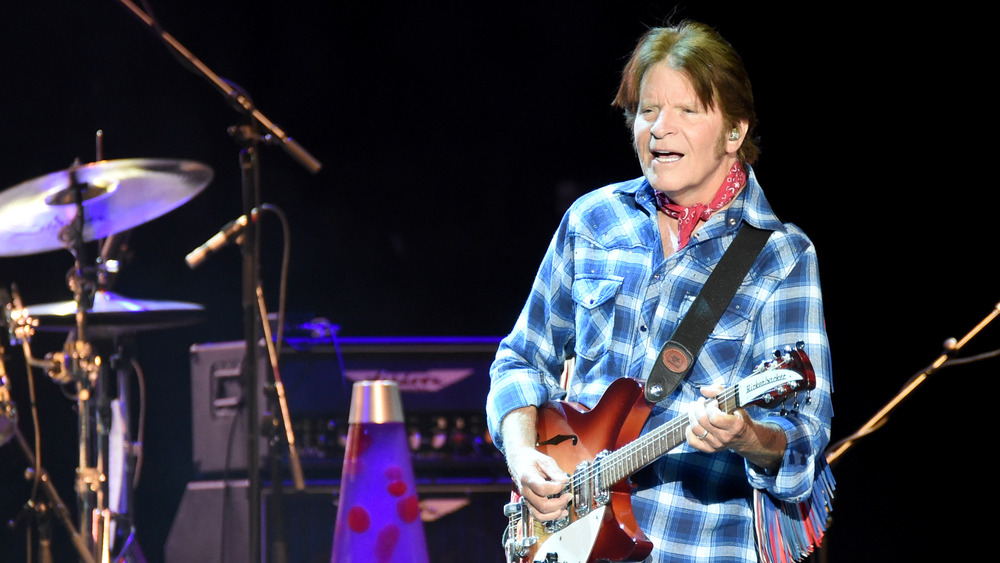
“Fortunate Son” (Live) is a clenched-fist singalong that still feels like a flare in the night—rage made rhythmic, so the crowd can carry it together.
John Fogerty wrote “Fortunate Son” and first unleashed it with Creedence Clearwater Revival in September 1969, pairing it on a double-sided single with “Down on the Corner” and placing it on the album Willy and the Poor Boys (released October 29, 1969). On the U.S. singles chart, “Fortunate Son” debuted on the Billboard Hot 100 at No. 58 on November 1, 1969, and—listed separately before Billboard’s methodology changes for two-sided hits—rose to No. 14 on November 22, 1969. The combined single “Down on the Corner/Fortunate Son” ultimately peaked at No. 3. These numbers matter because they show what the song always was: not a quiet complaint, but a public argument that people wanted to shout along with.
And that is exactly why “Fortunate Son” in live form hits differently—harder, sharper, more communal. Studio versions can feel like documents; live versions feel like evidence. The song’s famous opening line doesn’t arrive as a lyric so much as a spark. The band hits, the room reacts, and suddenly it’s not one man protesting—it’s a whole crowd agreeing, in real time, that something still doesn’t sit right.
The core meaning has never been subtle, and Fogerty has never pretended it was. “Fortunate Son” is aimed at the class divide—at the way wealth and connections can insulate the privileged while ordinary people are left to “do the dirty work.” Fogerty has recalled writing it with astonishing speed—about 20 minutes once the floodgates opened—after stewing on the unfairness he saw in American life and, later, the Vietnam-era draft system that allowed the well-born to dodge consequences. That’s why the song doesn’t sound like theory. It sounds like a nerve being touched.
A live performance also changes the song’s emotional temperature. In the studio, the anger is tight and biting. Onstage, it becomes something like a ritual—each verse a repeated indictment, each chorus a hard “no” that the audience gets to say out loud. Over the decades, the track has been used so often as cultural shorthand for Vietnam that it can border on cliché in films and media—but live, the cliché burns off. What remains is the spine of the song: the refusal to let patriotism be reduced to pageantry, the refusal to let power hide behind flags and slogans.
One of the most revealing modern “live” documents is Premonition—John Fogerty’s first solo live album, released June 9, 1998, recorded December 12–13, 1997 in front of an audience at Warner Bros. Studios, Stage 15. The significance isn’t just that “Fortunate Son” appears in the set. It’s that Fogerty was, by then, fully reclaiming the Creedence catalog in public, placing those songs back in his own hands and letting the crowd meet them again as living things—not museum pieces. In that setting, “Fortunate Son” feels less like a period protest and more like a permanently useful tool: a short, sharp song you can pick up whenever the world starts sounding too self-satisfied.
What makes the live rendition endure is the strange comfort it offers. Not comfort as softness—comfort as clarity. The song doesn’t ask you to decode it. It tells you plainly: some people are protected by the system, and some people are fed to it. And then, in performance, it gives you a way to respond that isn’t helplessness. You sing. You stamp time into the floor. You turn frustration into harmony with strangers.
That’s the secret gift of “Fortunate Son (Live)”—it turns anger into communion. The years keep moving, uniforms keep changing, headlines keep rewriting themselves, but that live chorus still lands like a truth you can hold in your mouth: it ain’t me. And for a few minutes, under stage lights or in a memory you replay, the light in the window is not nostalgia—it’s conscience.