
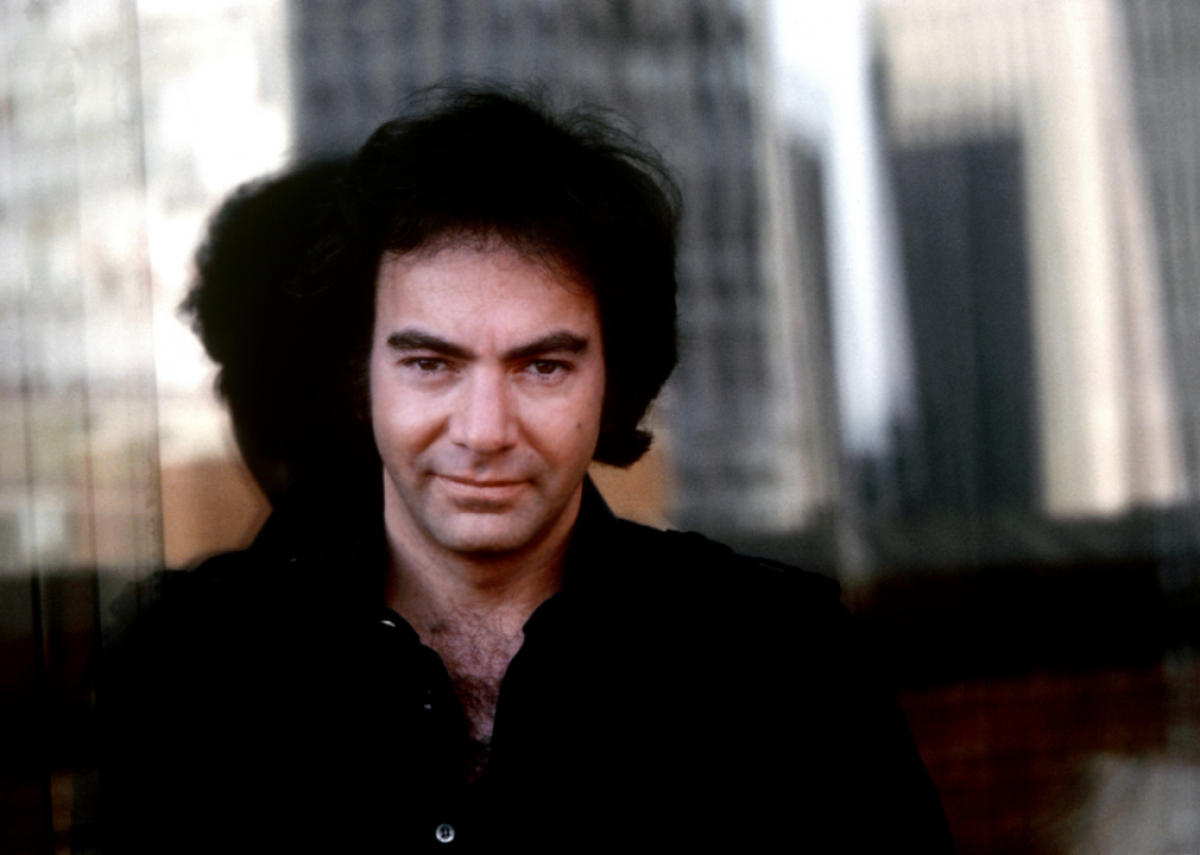
Some fans find Neil Diamond’s “Mr. Bojangles” even more heartbreaking than Jerry Jeff Walker’s original because Diamond turns a drifter’s story into a full emotional drama — less like overheard memory, more like a man reliving loss in real time.
When Neil Diamond recorded “Mr. Bojangles” for Touching You, Touching Me, released on November 14, 1969, he was taking on a song that was still very young, still close to its source, and already carrying unusual emotional weight. Jerry Jeff Walker had written and first released the song in 1968, after drawing on an encounter with a jailed street performer in New Orleans who called himself “Mr. Bojangles.” Walker’s original single reached No. 77 on the Billboard Hot 100, but the song’s legend grew far beyond that first chart showing. Diamond’s version was not the big hit cover that later belonged to the Nitty Gritty Dirt Band; instead, it appeared as an album track on a record that reached No. 30 on the Billboard album chart and was later certified gold. That means the case for Diamond’s version has never really been about chart size. It has always been about feeling.
And that is exactly where the comparison becomes interesting. Jerry Jeff Walker’s original has the grain of lived experience. It feels like a man telling a story he cannot quite shake, and that plainness is part of its greatness. But Neil Diamond hears something else in the song: not only the tale of an aging street performer, but the tragedy buried inside the way he tells it. Walker’s version is more folk-rooted, more observational, more conversational. Diamond’s version, by contrast, is grander, more theatrical, and more openly emotional. For some listeners, that added sweep makes the heartbreak hit harder, because the sorrow no longer sits at a distance. It rises right to the front of the performance. The difference is not that one version feels true and the other does not. It is that Diamond pushes the song from anecdote toward lament.
That helps explain why some fans never fully let go of Neil’s reading. Touching You, Touching Me was the first Diamond album since 1966 to include several outside songs rather than only his own material, and “Mr. Bojangles” sits on that album beside other interpretations such as “Everybody’s Talkin’” and “Both Sides Now.” In that setting, Diamond sounds like a singer deliberately reaching beyond pop hitmaking toward richer interpretive drama. He was already a major voice, but here he was also showing how fully he could inhabit somebody else’s sadness. His “Mr. Bojangles” runs nearly five minutes on many editions, longer than Walker’s single, and that extra space matters. It lets him linger. It lets the loneliness breathe.
The song itself gives him plenty to work with. Walker’s account of the real-life inspiration is already devastating: a homeless man in jail, hiding behind the name “Mr. Bojangles,” suddenly shifting the room from casual talk to grief when he remembers a dog killed by a car, then dancing to break the sadness he himself has created. That story is heartbreak by way of dignity. The man is poor, aging, half-forgotten, yet still capable of grace. Diamond leans hard into that contrast. In his hands, the song becomes less about colorful character and more about the unbearable fact that talent, charm, and humanity do not save a person from loneliness.
That is where his version can feel even more painful than the original. Neil Diamond was never afraid of emotional weight. He could sing with a kind of controlled urgency that made even reflective songs feel physically present, and on “Mr. Bojangles” he uses that gift to make the old dancer’s sorrow seem immediate rather than remembered. The sadness is not only in the lyric about age and loss. It is in the way Diamond phrases the pauses, the way he stretches the melody, the way he gives the song a bigger emotional silhouette than Walker does. Walker lets the tragedy emerge almost incidentally. Diamond frames it in light. For some listeners, that means more heartbreak; for others, it can feel almost too polished. But that division is exactly what keeps his version alive in conversation.
There is also a historical irony here. The cover that became the major pop hit was the Nitty Gritty Dirt Band version, which reached No. 9 on the Hot 100. Yet hit size is not the same thing as emotional ownership. Diamond’s recording remains one of those performances that admirers return to because it reveals something essential about him: his ability to turn a song into a scene of almost overwhelming feeling without losing musical control. He does not sing “Mr. Bojangles” as folklore. He sings it as heartbreak with a spotlight on it.
So why do some fans say Neil Diamond’s “Mr. Bojangles” is even more heartbreaking than the original? Because Jerry Jeff Walker gives them the man, while Neil Diamond gives them the wound. Walker’s version is beautifully human. Diamond’s is beautifully undone. And for listeners who want the song not merely to move them, but to break them a little, that difference can mean everything.