
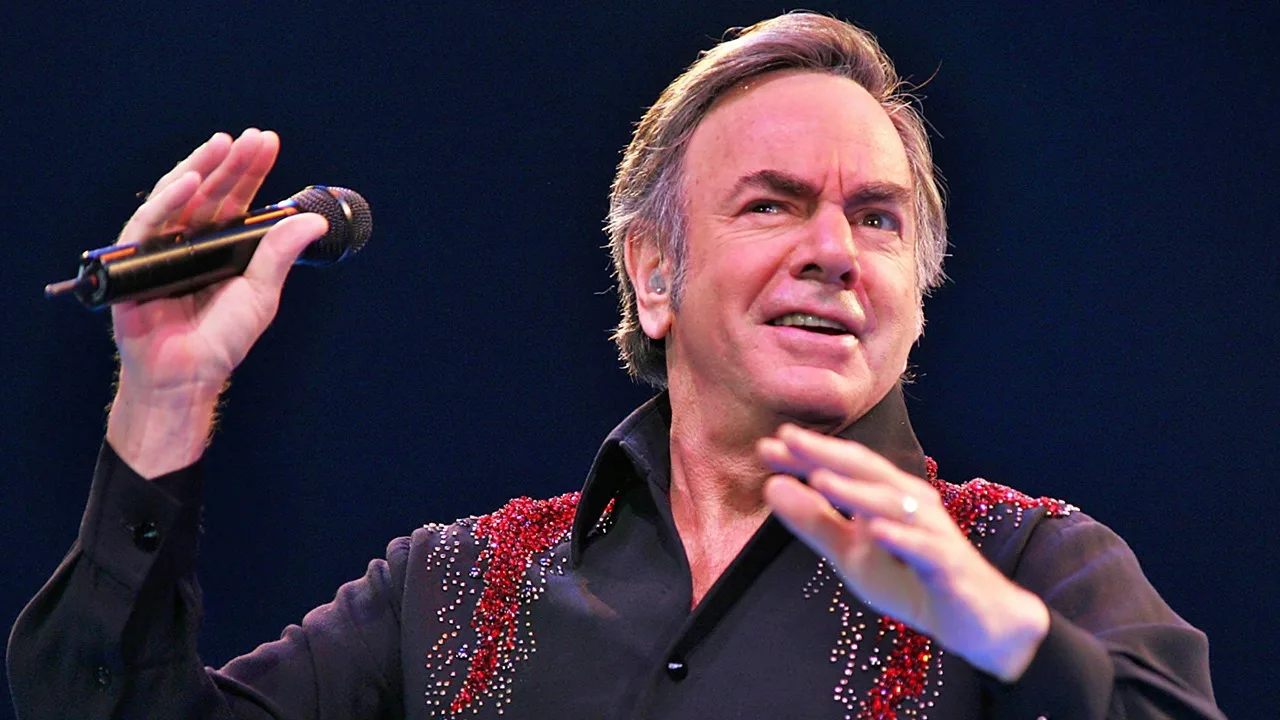
“Pretty Amazing Grace” divided listeners because it sounded at once like a prayer, a love song, and a late-life confession — and then, almost before anyone had finished arguing about it, Neil Diamond left them with one of the tenderest performances of his final great recording years.
When Neil Diamond released “Pretty Amazing Grace” in 2008, he was already deep into the long afterglow of legend, yet still capable of unsettling expectations in a way only true artists can. The song appeared on Home Before Dark, released in May 2008, his second collaboration with Rick Rubin. The album itself was a major event: it went to No. 1 in the United States, the United Kingdom, and New Zealand, and in America Diamond became, at that time, the oldest artist to top the U.S. album chart with new original material. “Pretty Amazing Grace” was one of the key songs associated with that release, and it also had a measurable single life of its own, reaching No. 30 on the U.S. Adult Contemporary chart, No. 49 in the UK, and No. 42 on the UK download chart.
Those are the facts that belong near the top. But the real story of “Pretty Amazing Grace” is emotional, not statistical.
This was a song that seemed to arrive carrying its own quiet argument. Even the title made people pause. For some listeners, “Pretty Amazing Grace” sounded almost too close to the famous hymn “Amazing Grace”, and that resemblance immediately created uncertainty. Was Diamond reaching toward the spiritual? Was he writing a devotional song? Was he borrowing sacred language for something romantic and personal? That ambiguity is exactly what divided people. Some heard a graceful meditation on redemption. Others heard a love song clothed in spiritual imagery. And still others were uneasy with how completely the two seemed to blur together. The mixed reaction was not imagined; it was built into the song from the first phrase. Even commentary from the time shows people debating whether the song was religious, romantic, or both.
But that uncertainty is also what gave the song its unusual power.
By the time Home Before Dark arrived, Neil Diamond was no longer the young hitmaker of the Bang years, nor simply the grand arena voice of the 1970s. Under Rick Rubin’s production, he was singing with a more weathered calm, with less need to impress and more willingness to reveal. Rubin had already helped reframe Diamond on 12 Songs, and on Home Before Dark that inward turn deepened further. The album was filled with songs of age, memory, loss, and gratitude. In that setting, “Pretty Amazing Grace” feels less like a clever title and more like an honest attempt to describe something hard to name — the experience of being restored by love, mercy, or simple human presence after a long season of emptiness.
That is why the song eventually leaves people in tears. It does not plead for sympathy. It does not build toward some oversized climax. Instead, it speaks in the voice of a man who has lived enough life to understand that grace is rarely abstract. It comes through another person. It comes through survival. It comes through being filled again after feeling hollowed out. The lyric’s language of being an “empty vessel” and then restored is not youthful romance. It is older than that, sadder than that, and gentler too. The song moves like gratitude touched by exhaustion, which is one reason it can hit so hard.
And perhaps that is the deeper reason fans were divided at first. Many listeners come to Neil Diamond carrying strong expectations. They know the dramatic sweep of “Love on the Rocks,” the autobiographical ache of “Brooklyn Roads,” the poetic warmth of “Longfellow Serenade,” the communal glow of “Sweet Caroline.” “Pretty Amazing Grace” does not sit comfortably beside any single one of those. It is quieter, more prayerful, more exposed. It asks the listener to accept vulnerability without ornament. For some, that felt moving at once. For others, it took time. But once the song settled in, once its tenderness was allowed to speak without the distraction of category or argument, it became harder to resist.
There is also something profoundly affecting in hearing Neil Diamond sing a song like this at that point in his life. At 67, with a voice no longer youthful but richer for its years, he sounds as though he is not merely performing the idea of grace but searching for it, and perhaps finding it in the act of singing. That search gives the performance its ache. The beauty here is not polished perfection. It is sincerity under restraint. The song seems to tremble slightly under the weight of what it wants to say, and that trembling is what makes it human.
So yes, “Pretty Amazing Grace” divided fans. But that division may have been the first sign that the song was doing something real. Great late-career songs often unsettle before they console. They refuse to fit the neat shelves people have built for the artist they thought they knew. Neil Diamond did exactly that here. He borrowed the language of grace, wrapped it around gratitude and longing, and sang it with the hush of a man who understood that some of the deepest salvations in life are also the hardest to explain.
And in the end, that is why the song lingers. Not because everyone agreed about it. Because they did not. Because it opened a space between faith and love, between argument and surrender, between memory and comfort. And in that space, Neil Diamond gave one of the most tender performances of his later years — a song that began as a question for some, a discomfort for others, and slowly became heartbreak of the softest, most unforgettable kind.