
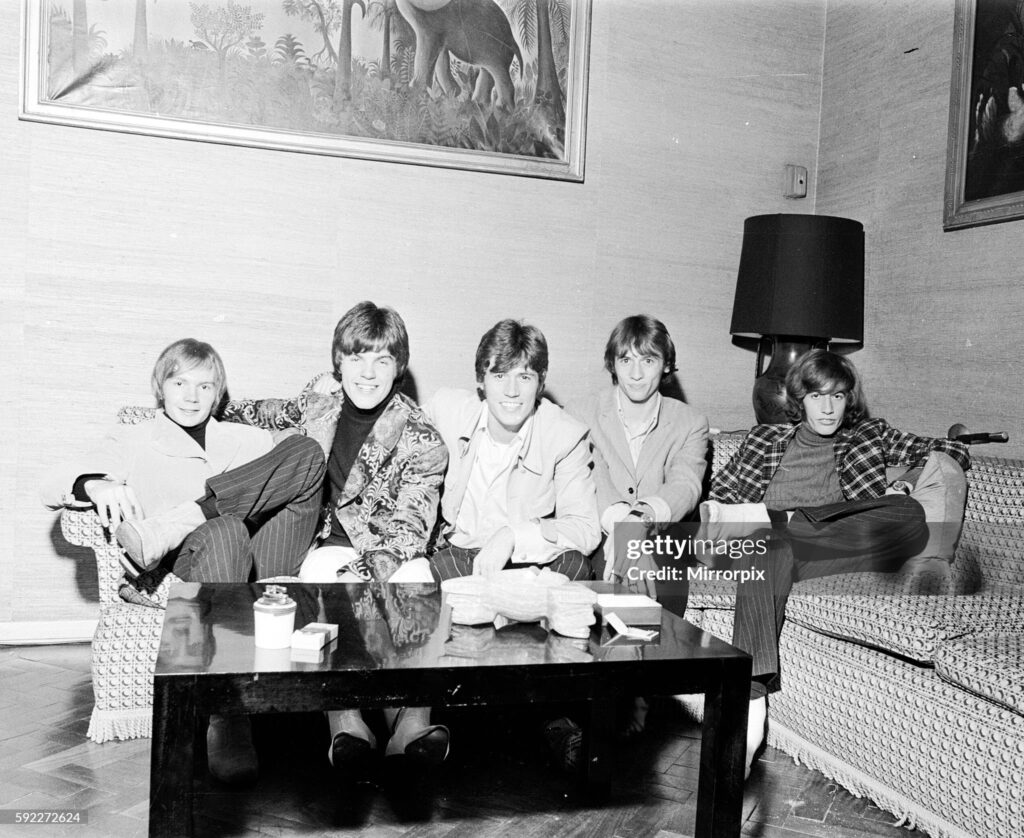
In “World,” the Bee Gees took a single, ordinary word and filled it with loneliness, wonder, and quiet heartbreak—until it sounded less like geography and more like the human condition itself.
There are songs that arrive with the force of a hit, and then there are songs that linger like weather in the soul. “World” belongs to the second kind. Released by the Bee Gees in November 1967 as the follow-up to “Massachusetts,” it did not become their biggest British smash, peaking at No. 9 on the UK Singles Chart, yet its emotional afterlife has proved deeper than many more obvious successes. In Europe, the record traveled farther than casual listeners sometimes realize, reaching No. 1 in Germany and No. 1 in the Netherlands, before appearing on the album Horizontal in January 1968. That alone tells us something important: this was not a minor afterthought in the Bee Gees story, but a key early statement from a group already moving beyond pop craftsmanship into something moodier, more inward, and more unsettling.
What makes “World” so affecting is that it never behaves like a conventional declaration. It does not plead in the straightforward way of a love ballad, nor does it explain itself too neatly. Instead, it hovers in that strange Bee Gees space where melody is beautiful, but the feeling beneath it is faintly wounded. The song asks large questions with a soft voice. Its sadness is not theatrical; it is private, almost embarrassed by its own depth. That is why the title can seem deceptively plain. A lesser song called “World” might try to sound grand. This one sounds fragile. It is as though the brothers looked out at everything around them—the noise, the confusion, the loneliness of modern life—and answered it not with certainty, but with ache.
The story behind the recording only makes the song more intriguing. According to session history and later notes on the period, “World” began during the 3 October 1967 sessions at IBC Studios, London, and was completed later that month. It was first conceived without orchestra, built on the group’s own playing, including Maurice Gibb on piano and Robin Gibb on organ; only afterward was orchestration added, forcing a technical compromise in the mix because of the limitations of four-track recording. Barry later recalled that the song came out of the atmosphere of the studio almost spontaneously—something born from the brothers and the band simply trying something, following instinct rather than formula. Guitarist Vince Melouney also remembered his idea of playing the melody high on the guitar behind the chorus, a choice that helped give the record its ghostly shimmer. Those details matter, because you can hear them in the finished performance: “World” feels discovered rather than manufactured.
And what a sound it is. The record has that late-1967 chamber-pop melancholy the Bee Gees wore so well, but there is something more exposed here. The piano does not simply accompany; it tolls. The Mellotron haze and the orchestral lift do not decorate the melody so much as deepen its isolation. Barry Gibb’s lead vocal carries the song with remarkable restraint, while Robin’s presence, especially as the performance moves toward its close, adds a tremor of haunted tenderness. Even now, one of the marvels of “World” is how intimate it remains despite its title and arrangement. It never swells into self-importance. It stays human-sized. That is why the emotion catches listeners off guard. Fans may come expecting another elegantly written 1960s Bee Gees single; what they find instead is a meditation that feels bruised, philosophical, and strangely modern.
Lyrically, the song seems to circle the old question of purpose: where does one belong in a world that feels too large, too indifferent, too broken to answer back? The language is not complicated, yet the feeling is enormous. That has always been one of the Gibb brothers’ secret gifts. They could take a simple word—“world,” “words,” “massachusetts”—and make it tremble with emotional implication. Here, “World” becomes more than a place. It becomes distance. It becomes disillusionment. It becomes the painful realization that one may live among millions and still feel spiritually alone. That is why the song has aged so well. It is rooted in 1967, yes, in its textures and recording style, but its emotional argument belongs to any era in which people feel surrounded yet unseen.
It also reveals something crucial about the early Bee Gees that is sometimes overshadowed by the brilliance of their later career. Before the falsetto anthems, before disco crowned them immortal, they were already masters of reflective pop drama. “World” sits beside songs like “Massachusetts” and “Words” as evidence that their real genius was never just melody, though melody came naturally to them. Their genius was emotional architecture: the ability to build songs that seemed simple on the surface but opened inward, room by room, into longing. Horizontal, the album that later housed “World,” has often been described as darker and heavier than Bee Gees’ 1st, and this track is one of the clearest reasons why. It stands at that crossroads where innocence begins to give way to introspection.
So yes, “World” is far more emotional than many fans expect. Not because it shouts its feelings, but because it doesn’t. It trusts melody, atmosphere, and understatement. It understands that sorrow often arrives quietly. And in that quiet, the Bee Gees created one of their most moving early recordings—a song that does not merely describe a broken world, but seems to feel its fracture from theBarry, Robin, and Maurice Gibb, one word was enough to hold an entire wounded horizon.