
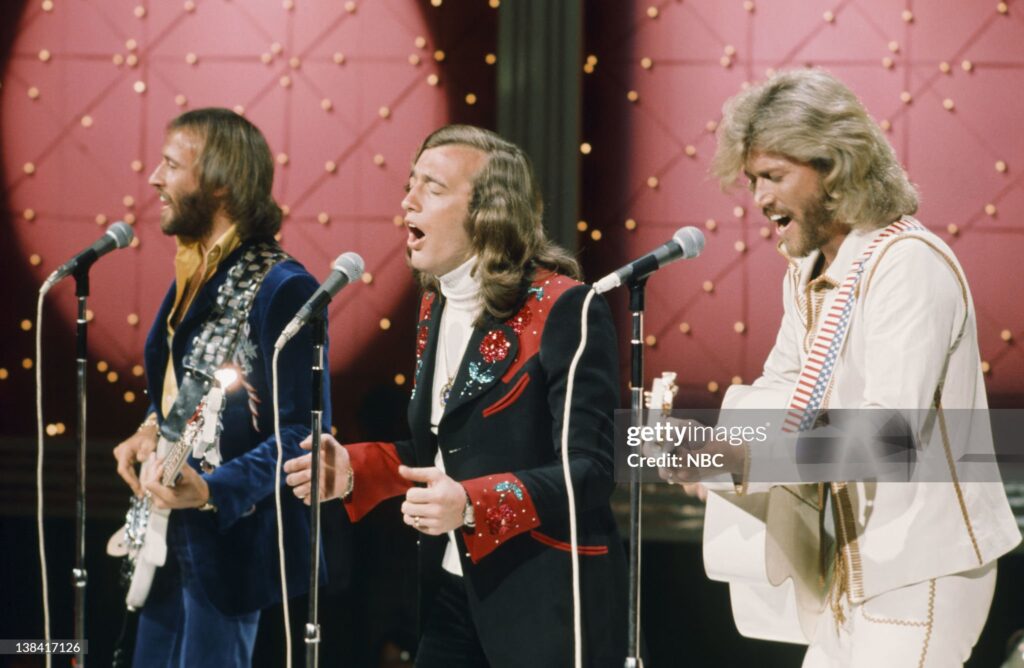
“Stop (Think Again)” is one of those quietly revealing Bee Gees recordings that turns a simple plea into something tender, hesitant, and deeply human.
When people speak about the Bee Gees, the conversation usually moves quickly toward the monumental records: “Massachusetts”, “How Can You Mend a Broken Heart”, “Jive Talkin'”, “Stayin’ Alive”. That is understandable. Few groups traveled so far stylistically, and few carried popular music through as many changing decades with such grace. But songs like “Stop (Think Again)” remind us that the real story of the group was never built on fame alone. It was built on feeling, on harmony, on the ability to make uncertainty sound intimate.
“Stop (Think Again)” belongs to the lesser-known side of the Bee Gees catalogue and is remembered far more by dedicated listeners and collectors than by chart historians. Unlike the group’s major singles, it was not a defining hit on the Billboard Hot 100 or the UK Singles Chart. In other words, it did not arrive with the commercial force that carried so many of their classics into public memory. Yet that very absence from the big chart narrative gives the song a different kind of life. It survives not because it dominated the airwaves, but because it reveals the emotional instincts that were already taking shape in the brothers’ music.
Heard in the context of the Bee Gees’ early years, “Stop (Think Again)” feels like a glimpse into a formative period, when the group was still building the language that would later make them world-famous. The vocal blend is the first clue. Even in material that never became part of the global canon, the brothers had an unusual gift for making harmonies sound personal rather than ornamental. Their voices do not simply decorate the melody; they carry the emotional argument of the song. That is one reason even an obscure title can still feel unmistakably like the Bee Gees.
The meaning of “Stop (Think Again)” is elegantly direct. It is a song of interruption, of emotional hesitation, of asking someone not to move too quickly past a feeling that still matters. The title itself contains the whole drama: stop, pause, reconsider. In lesser hands, that kind of lyric might have sounded like mere pleading. In the Bee Gees’ world, it becomes something more reflective. There is vulnerability in it, but also dignity. The voice at the center of the song is not demanding control; it is asking for a moment of clarity before love is lost to impulse, pride, or misunderstanding.
That emotional balance is what makes the song linger. So much of the Bee Gees legacy rests on songs that know how to ache without collapsing under the weight of their own sadness. “Stop (Think Again)” belongs to that tradition, even if on a smaller scale. It carries the ache of youth, but it does so with remarkable restraint. The performance suggests that the brothers already understood something that would stay with them throughout their career: heartbreak in song is often most powerful when it is sung softly.
There is also a historical charm to the recording. Before the arena-scale success, before the immaculate late-1970s sheen, before the world attached the Bee Gees name to one era more than any other, there was the sound of three brothers learning how far emotion could travel through a melody. That is the hidden reward of listening to a song like “Stop (Think Again)”. You hear not just a forgotten track, but a band in the process of becoming itself. The sensitivity that would later shape their finest ballads is already present. So is the instinct for phrasing, the care with mood, the refusal to rush a feeling before the listener has fully absorbed it.
Because it was not one of the group’s celebrated chart smashes, “Stop (Think Again)” has never been burdened by overexposure. It comes to the listener with a different sort of power: the power of rediscovery. For longtime admirers of the Bee Gees, that can be especially moving. It is like finding an old photograph that was never framed, only tucked away in a drawer. The image is smaller, perhaps less polished than the famous portraits, but it tells the truth in a more private voice.
And that may be the best way to understand the song’s place in the larger Bee Gees story. It is not an anthem, not a radio monument, not a song that rewrote the charts. It is something more delicate. It shows how naturally the group could inhabit a mood of uncertainty and turn it into melody. It shows that long before audiences around the world knew every chorus, the brothers already knew how to sing from the edge of hesitation, where love is still possible if only someone will pause and listen.
In the end, “Stop (Think Again)” matters because it preserves the emotional honesty that ran through the Bee Gees’ work from the beginning. It may sit in the shadows of bigger songs, but it does not disappear there. Instead, it glows quietly, as many overlooked recordings do, with the kind of sincerity that becomes more valuable as the years go by. Some songs make history with numbers. Others remain because they sound like a feeling we recognize at once. This is one of those songs.