
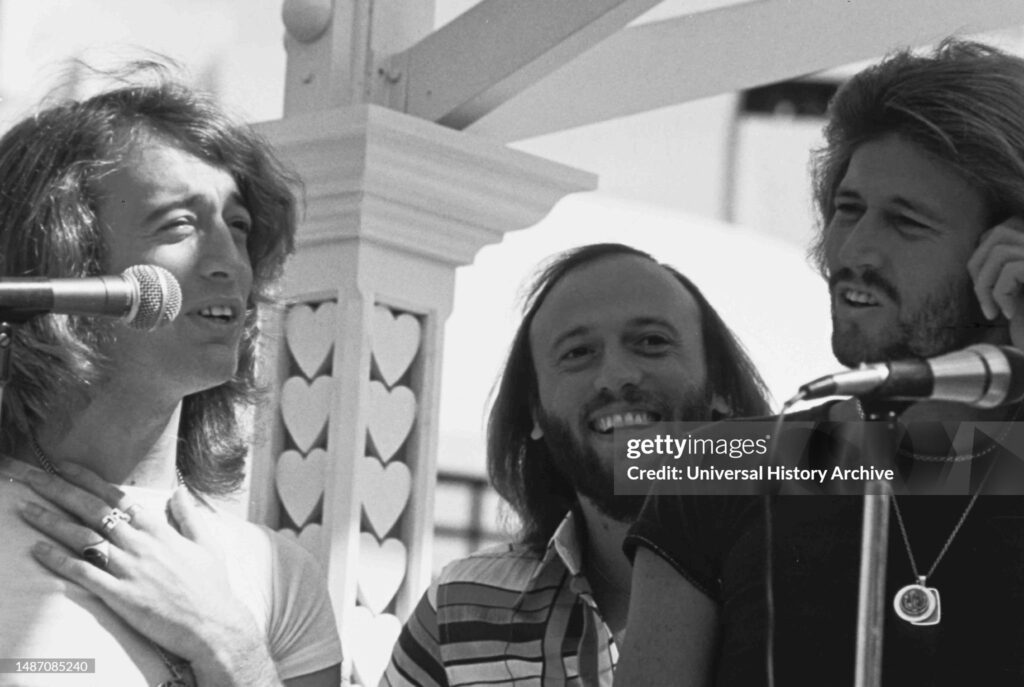
A title this ominous changed everything, and “For Whom The Bell Tolls” revealed how beautifully the Bee Gees could inhabit heartbreak when the light had gone out.
There are songs that arrive like a familiar voice at the door, and there are songs that make even the most devoted listener pause for a moment, as if hearing an old name spoken in a different tone. Bee Gees’ “For Whom The Bell Tolls” belongs to that second kind. By the time it appeared in November 1993 on Size Isn’t Everything, the brothers were already long established in popular memory—masters of melody, architects of harmony, men whose music had so often moved with elegance, polish, and emotional fluency. Yet this song carried another atmosphere altogether. It felt duskier, heavier in spirit, less interested in sweetness than in the ache left behind after love has already broken its promise. Released as the album’s second single, it climbed to No. 4 on the UK Singles Chart and No. 6 in Ireland, becoming the Bee Gees’ highest-charting UK single of the 1990s and giving them the rare distinction of scoring a UK Top 5 hit in four consecutive decades.
The title alone changes the temperature of the room. “For Whom The Bell Tolls” does not sound like a passing sorrow or a small romantic bruise. It sounds final. It sounds like the hour after the argument, the empty chair, the cold realization that something beautiful has ended and will not be called back by pleading. The Bee Gees had always understood sadness, of course, but often they wrapped it in velvet, in elegance, in melodic reassurance. Here, the sadness is given more shadow. It stands closer to the center. Even the title, borrowed from the same literary world that once gave them “Islands in the Stream,” feels weightier, more fatalistic, as if the brothers were no longer merely writing about parting, but about emotional reckoning.
What gives the song such depth is the way it refuses melodrama while still sounding wounded to the core. The lyric does not thrash about. It grieves with composure. There is longing in it, but also a stunned stillness, the kind that comes when loss has already settled in and the heart is no longer protesting, only enduring. That mood is what made the song such a revelation. So many people carried the Bee Gees in memory as masters of radiance—those impossible harmonies, those immaculate pop instincts, that gift for turning feeling into something airborne. “For Whom The Bell Tolls” reminded everyone that they could do something else just as powerfully: they could let the music darken, let the sorrow breathe, and trust silence as much as shine.
There is something especially moving in the way the brothers sing it. The performance does not feel decorative. It feels inhabited. Robin’s voice, in particular, gives the song its haunted center, while the arrangement allows the emotion to gather rather than burst. Nothing is rushed. Nothing is oversold. The hurt is allowed to arrive slowly, and because of that restraint, it lands harder. A song like this does not beg to be admired; it settles into the listener almost against one’s will. Long after the melody has passed, what remains is the sensation of a room gone quiet after difficult words.
Its success in Britain seems all the more meaningful because it was not built on nostalgia alone. The song spent 14 weeks in the UK Top 100, including six weeks in the Top 10, rising steadily from No. 38 to its peak of No. 4 across the closing weeks of 1993. It was not merely an old giant returning for applause. It was a serious song finding its audience on emotional force. In a decade that often felt eager for newer faces and sharper surfaces, the Bee Gees answered with maturity, craftsmanship, and a ballad unafraid of solemnity.
Even the critical response understood that something special had happened. Billboard called it arguably the finest tune they had written and recorded in fifteen years, praising its poetic lift and the strength of its arrangement. That kind of reaction says much about the song’s stature, but the deeper truth lies in how it feels when heard now. Time has only made it more affecting. What may once have seemed a striking late-career turn now feels like one of the great reminders of who the Bee Gees really were beneath the glittering reputation: not merely hitmakers, not merely craftsmen of polish, but brothers who knew how grief sounds when it stops trying to explain itself.
And perhaps that is what the title finally gave them—permission to be grave without apology. A name this ominous could easily have overwhelmed a lesser song. Instead, it sharpened everything. It invited the Bee Gees into a more shadowed chamber of their own artistry, where romance was no longer young, no longer dazzled, no longer hopeful by habit. In that darker room, they found one of their most quietly devastating performances.
So “For Whom The Bell Tolls” endures not simply because it was a hit, though it was a substantial one, nor because it marked another chapter in a remarkable career, though it certainly did. It endures because it let the Bee Gees be heard in a way many listeners had never fully expected—more weathered, more wounded, more inward, and perhaps more human than ever. Some songs entertain. Some console. This one lingers like the last echo in a church after the bell has already sounded, leaving behind not spectacle, but a deep and noble sadness that refuses to fade.