
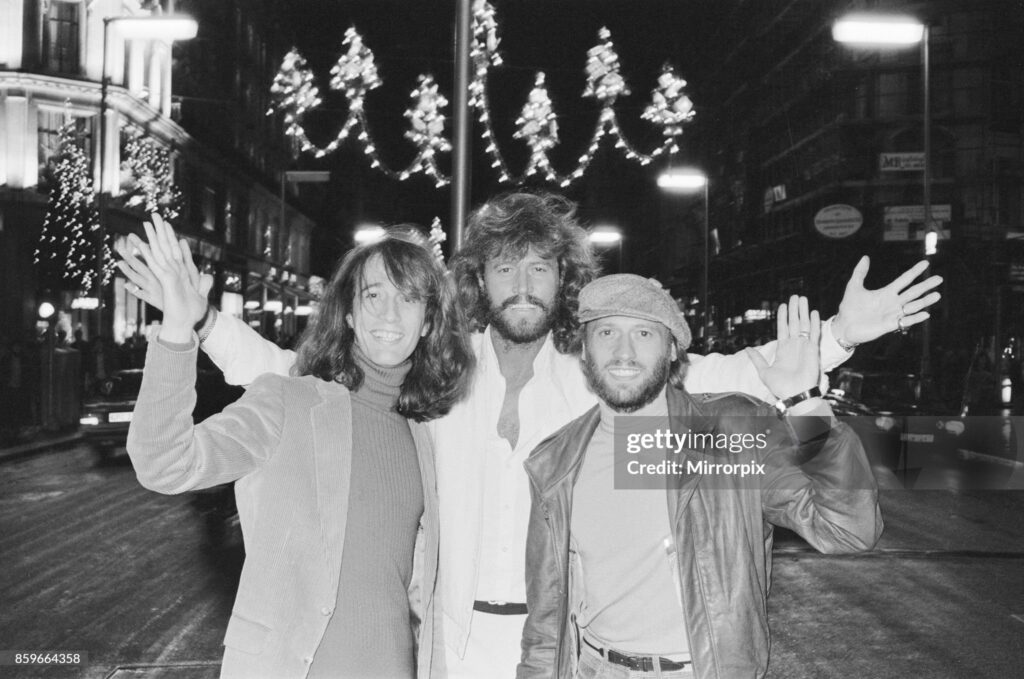
Before disco had fully claimed the decade, “Jive Talkin’” gave the Bee Gees a sharper silhouette—cooler, bolder, and suddenly alive with a new kind of swagger.
There are moments in a great career when the past does not disappear, but it steps aside. Bee Gees’ “Jive Talkin’” was one of those moments. By the time it appeared in May 1975 as the lead single from Main Course, the brothers were no longer the same group many listeners thought they knew. The soft melancholy, the exquisite balladry, the almost fragile elegance that had once defined them had not vanished, but it was no longer the whole story. Something had shifted in the air around them. “Jive Talkin’” came striding in with a clipped rhythm, a sly grin, and the confidence of a band that had found a new pulse under its feet. It later appeared on the Saturday Night Fever soundtrack, but its real importance came earlier: it had already begun rewriting the Bee Gees’ story before that film turned their world upside down.
Part of the song’s legend lies in how naturally that new sound seemed to arrive. The Bee Gees had moved to Miami and begun recording at Criteria Studios with producer Arif Mardin, and the atmosphere around Main Course opened a different door for them. Rhythm became more physical. The groove stopped behaving like accompaniment and started becoming the whole engine of the song. “Jive Talkin’” did not sound tentative, as comeback records sometimes do. It sounded assured, almost mischievous, as though the brothers had discovered not merely a fresh style but a fresh attitude. That is what still gives the record its snap. It does not ask permission to change. It changes in plain sight, and dares you not to follow.
There is also that irresistible little story behind its birth, one of those side notes that feels too perfect not to treasure. The song began life as “Drive Talkin’,” inspired by the rhythmic hum of a car crossing the Julia Tuttle Causeway in Miami. Somewhere between the road noise and the brothers’ imagination, the phrase shifted into “Jive Talkin’,” and suddenly the song had its title, its strut, and its character. One can hear that motion in the record even now. It moves like wheels over pavement, like a city glinting in heat, like a conversation that has already turned a little dangerous. There is deceit in the lyric, certainly, but there is pleasure in the sound—a pleasure so infectious that the hurt inside the song almost dresses itself as style.
And what a transformation it was. In the United States, “Jive Talkin’” went all the way to No. 1 on the Billboard Hot 100, becoming the Bee Gees’ first American chart-topper since “How Can You Mend a Broken Heart” four years earlier. In Britain, it reached No. 5 on the Official Singles Chart. Those numbers matter, but only because they reflect something larger: listeners could hear, immediately, that this was not a minor adjustment. This was a rebirth with rhythm at its center. The song reintroduced the Bee Gees to the mainstream and sketched the outline of the extraordinary run that would soon follow.
What remains so appealing about “Jive Talkin’” is the way it balances polish and bite. The groove is sleek, but not smooth in the passive sense. It has edges. It has posture. Barry Gibb’s vocal carries that lean, teasing authority that would become even more iconic in the years ahead, yet here it still feels like a discovery being made in real time. The brothers were not simply stepping toward disco; they were learning how rhythm itself could become personality. In that sense, “Jive Talkin’” is more than a hit. It is the sound of self-reinvention becoming audible.
Its later presence on the Saturday Night Fever soundtrack can blur the timeline for some listeners, because the film came to define so much of the Bee Gees’ late-1970s legend. But “Jive Talkin’” belongs to an earlier chapter, and perhaps a more fascinating one. It stands at the threshold, before the white suits and mirrored floors became the dominant image, before the global fever pitch, before the mythology hardened into pop history. It catches the Bee Gees in that thrilling moment when change is still a risk, still a surprise, still slightly dangerous. On the soundtrack, it became part of the era’s atmosphere; on Main Course, it was the opening turn of the key.
That is why the song still feels so alive. Not because it predicted what was coming, though it did. Not because it sits neatly in the Bee Gees canon, because in truth it unsettled that canon in the best possible way. It lives on because it captured the instant when elegance learned to move its hips, when hurt put on dark glasses, when three brothers with an already rich history decided history was not enough. “Jive Talkin’” did not merely announce a new sound. It carried the thrill of hearing a great group discover, with perfect timing and perfect nerve, that they could become modern all over again.