
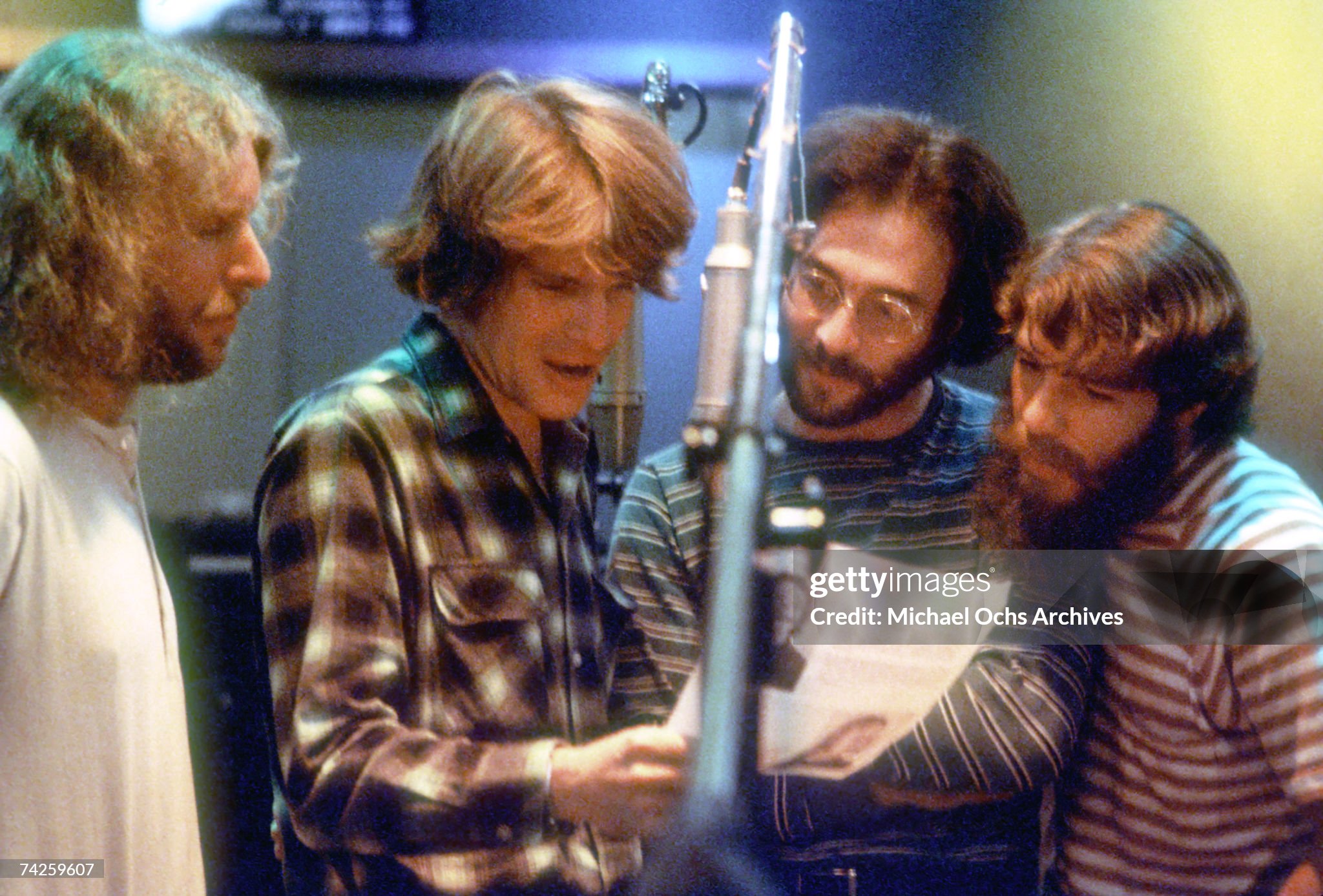
A jet-fueled blast of rock-and-roll urgency, “Travelin’ Band” sounds like motion, noise, and nerves all colliding in two breathless minutes.
Some songs do not enter a room so much as tear through it. Creedence Clearwater Revival’s “Travelin’ Band” is one of them. From its opening seconds, it feels less like a recording than like a sudden burst of pressure finally released—planes overhead, amplifiers humming, bodies already in motion before the mind has had time to catch up. When it arrived in January 1970 as the double A-side partner to “Who’ll Stop the Rain,” it made an immediate impact, climbing to No. 2 on the Billboard Hot 100 and later reaching No. 8 on the UK Singles Chart. Those numbers matter, of course, but what truly stays with the song is the sense of velocity it carries, as though John Fogerty had found a way to compress the entire racket and restlessness of touring life into barely more than two minutes.
What gives “Travelin’ Band” its particular fire is the way it reaches backward even while sounding utterly alive in its own moment. Fogerty built it in the image of 1950s rock ’n’ roll, especially the wild abandon of Little Richard, and you can hear that inheritance in the rasp, the pounding momentum, the almost delirious sense that the song might shake itself apart if it goes any faster. Yet it never feels like a museum piece or a respectful imitation. It feels hungry. The older rock-and-roll spirit is not being preserved here; it is being re-ignited.
That is what makes the record so thrilling. Creedence Clearwater Revival had already proven they could summon menace, melancholy, and swamp-born grit with astonishing ease. They could brood. They could smolder. They could turn social unease into songs that felt like weather rolling in over the bayou. But “Travelin’ Band” showed another side of their power: they could simply let loose. No mist, no caution, no slow-burn tension—just command, attack, and a joyous kind of noise. The walls do not merely tremble when this song comes on; they seem to remember what rock music was originally built to do.
There is also something wonderfully vivid in the lyric itself. Fogerty sings the road not as romance alone, but as chaos—airports, schedules, arrivals, departures, the endless blur of one city after another. Even the opening image, “Seven-thirty-seven coming out of the sky,” gives the song its lift-off. That line plants us immediately in transit, in the metallic modern rush of a band being carried from stage to stage with no time to grow sentimental about it. The road here is not dreamy. It is loud, exhausting, exhilarating, and very nearly absurd. That sense of strain is part of the song’s charm. Beneath all the excitement, one can hear the nerves beginning to fray.
And perhaps that is why “Travelin’ Band” still hits so hard. It is not polished into safety. It sounds a little reckless, a little overclocked, almost too alive to sit still inside the speakers. Even its history picked up some extra voltage when the publishers of “Good Golly, Miss Molly” later claimed it borrowed too much from that earlier classic, leading to a plagiarism suit that was eventually settled out of court. In a strange way, even that episode confirms what the ears already know: “Travelin’ Band” was never shy about wearing its rock-and-roll ancestry on its sleeve.
By the time Cosmo’s Factory arrived in July 1970, the song had already done its work. It had kicked the door open on an album that would become one of CCR’s defining statements, but “Travelin’ Band” itself remains a special kind of detonation—short, fierce, and unforgettable. It captures the old spirit of American rock at full boil while reminding us just how frighteningly efficient Creedence Clearwater Revival could be when they chose pure attack over atmosphere. Some bands build toward eruption. CCR, on a song like this, sound as though eruption is simply their natural state.