
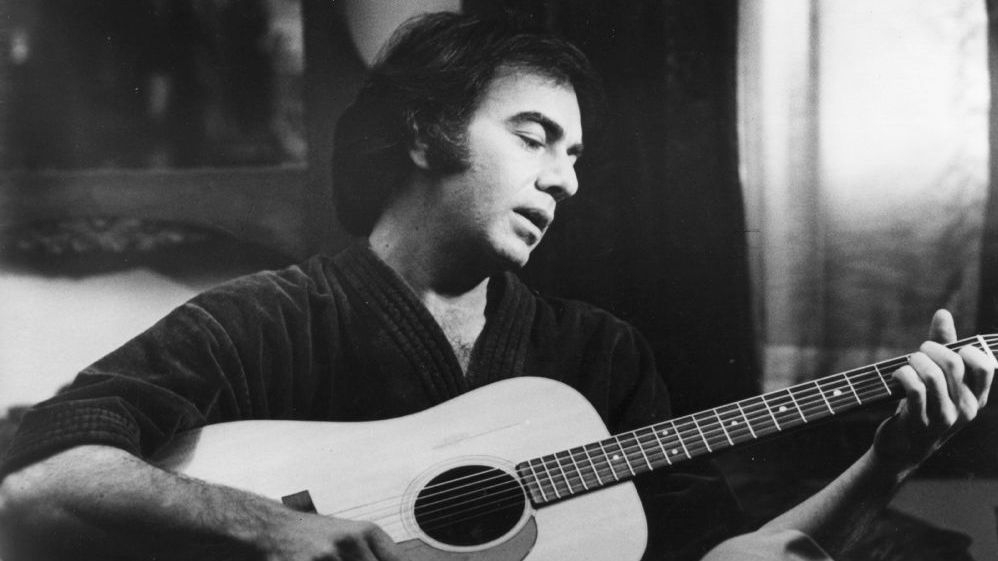
“Girl, You’ll Be a Woman Soon” still unsettles because it wraps desire, impatience, and vulnerability in such a soft melody that the darkness arrives almost before you realize it is there.
Some songs change the air in a room the moment they begin. Neil Diamond’s “Girl, You’ll Be a Woman Soon” has always done exactly that. Released in March 1967 on Bang Records, and included on Just for You, it became one of Diamond’s earliest major hits, reaching No. 10 on the Billboard Hot 100 in June of that year. Those facts matter, of course, because they place the song at the start of his rise as a singular pop songwriter. But what matters even more is the mood it carried. This was not the bright, easy romance of ordinary young-love records. From the title onward, the song came wrapped in tension—half invitation, half warning, full of longing that already felt slightly dangerous.
That dark romantic charge is the first precious thing worth holding onto. On paper, the song is simple: a young man tells a girl not to listen to those who judge him, insisting she make up her own mind. Yet “Girl, You’ll Be a Woman Soon” has never sounded entirely innocent. The lyric carries impatience, hunger, and a faint edge of grievance. “They never get tired of putting me down,” Diamond sings, and suddenly the song is no longer just about affection—it is about opposition, about adults or outsiders disapproving, about desire pressing against social boundaries. That is where the mood changes instantly. The melody is smooth, but the feeling underneath is restless, almost shadowed. It is one of those records where tenderness and unease walk side by side.
The second detail that warms the whole story is the period in which Neil Diamond wrote and recorded it. This was the Bang Records era, when he was turning out compact, emotionally vivid songs that mixed Brill Building craft with something more personal, more brooding, more inward than much of the pop around him. His official catalog still places “Girl You’ll Be a Woman Soon” among the key tracks of Just for You, and later official retrospectives continue to highlight it, including the mono single version in anniversary collections. That tells us something important: this was never a minor curiosity in his catalog. It was one of the early songs that revealed how well Diamond could fuse commercial pop with emotional ambiguity. He could write melodies people remembered immediately, yet hide a bruise inside them.
And perhaps that is why the song still lingers so strongly. It is not merely youthful. It is youth seen through a darker lens. Many coming-of-age songs celebrate anticipation as freedom, innocence, or excitement. “Girl, You’ll Be a Woman Soon” sounds more complicated than that. It understands that growing up can also be charged, awkward, and faintly frightening. The title itself is almost too direct, which is part of its lasting power. It catches the instant before innocence is gone, but it does not describe that threshold with warmth alone. It treats it as a crossing into emotional risk. That is what gives the song its strange electricity. It is romantic, yes—but it is romance with a pulse of trouble in it.
There is also something especially effective in the way Neil Diamond delivers the vocal. He does not oversing it. He does not make it melodramatic. Instead, he sounds insistent, intimate, faintly wounded. That restraint is crucial. A heavier performance might have made the song merely theatrical. Diamond keeps it personal, which makes it more unsettling. He seems less like a swaggering seducer than a young man trying to will a different future into being, convinced that love will justify everything if only the girl will choose him. That emotional pressure is what makes the song feel more adult than its surface might suggest. It is not just infatuation. It is longing sharpened by resistance.
The song’s afterlife also says something about its staying power. Decades later, it would be rediscovered by new generations through other versions and soundtracks, most famously in the 1990s, but the original still carries a particular gravity that later interpretations can only borrow. The reason is simple: Neil Diamond’s version belongs to the moment before he became a monument. It captures him when his writing still had that young, slightly dangerous tension between polish and raw feeling. In later live and retrospective releases, the song remains part of the story because it still represents something essential in his artistry: the ability to make a pop single feel intimate, memorable, and just a little haunted.
So yes, “Girl, You’ll Be a Woman Soon” still carries a dark romantic charge. Not because it shouts, and not because it explains itself too plainly, but because it leaves the listener inside that uneasy emotional threshold where desire, judgment, tenderness, and danger all blur together. It is one of the early Neil Diamond records that proved he could do more than write hits—he could alter the atmosphere. He could make a song feel like twilight even when it was playing in broad daylight. And that is why it remains so hard to shake: the melody may be soft, but the shadow it casts is long.