
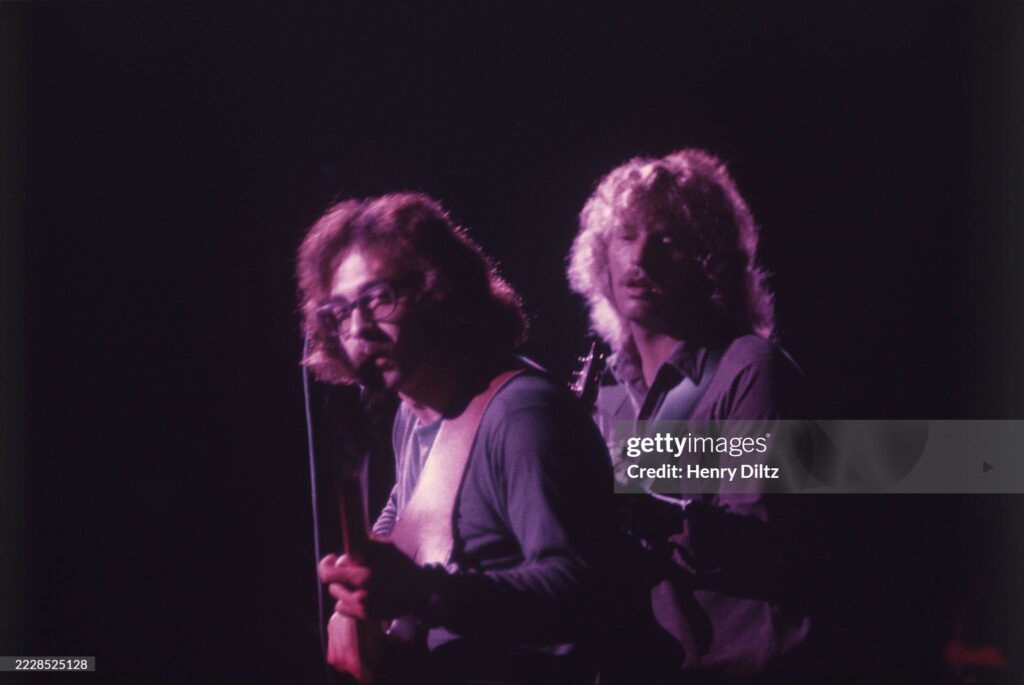
The title alone feels like bad news already on the move. In “Tombstone Shadow,” Creedence Clearwater Revival turns dread into rhythm—something stalking the song from the first words, cold enough to unsettle and sharp enough to stay there.
The trouble begins with the title. “Tombstone Shadow” does not sound symbolic in any soft or distant way. It sounds immediate. It sounds physical. It sounds like death not as an idea, but as something already falling across the path. That is why the song still sends a chill through rock fans. Before the lyric even starts unfolding, the phrase has already done its work: it places the listener under a threat.
“Tombstone Shadow” appeared on Green River, released on August 7, 1969, the third Creedence Clearwater Revival album and the second of their three studio albums that year. The record became one of the defining CCR albums, featuring “Bad Moon Rising,” “Green River,” “Lodi,” and “Commotion.” Inside that already shadowed, anxious landscape, “Tombstone Shadow” fits perfectly. It is not a hit single at the center of the band’s public legend, but it is one of the album’s darkest nerves.
The story behind the song makes that darkness even more vivid. A long-circulating account repeated in John Fogerty’s own social posts says the song was inspired by a visit he made to a fortune teller in San Bernardino, California. The fortune teller reportedly warned him to “fly in no machines” and gave him the eerie line about “13 months of bad luck.” Those exact images show up in the lyric, which means the song’s strangest details were not random decoration. They came from an encounter meant to disturb.
That is why the title feels like trouble before the song has gone very far. The “tombstone shadow” is not simply a gothic flourish. It belongs to a whole lyric world built out of warning, superstition, and the fear that bad news has already attached itself to the body. The song does not ask whether danger is coming. It sings as though danger is already here, following close enough to be felt. Even the documented background summary for the song describes it as illustrating “the threat of death.”
And CCR make that threat move.
That is one of the most striking things about the recording. The song is not slow, misty, or theatrical in the usual haunted-song sense. It has motion. The band pushes it forward with the same hard, clipped drive that made so many Creedence recordings feel built for roads, storms, and bad omens. That contrast is what gives “Tombstone Shadow” so much power: the lyric is full of menace, but the groove keeps advancing anyway. Dread is not sitting still here. It is walking beside you.
The album setting deepens that effect. Green River was recorded in San Francisco between March and June 1969, and later criticism singled it out as the album where CCR’s classic sound fully flowered. In the same body of work, “Bad Moon Rising” paired cheerful motion with apocalyptic lyrics, while “Lodi” turned defeat into something plain and unforgettable. “Tombstone Shadow” belongs to that same emotional weather—songs where the music can move briskly while the feeling underneath stays uneasy, fatalistic, or bruised.
There is also a telling musical detail in the song’s reputation. A detailed CCR song reference notes that “Tombstone Shadow” is especially remembered for its one-note, double-tracked guitar solo. That matters because it fits the song’s whole method. The record does not need flashy complexity to create unease. It uses repetition, pressure, and that blunt, needling feel to keep the listener inside the threat rather than outside it.
So the reason “Tombstone Shadow” still sends a chill is not mystery alone. The facts around it are already enough: a 1969 Green River track, born from a fortune-teller encounter, loaded with warnings, built around one of Fogerty’s most ominous titles, and carried by a band that knew how to make danger sound lean instead of decorative.
That is why the song lasts. The title feels like trouble because it is trouble. Not abstract trouble. Not poetic weather. Trouble with a shape, a shadow, and a rhythm under it. In “Tombstone Shadow,” Creedence Clearwater Revival turn superstition, mortality, and forward motion into one tight, chilling performance. And once that shadow falls across the song, it never really lifts.