
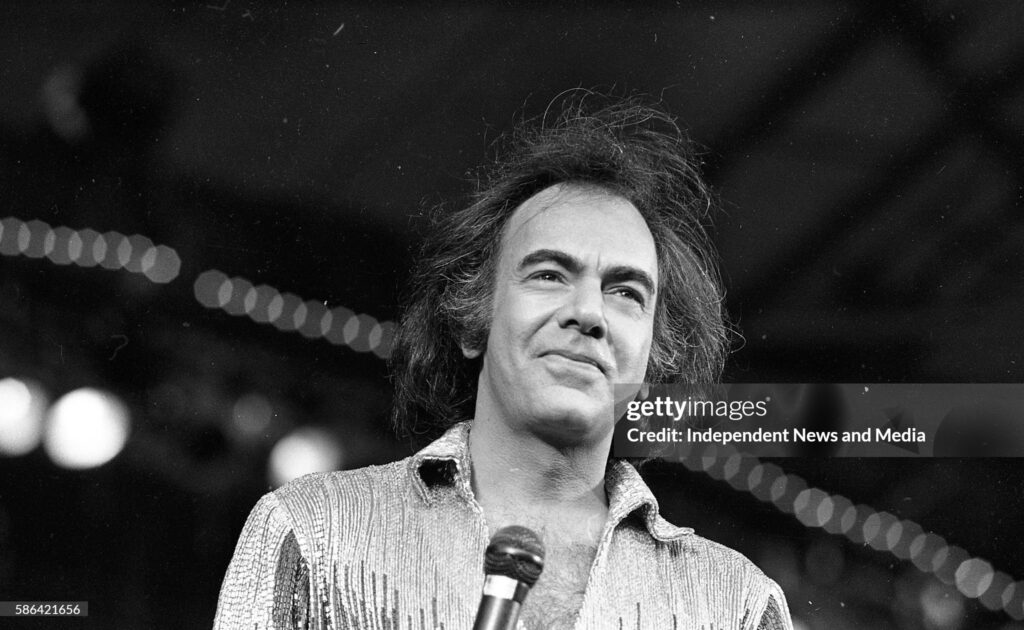
“Love on the Rocks” is where Neil Diamond turned romantic collapse into something grand, bruised, and unforgettable—one of the defining emotional centerpieces of The Jazz Singer.
Few songs in Neil Diamond’s catalog carry the same wounded majesty as “Love on the Rocks”, the towering ballad from the 1980 soundtrack to The Jazz Singer. Released as a single in 1980, the song rose to No. 2 on the Billboard Hot 100, where it remained blocked from the top spot only by Kenny Rogers’ “Lady”. It also reached No. 3 on the Adult Contemporary chart, confirming what listeners immediately understood: this was not just a soundtrack song, and not just a hit. It was one of those rare records that seemed to arrive already carrying the weight of memory.
On the surface, “Love on the Rocks” is a song about disillusionment. But that description hardly captures its force. Diamond sings not like a man merely disappointed in love, but like someone standing amid the wreckage, trying to make sense of how tenderness turned into distance. The title itself is a brilliant phrase—part cocktail shorthand, part emotional diagnosis. Love, once warm and intoxicating, has been poured over ice and left to chill. In Diamond’s hands, that image becomes a whole life story compressed into a few aching minutes.
The song was written by Neil Diamond and French composer Gilbert Becaud, and that combination helps explain its unusual character. There is American pop craftsmanship in its structure, but also a dramatic, almost continental sweep in its melody. It does not merely unfold; it surges. From the first piano-led phrases to the full-throated chorus, the arrangement gives Diamond room to move from private hurt to public declaration. That was always one of his gifts as a vocalist: he could make emotion feel both intimate and theatrical at once.
Within The Jazz Singer, “Love on the Rocks” fits the film’s central tensions beautifully. The movie tells the story of a singer torn between family expectations, faith, identity, and the demands of a changing life. Whether or not one embraces the film itself as a classic, the music remains its enduring triumph. And among all the soundtrack’s memorable numbers, “Love on the Rocks” stands apart because it feels less tied to plot than to the universal ache beneath the story. It carries the loneliness of ambition, the cost of emotional missteps, and the silence that follows when love no longer knows how to speak.
There is also something deeply adult about the song. This is not the language of first heartbreak. It is the language of somebody old enough to know that relationships rarely collapse in a single dramatic instant. They erode. They harden. They become impossible to hold the way they once were. Diamond does not oversell that truth; he leans into it with weary conviction. When he reaches the chorus, the pain is not wild or youthful. It is seasoned. That is what gives the performance its staying power.
Musically, the record is pure early-1980s adult pop at its finest—polished, expansive, and emotionally direct. The piano sets the mood with sober elegance, while the rhythm section and orchestration slowly widen the frame. By the time the chorus arrives, the song has grown into a full emotional landscape. Yet for all its scale, it never loses its bruised center. Diamond’s voice remains the anchor: grainy, warm, slightly frayed around the edges, and utterly believable. He does not sound like he is acting heartbreak. He sounds like he has lived with it long enough to sing it without disguise.
That may be one reason the song has lasted so powerfully across the decades. So many heartbreak songs plead, blame, or dramatize. “Love on the Rocks” does something subtler. It admits defeat without surrendering dignity. It recognizes that some endings arrive not with noise, but with a sad clarity. That emotional honesty has helped keep the song alive long after the era of its release. Even listeners who first discovered it through radio rather than film often remember exactly where it seemed to meet them—in a quiet room, on a late drive, at the end of a long season of disappointment.
In the larger arc of Neil Diamond’s career, the song represents one of his great mature statements. By 1980, he was already a major songwriter and performer with an extraordinary run behind him, but “Love on the Rocks” reminded audiences that his voice could still deliver emotional thunder without sacrificing tenderness. It was not youthful innocence he offered here; it was hard-earned feeling. That distinction matters. It is why the song still resonates not merely as a hit from The Jazz Singer, but as one of the most fully realized heartbreak performances of its time.
And that is why the song endures. Not because it belongs to a film, or because it climbed the charts, though both are true and important. It endures because Neil Diamond found a way to sing disappointment with grace, ache with grandeur, and loneliness with a kind of weathered poetry. “Love on the Rocks” does not ask for sympathy. It offers recognition. It knows that sometimes the deepest songs are the ones that tell us, with painful elegance, that what has broken cannot always be repaired—only remembered.