
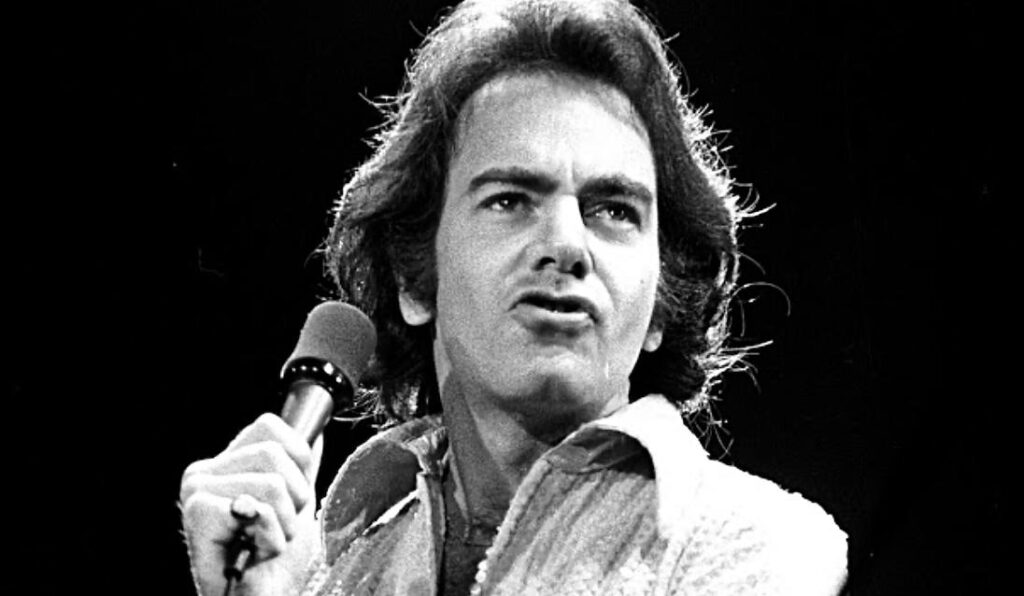
“Desirée” is Neil Diamond’s bittersweet memory of first awakening—where desire feels like sunlight, and regret arrives the morning after, when the room is already empty.
Some songs don’t unfold like a love story; they unfold like a confession. Neil Diamond’s “Desirée” (often written without the accent as “Desiree”) is one of those late-’70s records that sounds warm on the surface—grand piano, a gentle rock pulse—yet carries the quiet sting of a man looking back at the moment he “became a man” and realizing how little control he truly had. It was released as a single in November 1977 on Columbia, with “Once in a While” on the B-side, written by Neil Diamond and produced by Bob Gaudio.
The timing matters. “Desirée” was the lead single from Diamond’s album I’m Glad You’re Here with Me Tonight, released November 11, 1977—a period when his work leaned into a more mature, studio-polished pop sound, but still kept his storyteller’s instinct intact. The song’s “ranking at arrival” tells a tale of steady momentum rather than instant takeover: it debuted on the Billboard Hot 100 at No. 70 (the chart lists that debut position), then climbed week by week to a peak of No. 16 on the chart dated February 11, 1978. And while pop radio treated it as a solid hit, adult-leaning stations truly embraced it: the song reached No. 1 on Billboard’s Easy Listening (Adult Contemporary) chart, becoming Diamond’s fifth chart-topper there.
Behind the statistics is a human scene painted with startling directness. The lyric begins with a date—“the third of June”—and with that one detail Diamond does what he always did best: he makes memory feel physical, pinned to a calendar, as if you could touch the day and change it. The story is frank: the narrator is young, and Desirée is “almost twice” his age; she arrives “like a morning sun,” and by her hands he crosses an invisible threshold. Yet the emotional hook isn’t the seduction—it’s the aftermath. She’s gone by morning, and what’s left behind isn’t triumph. It’s a kind of ache, the bewildered loneliness of a boy who expected initiation to feel like belonging, only to discover that desire can be a doorway that swings shut just as fast.
That’s why “Desirée” has endured for listeners who have lived long enough to recognize the complicated shape of “first times.” Diamond doesn’t romanticize the power imbalance; he frames it as a haunting. The song is less “I remember my conquest” and more “I remember the moment I learned how wanting can wound.” The name Desirée itself functions like a spell—beautiful to say, impossible to forget—because she is no longer merely a person in the lyric. She becomes the embodiment of a certain kind of memory: half sweetness, half bruise.
Critics in the trade press at the time noticed the craft, too. Cash Box praised its “infectious” piano-led opening and suggested Diamond was “at the top of his form,” while Record World described a light rock arrangement designed to spotlight the lyric’s provocative core. That’s exactly right: the production doesn’t drown the story in drama. It lets the words sit forward, where you can’t politely ignore them.
And then there’s the most quietly poignant detail of all: “Desirée” belongs to an era when a song could debut modestly, climb patiently, and become part of people’s lives through repetition—through car radios, kitchen radios, the slow ritual of days. It doesn’t sound like a record chasing a trend. It sounds like a man turning a private recollection into something singable, because singing is the only way he knows to live with it.
In the end, Neil Diamond’s “Desirée” is not merely nostalgia. It’s memory with consequences—a reminder that the moments we thought would make us “older” sometimes only make us more tender, because we finally understand what we didn’t understand then: how quickly the morning comes, how easily a name becomes a ghost, and how one bright night can echo for the rest of a lifetime.