
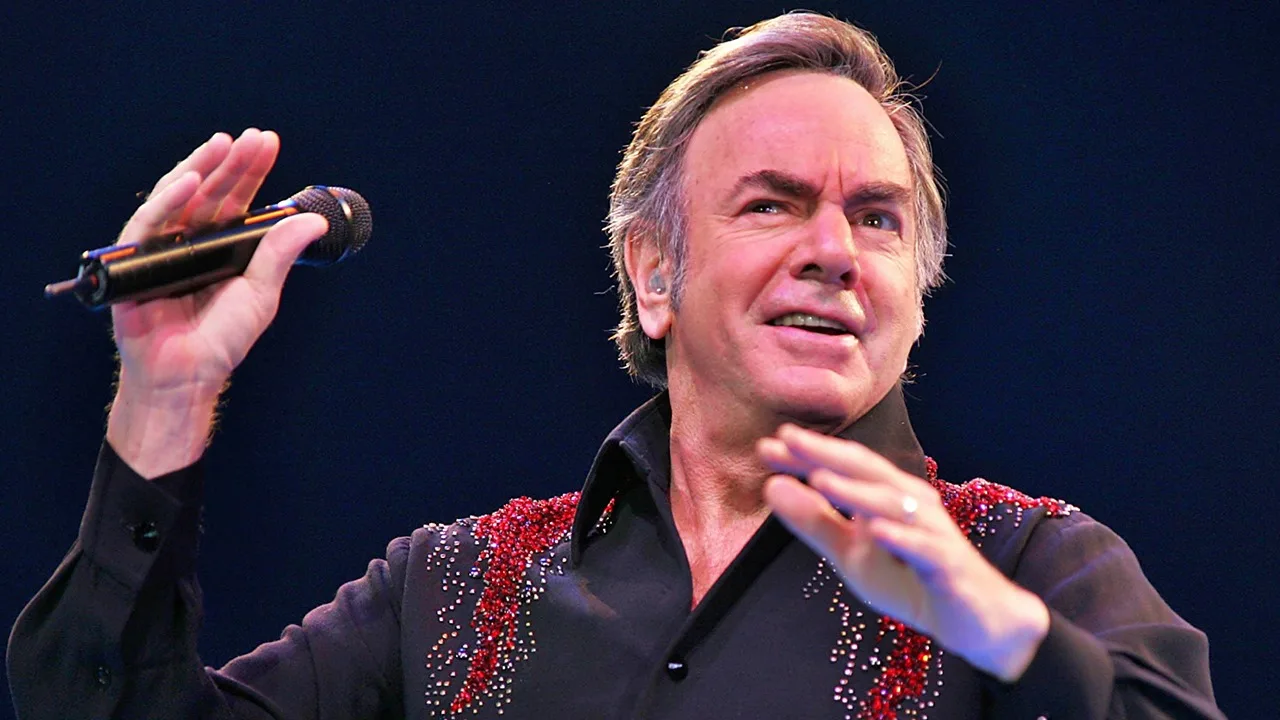
“America” is Neil Diamond turning the immigrant story into a marching hymn of the heart—hopeful, bruised, bright with belief, and loud enough to make a whole arena feel like one family.
There are songs that merely describe a country, and then there is “America”—a song that moves like a country in motion. Neil Diamond first placed it on the soundtrack to his 1980 film and album The Jazz Singer, but it truly announced itself to the wider public when it was released as a single in April 1981. The impact was immediate and measurable: it rose to No. 8 on the Billboard Hot 100, and—just as telling for Diamond’s long romance with adult radio—became his sixth No. 1 on Billboard’s Adult Contemporary chart. In the year-end reckoning, Billboard ranked it the No. 62 pop single of 1981.
Yet numbers only sketch the outline. The full picture is emotional: “America” doesn’t stand still. It travels. It gathers people. It keeps walking forward even when the voice is trembling with the effort of believing.
One reason the record feels so large is that it was built to feel larger than a studio. The single version is, technically, a studio recording—yet it famously uses overdubs of crowd cheering to simulate the electricity of a live performance. That choice—almost cinematic in its illusion—fits the song’s worldview. This isn’t a private diary entry. It’s a communal shout, a chorus meant to be answered by thousands of strangers who suddenly don’t feel like strangers anymore.
The song’s “plot,” such as it is, is an affirmative reading of the history of immigration to the United States, reaching back to the early 1900s while also speaking in the present tense. And then, at the finish line, Diamond does something both theatrical and deeply traditional: “America” closes with an interpolation of “My Country, ’Tis of Thee.” It’s a gesture that can sound grand—almost pageant-like—until you notice how human the feeling underneath it really is. The patriotism here isn’t abstract. It’s the patriotism of suitcases, ship decks, train stations, last names misspelled at a desk, and the stubborn decision to begin again.
Behind the scenes, the single’s credits also matter for understanding its punch. Neil Diamond wrote the song himself, and the single lists Bob Gaudio as producer. That pairing helps explain the track’s muscular architecture: drums that rumble like an approaching crowd, a melody that climbs in determined steps, and that final, flag-unfurling lift that feels designed to carry a room of people on its shoulders.
But “America” also has a second life—one that lives outside the charts, in the way the culture kept borrowing it when it needed a shorthand for belonging. The song was used as the theme for Michael Dukakis’s 1988 presidential campaign, a striking choice precisely because the lyric leans into immigrant roots rather than empty slogans. Over the years it also found its way into broader public-pageantry contexts, including promotion surrounding the 1996 Olympics. And whenever Diamond performed it live, it tended to become less “a song” than “a moment”—the kind where the audience doesn’t just sing along; it participates.
Then history darkened, and the song revealed another layer of character. After September 11, 2001, Diamond sometimes altered the climactic lyric in performance—shifting from “They’re comin’ to America” to “Stand up for America.” Even if you prefer the original phrasing, that change tells you something profound: “America” was never frozen in amber. It was alive enough to be adapted in grief, like a communal prayer that people reach for when ordinary language fails.
So what does “America” mean, beyond its obvious patriotic sweep? It means that arrival is holy. It means that longing can be inherited. It means that the dream is not always triumphant—sometimes it’s simply persistent. Diamond’s genius is that he doesn’t romanticize immigration as an easy fairy tale; he romanticizes it as an act of courage repeated across generations. The song is filled with forward motion—names, faces, places implied rather than itemized—because the real subject is not geography. The real subject is desire: the desire to be included, to be safe, to be seen, to start over without being erased.
And that’s why, decades later, “America” still hits like a bright wind. It carries the sound of a certain kind of faith—earnest, unembarrassed, almost stubborn. Not the faith that insists everything is perfect, but the faith that insists the journey still matters. In a world that changes its mood quickly, Neil Diamond built a song that keeps its shoulders squared: The Jazz Singer, “America”, and that climbing chorus that feels like a train you can hear before you see it—coming closer, carrying voices, carrying hope, carrying the ache of leaving and the miracle of arriving.