
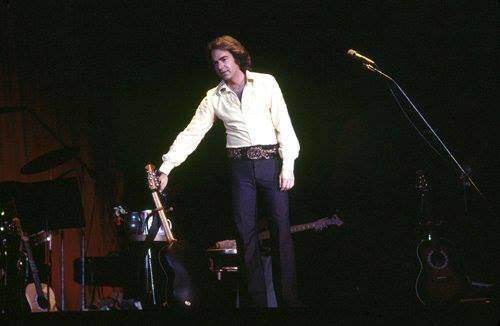
Neil Diamond turns “He Ain’t Heavy, He’s My Brother” into something more than a cover song—he sings it like a lifelong reflection on loyalty, mercy, and the weight we gladly carry for the people we love.
Some songs arrive as hits. Others stay long enough to become part of the way we understand one another. “He Ain’t Heavy, He’s My Brother” belongs to that second kind. By the time Neil Diamond recorded it for his 2010 album Dreams, the song was already woven deep into popular memory. Written by Bobby Scott and Bob Russell, it had long been associated with compassion, endurance, and the quiet dignity of standing beside someone in need. But in Diamond’s hands, it gained another layer: age, experience, and that unmistakable sense that he was no longer simply singing a lyric—he was testifying to it.
The most important chart fact connected to Diamond’s version is that it appeared on Dreams, an album of beloved standards and favorites that reached No. 8 on the Billboard 200 after its release in 2010. “He Ain’t Heavy, He’s My Brother” was not promoted as a major standalone chart single in the way classic pop singles once were, so its story is not really a chart story. It is something more enduring than that. It is a song chosen by an artist old enough, seasoned enough, to understand exactly what its message costs—and why it still matters.
That is what makes Diamond’s reading so moving. He does not rush the sentiment or inflate it. He lets the words breathe. The famous line, “He ain’t heavy, he’s my brother,” can sound noble, even grand, in other versions. With Neil Diamond, it sounds personal. There is warmth in the phrasing, but also gravity. He sings as if he knows that devotion is not always dramatic. Sometimes it is simply the decision to stay, to help, to forgive, to keep walking with someone when the road has grown longer than expected.
And that has always been one of Diamond’s great gifts as an interpreter. Though celebrated for writing and performing towering originals such as “Sweet Caroline”, “Solitary Man”, and “I Am… I Said”, he also understood how to inhabit another writer’s song without erasing its soul. On Dreams, he did not choose material as a museum curator would. He chose songs that had lived with him. You can hear that throughout the album, and especially here. His version of “He Ain’t Heavy, He’s My Brother” feels less like reinvention and more like recognition.
The song itself carries a remarkable history. The title was inspired by a phrase associated with the Boys Town movement, where the idea of carrying another person was framed not as a burden, but as an expression of love and responsibility. Lyricist Bob Russell, who was seriously ill during the song’s creation, helped shape words that speak not in slogans, but in tenderness. That is part of why the song has endured for generations. It does not pretend life is easy. It simply insists that kindness is worth the effort.
When Neil Diamond sings it, that meaning settles even deeper. His mature voice—slightly weathered, unmistakably human—adds a kind of lived authority. Younger singers can bring power to this song. Diamond brings perspective. He sounds like a man who has seen fame, loneliness, reinvention, devotion, and the long memory of music itself. So when he reaches for the emotional center of the lyric, he does not oversell it. He trusts it. That restraint gives the performance its emotional force.
There is also something beautifully fitting about Diamond recording this song in 2010. By then, he was no longer proving anything. He was an institution in American popular music, admired not only for his songwriting, but for the emotional sincerity that had carried his work across decades. Dreams arrived as a reflective album, full of reverence for songs that shaped him. In that setting, “He Ain’t Heavy, He’s My Brother” feels like one of the album’s spiritual anchors—a song about fellowship chosen by an artist who had spent a lifetime learning how to communicate directly with people’s hearts.
What lingers most is the lack of showmanship in the message. The song’s greatness has never depended on ornament. Its power lies in a simple moral truth: love becomes visible when someone is willing to carry part of another person’s sorrow. Diamond understands that. He gives the song room, dignity, and emotional clarity. The result is a version that feels autumnal in the best sense—full of late light, memory, and the kind of wisdom that only grows more persuasive with time.
That may be why this performance continues to resonate. In an era that often celebrates noise, speed, and spectacle, Neil Diamond’s “He Ain’t Heavy, He’s My Brother” reminds us of something steadier. It reminds us that the deepest songs are often the ones that speak gently. It reminds us that brotherhood, in the broadest human sense, is not a slogan but a daily act. And above all, it reminds us that when a great voice meets a great truth, no elaborate explanation is needed. We hear it. We know it. We carry it with us.