
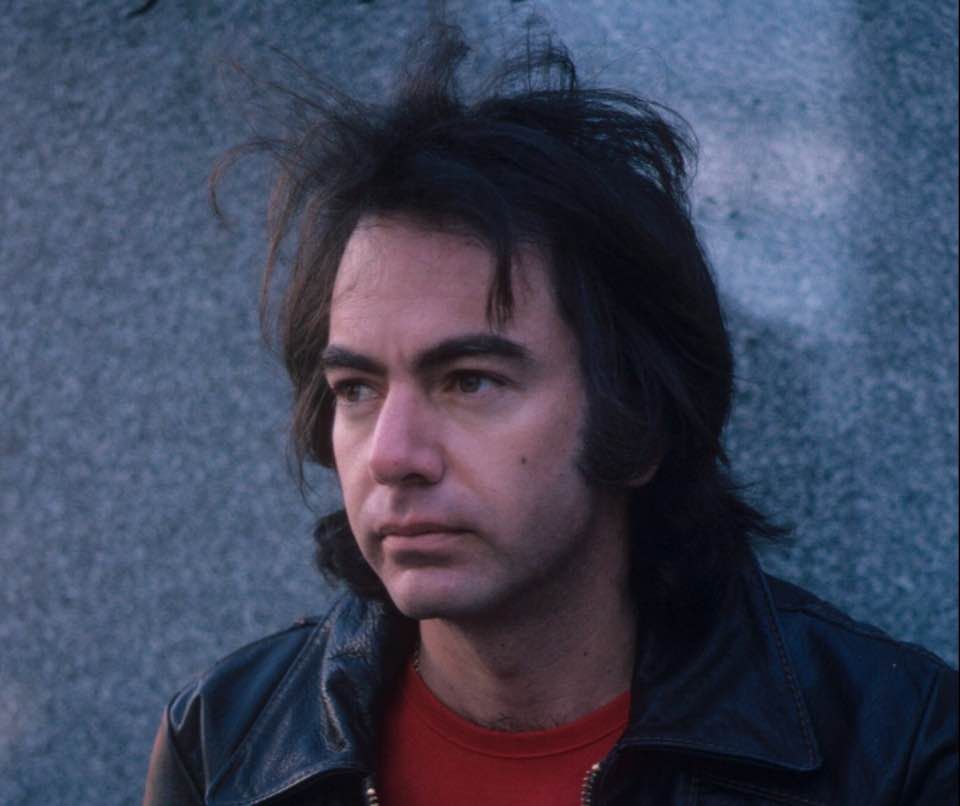
A late-career reflection wrapped in warmth and restraint, “Slow It Down” finds Neil Diamond looking straight at time, memory, and the deep human wish to hold life still for just a moment longer.
Released in 2008 as part of Home Before Dark, “Slow It Down” did not arrive as a flashy hit single, and that is part of what makes it so moving. It lived inside an album that mattered enormously in Neil Diamond’s career. Home Before Dark debuted at No. 1 on the Billboard 200, becoming Diamond’s first American chart-topping album, and it also reached No. 1 in the UK. For an artist who had already spent decades filling arenas and writing songs that felt woven into American life, this was no small late triumph. Yet one of the album’s deepest emotional rewards was not a grand anthem, but this hushed, searching song about pace, aging, and the quiet terror of how quickly life moves.
By the time “Slow It Down” appeared, Neil Diamond was no longer trying to prove he could still command a stage. Everyone already knew that. What changed in this period, especially through his work with producer Rick Rubin, was the willingness to strip away polish and stand closer to the bone. Rubin had already helped Diamond reconnect with a more intimate, songwriter-centered sound on 12 Songs in 2005. On Home Before Dark, that inward mood deepened. The production is careful, spacious, and unhurried. It leaves room for breath, for reflection, and for the grain of Diamond’s older voice to carry meaning that a younger voice could never fully express.
That is the real beauty of “Slow It Down”. It is not merely about moving at an easier pace. It feels like a conversation with time itself. The title sounds almost simple at first, but in Diamond’s hands it becomes a plea, a confession, and perhaps even a prayer. This is a man who had lived through the roar of pop fame, the theatrical sweep of the 1970s, the towering concert years, the reinventions, the criticism, the comebacks, and the strange loneliness that often follows applause. In that light, the song does not sound like advice given from a distance. It sounds lived in.
Musically, the song leans into understatement. That choice is crucial. Earlier in his catalog, Neil Diamond could be explosive, dramatic, even chest-beating in the best possible way. Think of the forward motion in songs like “America” or the open-armed communal lift of “Sweet Caroline”. “Slow It Down” moves in the opposite direction. It does not rush toward a chorus designed to conquer a stadium. Instead, it settles into a reflective current, as if every phrase is measuring what has been gained and what has been lost. The arrangement supports that mood beautifully, never overcrowding the message.
Lyrically, the song carries one of the oldest truths in popular music: the older we get, the more clearly we feel that time is both precious and merciless. But Neil Diamond approaches that truth with tenderness rather than self-pity. There is no melodrama here. What we hear instead is wisdom edged with vulnerability. The song recognizes that life speeds up in ways we do not notice until the years are suddenly behind us. It understands the ache of wanting one more conversation, one more unhurried evening, one more chance to savor what once slipped past unnoticed. That emotional register is what gives “Slow It Down” its staying power.
There is also a subtle courage in the performance. Many veteran artists lean on nostalgia by repeating old gestures. Neil Diamond does something more difficult here: he allows maturity to become the song’s central instrument. His voice on Home Before Dark is weathered, intimate, and deeply believable. On “Slow It Down”, that voice carries the feeling of someone who has stopped running from silence. He does not try to out-sing time. He sings from inside it. That difference is everything.
The story behind the song, then, is not one of scandal or studio warfare. Its power comes from something quieter and, in many ways, rarer. It came from a late period in which Neil Diamond embraced reflection instead of spectacle. Working in the more restrained world of Rick Rubin’s production, he found a space where songs could breathe and where emotional truth mattered more than chart formulas. Even though “Slow It Down” was not the commercial centerpiece of the album, it became one of its emotional anchors, a song that reveals what an artist can say when he no longer feels any need to shout.
That is why the song still resonates. It speaks to listeners who know that life is not measured only in milestones, but in the speed with which ordinary days disappear. It reminds us that some of the most powerful songs are not the ones that arrive with fanfare, but the ones that sit beside us years later and say exactly what we were not yet ready to hear the first time. In the long arc of Neil Diamond’s catalog, “Slow It Down” may not be the loudest title or the most famous. But it is one of the most humane.
And perhaps that is the final meaning of the song. After all the bright lights, all the movement, all the career peaks that made Neil Diamond a giant of modern songwriting, “Slow It Down” offers something gentler and, in its own way, even more lasting: a man standing in the later afternoon of life, asking for presence over momentum, depth over noise, and a little mercy from the clock. Few artists ever reach that kind of honesty. Fewer still can make it sound this graceful.