
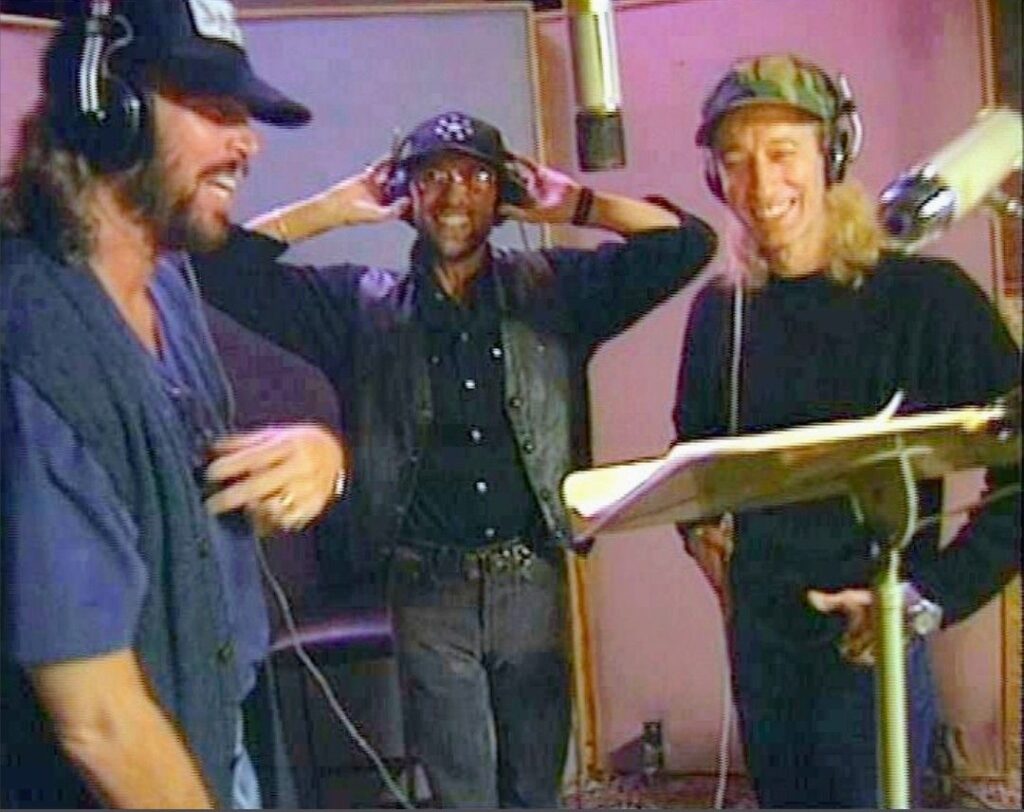
A deeply overlooked Bee Gees performance, Man in the Middle captures the ache of being caught between voices, loyalties, and identities at a moment when the group itself was beginning to strain.
Man in the Middle is not one of the songs most casual listeners mention first when they speak of the Bee Gees. It was never pushed as a major single, and it never had the chart life of Massachusetts, I Started a Joke, or the later era-defining hits that made the brothers global icons all over again. But that is precisely why the song still carries such a haunting power. First released in 1969 on the ambitious double album Odessa, Man in the Middle arrived during one of the most fragile and artistically rich periods in the group’s history. As a standalone track, it did not chart on its own, but Odessa performed strongly, reaching No. 10 on the UK Albums Chart and No. 20 on the US Billboard 200.
That setting matters. Odessa was not a simple pop record. It was ornate, serious, melodic, and often drenched in atmosphere, with the Bee Gees stretching themselves into something more theatrical and reflective. By the time the album reached the public, tensions within the group were already becoming harder to hide. The disagreement over which song should be featured as the single from the album became part of the larger fracture that soon led to Robin Gibb temporarily leaving the group. In that uneasy climate, Man in the Middle feels less like a decorative album cut and more like a quiet emotional document.
One of the song’s most affecting qualities is the voice at its center. Maurice Gibb, so often praised by musicians for his versatility and instinct but too often overshadowed in public memory by the more immediately recognizable voices of Barry and Robin, gives Man in the Middle a human scale that makes it unforgettable. His vocal does not demand attention in a grand or theatrical way. It draws you in more gently than that. There is restraint in it, but also weariness, tenderness, and something almost painfully intimate. He sounds like someone trying to hold his place in a world that keeps shifting around him.
That is part of what gives the title its lasting resonance. Man in the Middle can be heard as a song about emotional pressure, about the burden of standing between forces that cannot easily be reconciled. It is tempting to hear it as a reflection of Maurice Gibb’s own place inside the Bee Gees: the brother in the center of a famous family triangle, essential to the group’s musical chemistry, yet rarely treated as its public focal point. No responsible listener should reduce the song to autobiography alone, but the association has lingered for decades because the feeling is simply too strong to ignore. Even when the lyrics remain open to interpretation, the mood suggests divided loyalties, inward conflict, and the loneliness of being needed without always being fully seen.
Musically, the track belongs completely to the late-1960s Bee Gees world: carefully arranged, melodically rich, and emotionally layered without becoming heavy-handed. The brothers had an extraordinary gift in this era for combining chamber-pop elegance with private feeling, and Man in the Middle shows that gift in a particularly mature form. Nothing is rushed. The arrangement allows the emotion to gather slowly, almost like a memory returning. That patience is one reason the song has aged so well. It does not chase fashion. It trusts melody, mood, and the wounded intelligence of the performance.
There is also something quietly prophetic about it when heard in the context of Odessa. The album now stands as one of the most fascinating chapters in the Bee Gees catalogue because it preserves the group at once at full creative ambition and near internal breaking point. Many songs from that period seem touched by distance, longing, or misunderstanding, and Man in the Middle fits that emotional weather perfectly. It is not loud about its sadness. It is more dignified than that, and perhaps more moving because of it. The song seems to understand that some of life’s deepest pressures are not dramatic in public. They are carried quietly, day after day, in the heart and in the voice.
For listeners who know the Bee Gees mainly through the brilliance of the disco years, returning to Man in the Middle can be a revelation. It reminds us that before the white suits, before the falsetto storm changed popular music, there was another Bee Gees story: one built on intricate songwriting, melancholy atmosphere, and emotional sophistication far beyond what radio history sometimes allows. This song belongs to that story. It reveals a group capable of enormous subtlety and a singer, in Maurice Gibb, whose emotional intelligence gave the band a depth that cannot be measured by lead-credit statistics alone.
That may be why Man in the Middle continues to linger with devoted listeners. It feels like the kind of song that grows larger as life does. In youth, it may sound simply beautiful and melancholy. With time, it starts to feel wiser. It speaks to anyone who has ever stood between competing demands, between love and duty, between what is felt and what is said aloud. And in the long, remarkable history of the Bee Gees, that makes it far more than a hidden track on Odessa. It becomes a quiet truth, preserved in melody.