
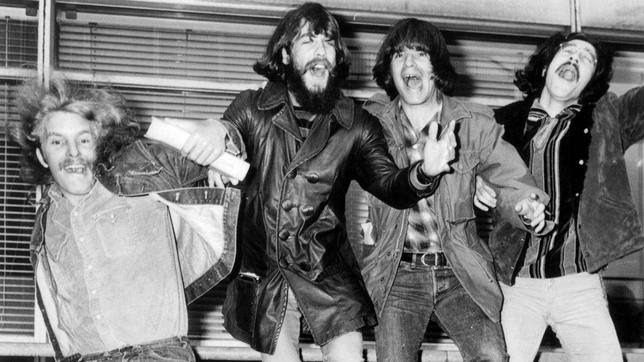
Feelin’ Blue is one of those quiet Creedence Clearwater Revival songs that does not ask for attention, yet it leaves behind the ache of a long night and the truth of a heart too tired to pretend.
Feelin’ Blue was never one of the headline-grabbing singles in the Creedence Clearwater Revival catalog, and that is part of what makes it so affecting. Written by John Fogerty and included on the 1969 album Willy and the Poor Boys, the song arrived during one of the most astonishing creative runs in American rock history. It did not chart on the Billboard Hot 100 because it was not released as a stand-alone single, but the album that carried it, Willy and the Poor Boys, reached No. 3 on the Billboard 200. It came out in the same season that made “Down on the Corner” and “Fortunate Son” unavoidable on radio, both songs helping define the public image of the band. Yet tucked inside that famous record was Feelin’ Blue, a slower, more inward performance that showed another side of CCR’s power.
That contrast matters. When people think of CCR, they often hear movement first: the roll of the rhythm, the bark of the guitar, the confidence of songs that seem to push forward no matter what stands in the way. Feelin’ Blue does something different. It leans into weariness. It sounds less like a rallying cry than a private admission. The groove still carries the unmistakable swamp-rock stamp of the band, but the emotional center is tired, lonely, and bruised. It is not theatrical heartbreak. It is more familiar than that, more lived-in. The song feels like the moment after the noise has died down, when all that remains is the plain fact that something inside has gone dim.
Placed at the end of the first side of the original Willy and the Poor Boys LP, Feelin’ Blue serves almost like a pause in the whirlwind. Before it, the album moves through humor, grit, roots music, and social tension. Then this song arrives and lowers the lights. That sequencing was no small thing. Creedence Clearwater Revival understood albums as journeys, and Feelin’ Blue gives the listener a deeper emotional register before the record turns again toward the sharper political fire of “Fortunate Son” and the haunted unease of “Effigy.” In that sense, the song is not filler, and certainly not a minor afterthought. It is part of the architecture of the album’s soul.
The story behind Feelin’ Blue is not the kind built from grand mythology or a famously turbulent recording session. In many ways, its story is simpler and perhaps more revealing. John Fogerty had an extraordinary gift for taking old American forms, especially blues, rockabilly, country, and rhythm and blues, and stripping them down until they felt timeless again. Feelin’ Blue is one of the clearest examples of that instinct. Rather than relying on a flashy hook or a broad social statement, Fogerty builds the song from repetition, mood, and pressure. The feeling is the message. That is why the title itself matters so much: it is not decorative sadness, but a condition, a weight, a spell the singer cannot quite break.
What gives the song its lasting force is the performance. John Fogerty’s voice does not oversell the sorrow. He sounds worn rather than shattered, restrained rather than dramatic, and that choice makes the emotion more believable. Around him, the band plays with the kind of disciplined unity that became one of CCR’s signatures. Tom Fogerty, Stu Cook, and Doug Clifford never crowd the song. They let it breathe. The result is a track that moves with a heavy, patient pulse, as if the music itself is carrying something difficult from one line to the next.
Lyrically, Feelin’ Blue belongs to a long tradition of American songs that express pain without trying to decorate it. That is part of its meaning and part of its dignity. There is no need here for elaborate metaphor or narrative twists. The emotional truth is direct: the singer is low, unsettled, and caught in a state he cannot easily explain away. Many artists have tried to turn sadness into a spectacle. Creedence Clearwater Revival instead turned it into atmosphere. That restraint is one reason the song ages so well. It leaves room for memory. It leaves room for the listener.
It is also worth remembering where Feelin’ Blue sits in the broader 1969 story of CCR. In that single year, the band released Bayou Country, Green River, and Willy and the Poor Boys, an almost unbelievable pace for music of such consistency and identity. Because of that flood of greatness, some songs were destined to live in the shadow of larger hits. But time has a way of correcting the record. Listening now, Feelin’ Blue feels less like a forgotten album cut and more like evidence of just how deep this band could go without losing simplicity, grit, or grace.
If the best-known Creedence Clearwater Revival songs often sound like America in motion, Feelin’ Blue sounds like America alone with its thoughts. It is humble, sturdy, and quietly devastating. Not every song needs to arrive as a hit to become essential. Some endure because they tell the truth in a lower voice. This one does exactly that, and decades later, it still lingers with uncommon honesty.