
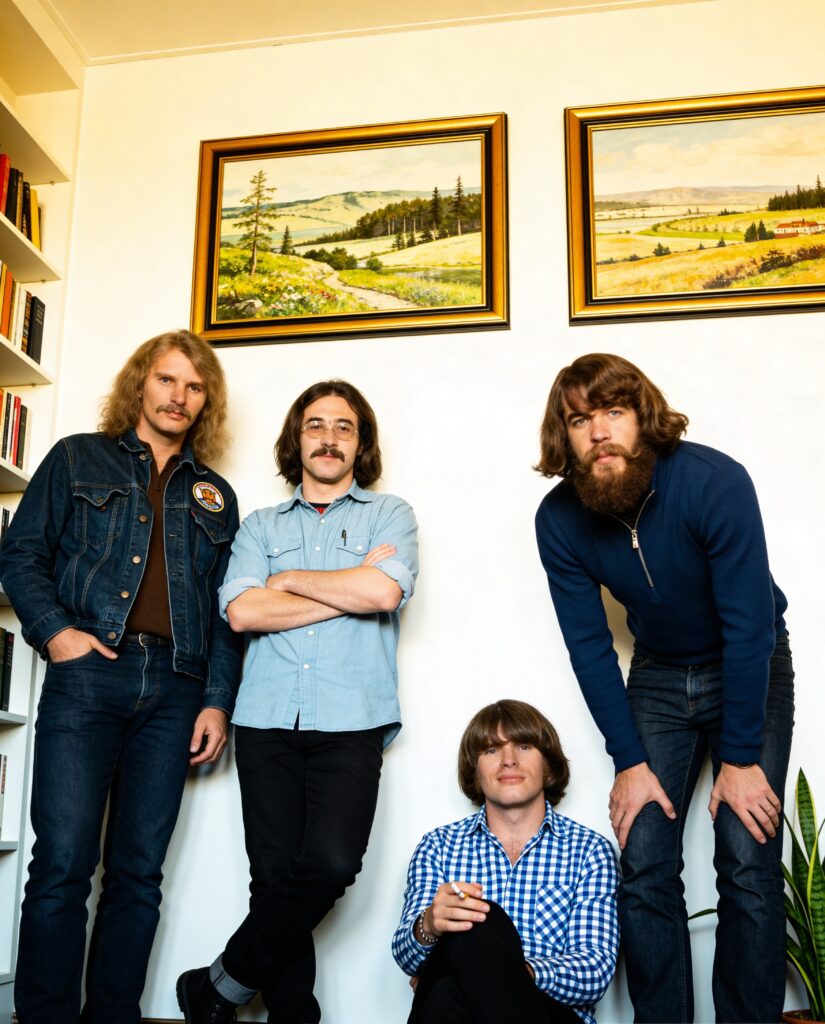
A forgotten closing track, Walk on the Water captures the exact moment Creedence Clearwater Revival stopped sounding like a promising band and started sounding like themselves.
When Creedence Clearwater Revival released its self-titled debut album in May 1968, the record climbed to No. 52 on the Billboard 200, helped greatly by the success of Suzie Q, which reached No. 11 on the Billboard Hot 100. By comparison, Walk on the Water was never the big chart-driving title. It was not the song that introduced the band to the widest audience, and it was not packaged as the obvious breakthrough. Yet for listeners who care about origins, identity, and those quiet moments when a group begins to discover its true voice, this song is one of the most revealing performances in the entire early CCR story.
Its story begins before the band was even known as Creedence Clearwater Revival. In 1966, the same four musicians, John Fogerty, Tom Fogerty, Stu Cook, and Doug Clifford, recorded an earlier version under the name The Golliwogs, with the slightly longer title Walking on the Water. That earlier single did not become a national hit, but the composition clearly mattered to John Fogerty. When the group reintroduced itself in 1968 with a new name and a more focused artistic direction, he brought the song back, tightened it, reshaped its atmosphere, and gave it a second life. That detail alone makes the recording important: Walk on the Water is not merely an album track, but a bridge between two identities.
And what a bridge it is. On the surface, the title suggests something mystical, biblical, even unreachable. But the performance itself is far more grounded in tension than in serenity. This is not a hymn. It is not a song of easy answers. Instead, it feels like a young writer reaching toward larger symbols while still keeping both feet in the grit of everyday life. That was one of Fogerty’s great instincts even before the classic run of later albums: he could use language that sounded larger than life, then pull it back into something human, uneasy, and strangely familiar.
Musically, Walk on the Water still carries traces of the mid-1960s garage and psychedelic era that surrounded the band in California, but it also hints at the leaner, tougher approach that would soon define CCR. The guitars do not drift lazily; they press forward. The rhythm section does not decorate the song; it anchors it. Doug Clifford and Stu Cook give the track a firm, almost marching undercurrent, while John Fogerty’s vocal comes through with that tightening edge that would later become unmistakable. There is already a sense of compression here, a sense that the band is learning how to say more with less. They are moving away from period fashion and toward something far more durable.
That is one reason the song continues to fascinate longtime listeners. It lets you hear Creedence Clearwater Revival in transition. The group had not yet fully arrived at the swamp-rock authority of Bayou Country, Green River, or Willy and the Poor Boys, but the instinct was already in place. Walk on the Water closes the debut album almost like a final glance backward before the band steps into the extraordinary run that would soon follow. There is history in it, but there is also momentum.
As for meaning, the song has always felt most powerful when heard as a reflection on impossible promises and the restless search for something beyond the ordinary. The title offers the language of miracle, but the mood suggests uncertainty rather than triumph. That contrast is part of its beauty. Fogerty does not present wonder as something simple or easily held. He presents it as something people long for, talk around, chase after, and rarely grasp in a clean or complete way. In that sense, the song belongs to a very old tradition in rock writing: taking a grand image and using it to illuminate ordinary confusion, pride, hope, and disappointment.
It also says something important about the young John Fogerty as a songwriter. Even before he reached the concise brilliance of later songs, he was already trying to merge roots music, sharp imagery, and emotional ambiguity. He was not content to imitate the British Invasion or drift with West Coast trends. He was searching for an American sound with dust on its shoes and tension in its heart. Walk on the Water may not be the finished manifesto, but it is undeniably part of the map.
There is also a special kind of affection reserved for songs like this, songs that were not the biggest hits but gradually became essential to understanding the artist. People often come to Creedence Clearwater Revival through the obvious classics, and rightly so. But once they stay a while, they begin to hear how much the so-called lesser-known tracks matter. This one matters because it preserves the feeling of a threshold. You can hear the band leaving one version of itself behind and stepping toward another.
That is why Walk on the Water still lingers. Not because it dominated radio, and not because it arrived with the same immediate force as the later singles, but because it contains something rarer: the sound of a transformation still taking shape. It is a quiet turning point, rich with atmosphere, craft, and intention. And in the long history of Creedence Clearwater Revival, that makes it far more than a closing track on a debut album. It makes it one of the first true signs that a remarkable voice had found its footing.