
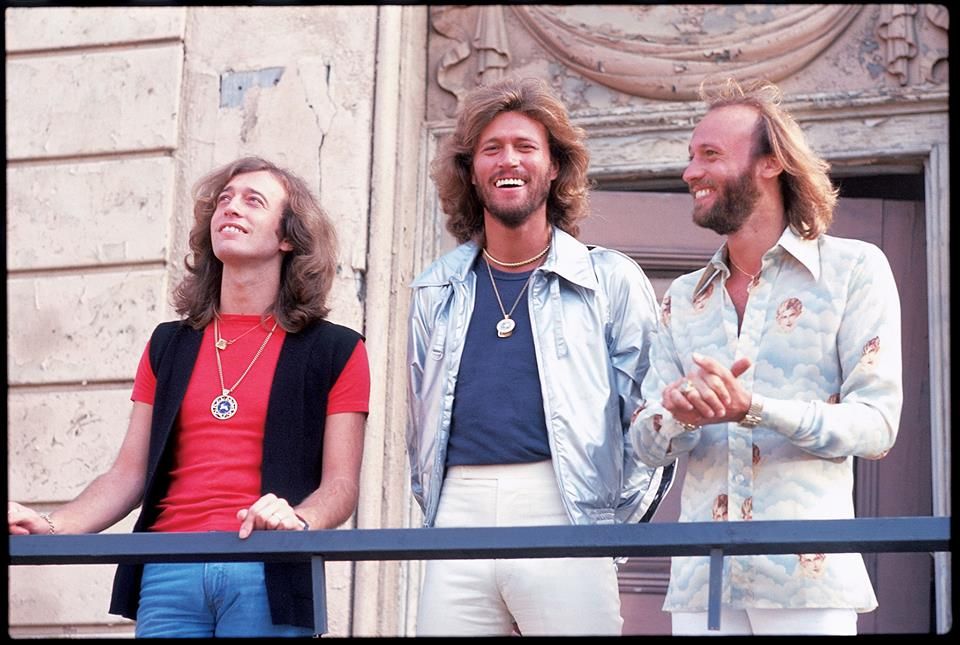
A tender reunion set to music, “How Can You Mend a Broken Heart” captured the moment the Bee Gees turned private heartache into one of the most haunting ballads of their career.
Long before the white suits, the disco pulse, and the unstoppable late-1970s comeback, the Bee Gees revealed a different kind of greatness in “How Can You Mend a Broken Heart”—quiet, wounded, and deeply human. Released in 1971 as the lead single from the album Trafalgar, the song became a milestone in the group’s story. It rose to No. 1 on the Billboard Hot 100 in the United States, where it stayed for four weeks, giving the Bee Gees their first American chart-topper. It also reached No. 1 on the Billboard Easy Listening chart, confirming that this was not simply a hit record, but a song that found listeners exactly where they lived—in memory, in longing, in the places the heart does not easily repair.
What made the record so powerful was not only its melody, though that melody is one of the most graceful the brothers ever wrote. It was the timing. By the end of the 1960s, the Bee Gees had already experienced enormous success, but they had also suffered a painful internal fracture. Robin Gibb had left the group after tensions within the band, and for a time it seemed possible that the extraordinary blend of Barry, Robin, and Maurice Gibb might become part of music history too soon. Their reunion brought more than a return to recording. It brought reflection, humility, and a kind of emotional maturity that can be heard in every line of “How Can You Mend a Broken Heart”.
Written by Barry Gibb and Robin Gibb, the song carries the ache of separation without ever sounding theatrical. It asks questions so simple they feel almost impossible to answer: how do you stop the rain from falling, how do you mend this broken heart, how can a loser ever win? Those lines are memorable because they do not pretend to solve anything. They sit inside sorrow honestly. That honesty is the song’s real strength. It does not dramatize pain; it recognizes it. And because of that, listeners have carried it with them for decades.
There is also something quietly remarkable about the performance itself. The arrangement is elegant but never crowded. The piano, the measured rhythm, the swelling strings, and the soft ache of the vocal harmonies allow the song to breathe. Barry Gibb’s lead vocal is especially affecting here. He does not overpower the lyric. He leans into it with restraint, sounding less like a star delivering a hit and more like a man trying to say something true before the feeling disappears. When the harmonies arrive, the song becomes even more moving, because the voices do what the lyric longs for: they come back together.
That may be the hidden emotional core of “How Can You Mend a Broken Heart”. On the surface, it is a ballad about romantic grief. But in the context of the Bee Gees, it also feels like a song about reconciliation, about brothers finding their way back through pride, hurt, and distance. The title itself could apply to love, family, friendship, or even a damaged sense of self. Few songs leave that much room for the listener while still feeling so personal.
The album Trafalgar deserves mention as well, because it arrived at a transitional moment for the group. It was not yet the era that would make the Bee Gees global pop titans once again, but it showed their depth as writers and interpreters of feeling. In many ways, “How Can You Mend a Broken Heart” stands as one of the clearest bridges between the group’s orchestral, melancholy early style and the broader emotional command they would later bring to every phase of their career.
For many listeners, the song endures because it never loses its tenderness. It belongs to that rare class of records that seem to grow wiser with time. A younger listener may hear heartbreak. An older one may hear all the things life asks us to rebuild: trust, hope, courage, connection. The song remains gentle, but it is not weak. It understands that some wounds do not close neatly, and that asking the question is sometimes the most truthful thing a singer can do.
There are bigger productions in the Bee Gees catalog, more famous dance records, and grander pop landmarks. Yet “How Can You Mend a Broken Heart” occupies a sacred place because it reminds us what made the group special before every reinvention: the ability to turn fragile emotion into something timeless. In 1971, the Bee Gees did more than score a No. 1 hit. They gave the world a song of reunion, vulnerability, and quiet endurance—one that still feels like it understands us when words fail.