
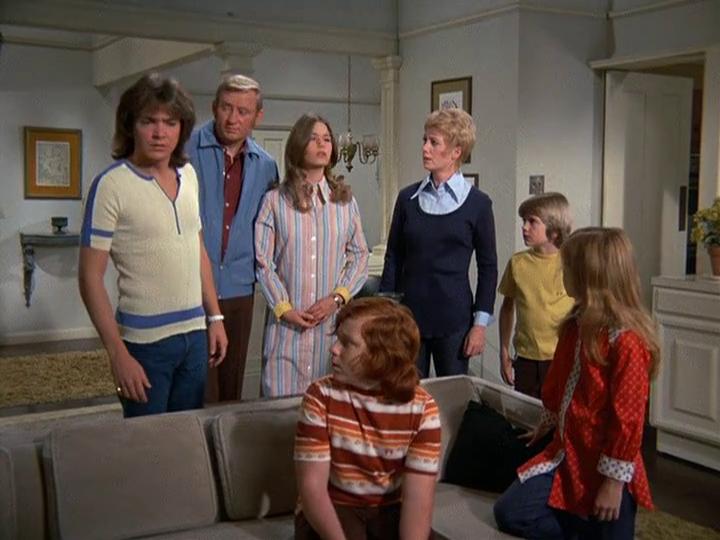
Love Must Be the Answer is one of those The Partridge Family recordings that leaves the bright rush of pop behind for something gentler: the belief that after all the confusion, love still feels like the truest answer.
When most people remember The Partridge Family, they remember the giant hits first. I Think I Love You reached No. 1 on the Billboard Hot 100 in 1970, and songs like Doesn’t Somebody Want to Be Wanted and I’ll Meet You Halfway gave the group a powerful run on early-1970s radio. Love Must Be the Answer, by contrast, is not remembered as one of the act’s major U.S. chart events. It did not arrive with the same headline-making chart profile as the signature singles, and that relative quiet is part of what makes it so appealing today. This is not a song carried by statistics alone. It survives because of mood, sincerity, and the soft emotional intelligence at its center.
That context matters, because The Partridge Family has too often been reduced to a television memory. Yes, the group was born from the hit ABC series that debuted in 1970. Yes, it was a carefully constructed pop phenomenon. But the records themselves were made with real craft. David Cassidy was the unmistakable lead voice behind the biggest songs, Shirley Jones gave the project its family identity, and producer Wes Farrell helped shape a polished California studio sound that could be bright, catchy, and unexpectedly tender. Once you move beyond the familiar image of the bus and the smiling cast, you begin to hear something more lasting in the music.
Love Must Be the Answer belongs to that more lasting side of the catalog. It is built less on teenage excitement than on emotional reassurance. The arrangement feels warm and controlled, with the smooth, melodic finish that defined so much early-1970s pop, yet the emotional pull comes from its restraint. The song never tries too hard. It does not lunge for drama. Instead, it opens itself slowly, as if it already understands that the most convincing romantic songs are often the most unhurried ones. That is what gives the title its power. It sounds simple, almost plain, but in the song it becomes a conclusion reached through feeling rather than through display.
Its meaning is easy to recognize and a little harder to forget. At heart, Love Must Be the Answer is about trust in the middle of uncertainty. It suggests that after confusion, longing, and second-guessing, the heart still returns to one clear truth. That may sound modest on paper, but it is exactly the sort of emotional premise that ages well. Pop music is full of songs about wanting, waiting, and wondering. What makes this one special is the calmness of its belief. It is not desperate. It is not theatrical. It is comforting. It feels like a hand resting lightly on the shoulder rather than a spotlight aimed at the stage.
A great deal of that effect comes from David Cassidy. Whatever else one says about the Partridge Family machine, Cassidy had a rare ability to make polished pop feel lived in. Even inside tightly arranged studio productions, he could bring warmth, openness, and just enough ache to make a lyric feel personal. On Love Must Be the Answer, he does not sing as though he is trying to conquer the song. He sounds as though he is listening to it while singing it, letting its certainty settle in line by line. That quality makes all the difference. It turns an attractive melody into a believable emotional statement.
In that sense, the song also reflects an important truth about the later Partridge Family recordings. The earliest hits were built to explode immediately from radios and television sets, and many of them still do. But as the catalog expanded, there were more moments of softness, reflection, and romantic patience. Love Must Be the Answer sits beautifully in that space. It shows that the project was capable of more than cheerful momentum. It could also pause, breathe, and allow a song to mean something quieter. For listeners who return to these recordings now, that quieter quality can be more rewarding than pure nostalgia.
This is also why the song has become the sort of favorite that devoted listeners hold onto even when casual fans may not name it first. Big hits belong to public memory; gentler songs often belong to private memory. They come back in a different way. They are the tracks you rediscover on an album and suddenly realize you understand better now than you did before. Love Must Be the Answer has exactly that kind of endurance. It may not have the towering chart narrative of I Think I Love You, but it offers something just as valuable: emotional steadiness.
And perhaps that is the most beautiful thing about it. The Partridge Family was often presented as bright entertainment, and of course it was. But songs like this remind us that even within a polished pop format, sincerity could still break through. Love Must Be the Answer is not a grand statement, not a flashy milestone, not a song that needs to shout its importance. It simply stays with you. Years later, it still sounds like a warm thought set to music, carried by a voice and a style that knew how to make tenderness feel immediate. That is why it remains worth revisiting: not just as a period piece, but as a lovely example of how softly a song can speak and still be heard for decades.