
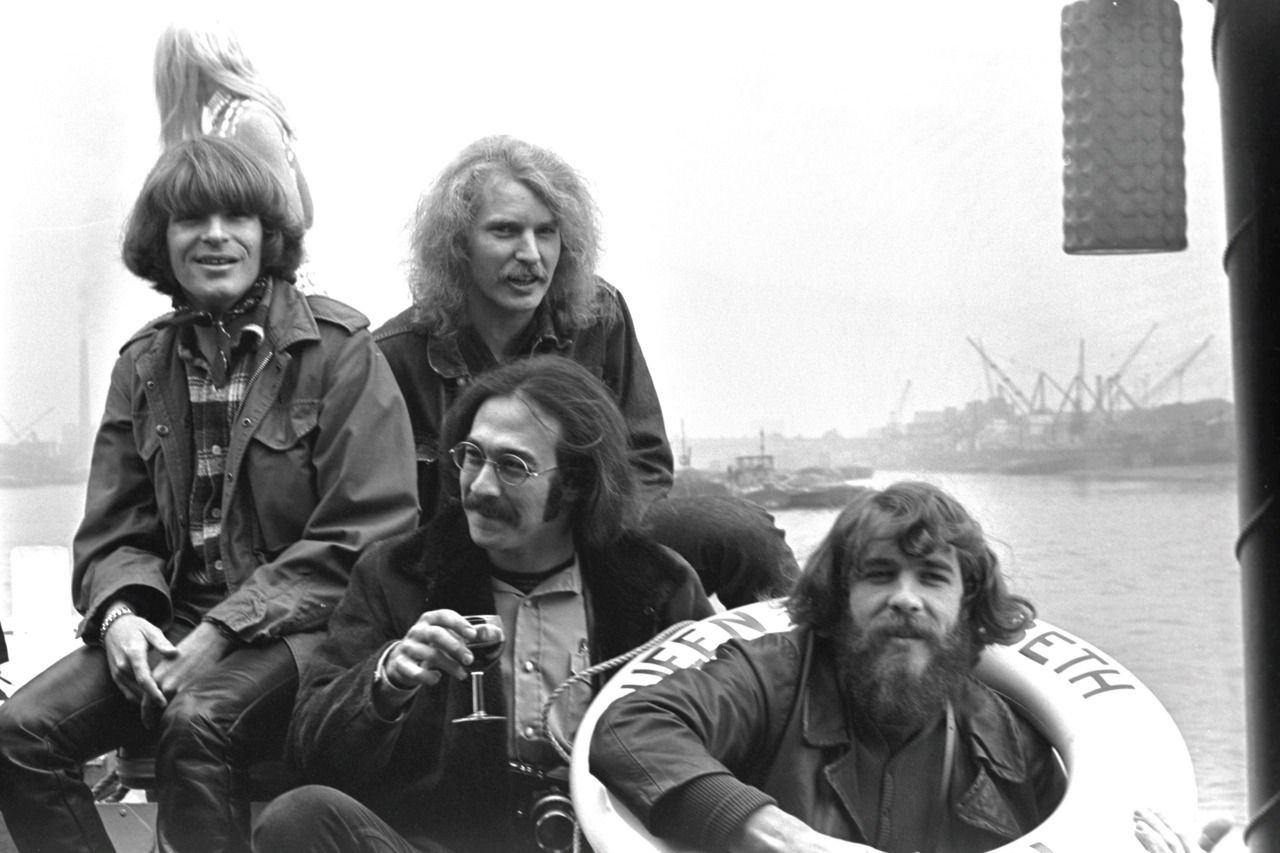
Need Someone to Hold is more than a rough-edged plea for comfort; it is the sound of Creedence Clearwater Revival standing at a crossroads, still recognizable, yet clearly no longer the same band that had once seemed unstoppable.
Released in 1972 on Mardi Gras, the final studio album by Creedence Clearwater Revival, Need Someone to Hold has never occupied the same celebrated place as the group’s towering classics. It was not issued as a major U.S. hit single, so it did not enter the Billboard Hot 100 on its own. But the album that carried it, Mardi Gras, still climbed to No. 12 on the Billboard 200, a reminder that even in a complicated final chapter, the band still commanded attention. From that same period, Sweet Hitch-Hiker reached No. 6 and Someday Never Comes reached No. 25 in the United States, which only makes this lesser-known track more intriguing: it sits just outside the spotlight, quietly telling the deeper story.
What makes Need Someone to Hold so fascinating is not that it sounds like the definitive CCR anthem. In truth, it does not. And that is precisely the point. By the time Mardi Gras was recorded, the internal balance of the band had shifted. For years, John Fogerty had been the unmistakable creative center of Creedence Clearwater Revival, shaping its songs, its voice, and its astonishing run of late-1960s singles. But on Mardi Gras, bassist Stu Cook and drummer Doug Clifford were given a far larger share of writing and singing responsibilities. Need Someone to Hold, with Doug Clifford stepping into the lead vocal role, stands as one of the clearest examples of that change.
You can hear it almost immediately. The song carries a barroom looseness, a blues-rock stomp, and a deliberately unvarnished feel. It does not glide with the eerie grace of Born on the Bayou, nor does it strike with the sharp precision of Green River or Up Around the Bend. Instead, it lurches forward with a rough, human urgency. That roughness has often divided listeners. Some hear a band losing its once-unbreakable center. Others hear something more vulnerable and more revealing: a famous group allowing the seams to show.
Lyrically, Need Someone to Hold is built on a simple emotional premise, and its simplicity is part of its character. This is a song about wanting closeness, warmth, and reassurance without ornament or philosophy. There is no elaborate metaphor here, no poetic maze to work through. It is a plainspoken cry for connection. In another artist’s hands, that directness might have felt slight. But inside the story of Creedence Clearwater Revival, it lands differently. Heard in the context of Mardi Gras, the song feels almost accidental in its honesty, as if the emotional need in the lyric is mirrored by a band that itself was searching for some way to hold together.
That may be why the track lingers in memory more than its reputation would suggest. It captures a moment when polish mattered less than atmosphere. The groove is earthy, the vocal is unpretentious, and the whole performance has the feeling of musicians leaning into instinct rather than myth. There is something almost humble about it. CCR had spent years sounding inevitable, as if every riff arrived already destined for the radio. Need Someone to Hold is different. It sounds like effort. It sounds like strain. It sounds like a room full of musicians trying to find common ground one more time.
That, of course, is also why Mardi Gras remains one of the most debated albums in the group’s catalog. It lacks the unified brilliance of Willy and the Poor Boys, Green River, or Cosmo’s Factory. Yet history has a way of softening first judgments. What once seemed merely uneven can, with time, start to feel revealing. And in that light, Need Someone to Hold becomes more than a lesser track from a difficult album. It becomes a document of transition, a snapshot of identity in motion.
There is also something unmistakably American about the song’s musical language. Its bones are in blues, roadhouse rock, and working-band rhythm. It does not chase grandeur. It keeps its feet on the floor. That quality connects it, however imperfectly, to the rootsy plainness that always gave Creedence Clearwater Revival its power. Even when the chemistry had changed, the band still knew how to make music that felt dusty, immediate, and lived-in.
So no, Need Someone to Hold is not usually the first song named when people speak of Creedence Clearwater Revival. It is not the song that built the legend. But it is one of the songs that helps explain the legend’s final shape. It reveals a band no longer operating from the same center, yet still capable of producing a track with personality, grit, and emotional plainness. Sometimes the most telling songs in a catalog are not the masterpieces. Sometimes they are the songs that let you hear the change while it is happening.
And that is the enduring pull of Need Someone to Hold. It is not polished enough to be mythic, and perhaps that is why it feels so human. On an album that marked the end of Creedence Clearwater Revival as a recording unit, this rough little plea for companionship still carries a strange warmth. It reminds us that even in unsettled seasons, music can preserve the texture of a moment: the uncertainty, the effort, the longing, and the sound of a great band trying, one last time, to move forward together.