
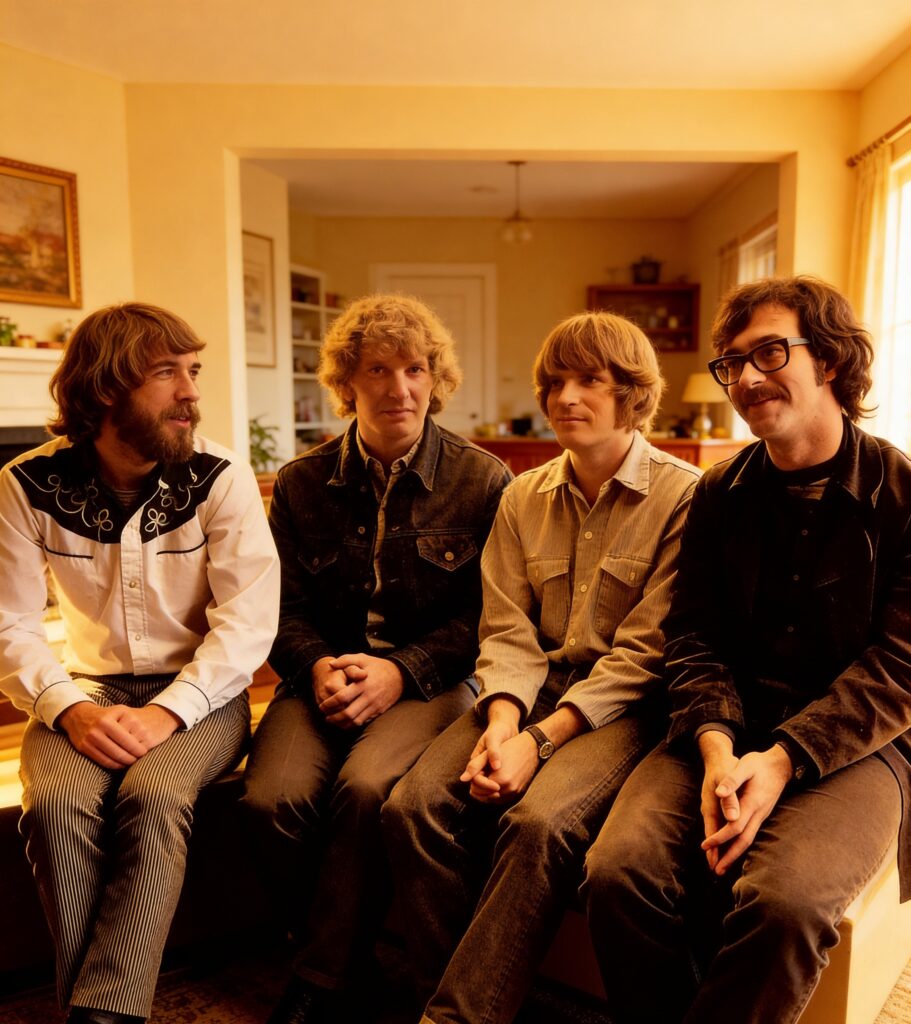
Behind its quick, bright rhythm, “Bad Moon Rising” carries a warning about uneasy times, proving how “Creedence Clearwater Revival” could make dread sound strangely irresistible.
Few songs in American rock history feel as instantly familiar as “Bad Moon Rising” by “Creedence Clearwater Revival”. Released in April 1969 and later included on the album “Green River”, the song rose to No. 2 on the Billboard Hot 100 in the United States and reached No. 1 on the UK Singles Chart, where it stayed for three weeks. Those chart facts matter because they confirm what listeners already feel in their bones: this was not simply a hit record, but one of those rare songs that entered everyday life and never truly left it.
Written by John Fogerty, “Bad Moon Rising” remains one of the most fascinating contradictions in the Creedence Clearwater Revival catalog. The melody moves with a brisk, almost cheerful bounce. The guitar is crisp, the rhythm light on its feet, and the whole record seems built for car radios, summer air, and singalongs. Yet the words tell another story entirely. “I see a bad moon a-rising / I see trouble on the way” is not the language of comfort. It is the language of intuition, of sensing a storm before anyone else can feel the wind change.
That tension is exactly what gives the song its lasting power. Fogerty once explained that the lyric was inspired by a scene from the 1941 film “The Devil and Daniel Webster”, especially its violent weather imagery. What he took from that cinematic moment was not merely disaster imagery, but a larger mood: the sense that upheaval can arrive while ordinary life is still going on. In “Bad Moon Rising”, that idea becomes unforgettable because the arrangement refuses to become heavy-handed. Instead of sounding gloomy, the record smiles through clenched teeth.
That was one of CCR’s special gifts. They could take blues, country, swamp rock, early rock and roll, and working-class plainspokenness, then shape it into something lean and immediate. On “Bad Moon Rising”, there is no wasted motion. The song lasts just over two minutes, but within that short space it delivers atmosphere, melody, urgency, and one of the most quoted choruses of the era. It feels handmade, direct, and unpretentious, which is one reason it has aged so gracefully.
It also arrived at a moment when American culture was filled with uncertainty. By 1969, popular music was increasingly reflecting social tension, generational change, and a broad feeling that the ground beneath everyday life was shifting. “Bad Moon Rising” never names those anxieties outright, and that may be why it travels so well across decades. It is specific enough to feel vivid, yet open enough for each listener to bring personal meaning to it. Some hear weather. Some hear political unease. Some hear private foreboding, the quiet sense that a season of life is turning.
Musically, the record is a small masterclass in balance. Tom Fogerty, Stu Cook, and Doug Clifford help build a track that never overreaches. Everything serves the song. The beat keeps moving, the guitar lines stay sharp and uncluttered, and John Fogerty sings with that unmistakable nasal edge that gave Creedence Clearwater Revival so much character. He does not oversell the warning. He delivers it plainly, almost matter-of-factly, which somehow makes it more believable.
There is also a human warmth to the way people remember this song. Many first encountered it on AM radio, through a jukebox, or from a turntable in a room full of conversation. Others came to it later through compilation albums and remastered releases that brought fresh clarity to the original recording. However one arrives at it, the effect is usually the same: recognition in the first second, then that quick return to a place, a season, a younger self, or a vanished afternoon. The song does not merely survive nostalgia; it earns it.
Another reason “Bad Moon Rising” endures is that it captures a feeling many great songs miss: the ability to sound inviting while saying something unsettling. Plenty of records are joyful. Plenty are ominous. Very few can be both at once. That duality is why the song continues to appear in films, television, playlists, and conversations about the essential American singles of the late 1960s. It is catchy enough for casual listeners, but rich enough to reward people who have lived with it for years.
In the end, “Bad Moon Rising” is not just a classic because it topped charts or because it belongs to the golden run of “Creedence Clearwater Revival”. It lasts because it tells a timeless truth in a deceptively simple way: life can still sound bright even when the horizon darkens. That is the genius of John Fogerty and the enduring elegance of CCR. They made a warning feel like a memory you want to revisit, again and again.