
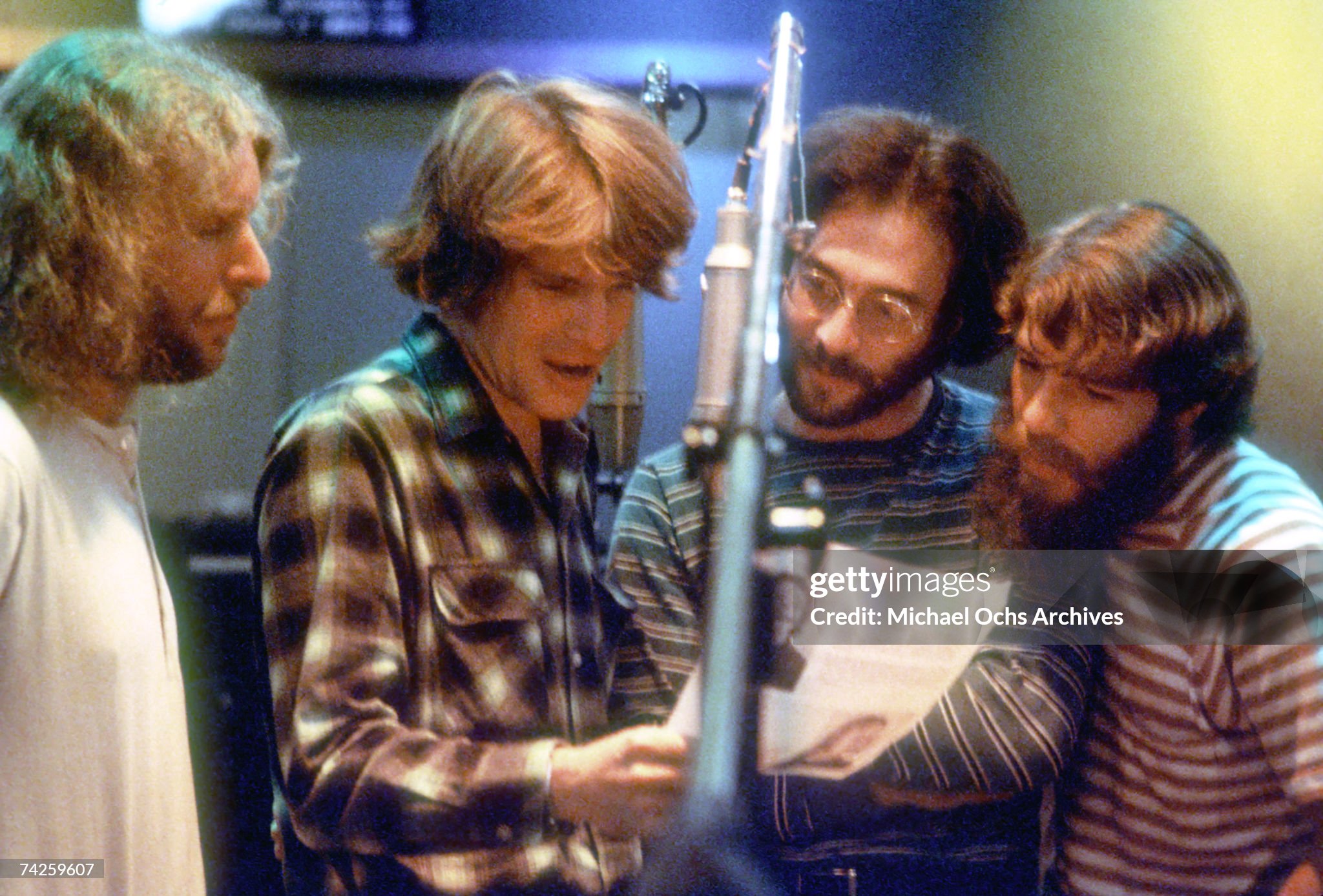
“Walk On The Water” is CCR’s early spell of belief and doubt—where the language of miracles meets the plain, stubborn truth that sooner or later, everyone has to swim.
Put the important facts right at the front, because Creedence Clearwater Revival history is full of half-remembered details: “Walk On The Water” appears on the band’s self-titled debut album, Creedence Clearwater Revival, released in 1968 (often listed as July 5, 1968) on Fantasy Records. That album—carrying the breakthrough glow of “Suzie Q”—went on to reach No. 52 on the Billboard 200. And the song itself is historically significant inside the CCR catalog for one rare reason: it’s credited to John Fogerty and Tom Fogerty—the only co-write between the brothers to appear on a Creedence album.
That single credit tells a quiet story before the music even starts. CCR would soon become synonymous with John Fogerty’s singular command—writer, singer, guitarist, producer, and the band’s uncompromising compass. But here, early on, “Walk On The Water” still carries a trace of the band’s “before” life, when the Fogerty brothers were writing together under the old, pre-CCR identity. In fact, a version of the song existed earlier as “Walking On The Water” by The Golliwogs, released as a 1966 single (Scorpio 408). The CCR album cut is a later re-recording—new performance, new muscle, and a new name that sounded like it had always belonged to them.
If you were buying 45s in late 1968, you might have met it another way: “Walk On The Water” served as the B-side to CCR’s single “I Put a Spell on You”, released in October 1968. That A-side reached No. 58 on the U.S. charts—meaning “Walk On The Water” traveled into homes almost like an unannounced companion, the flip-side voice you heard after the needle had already made its point.
Now for the part that lasts: what it means.
A title like “Walk On The Water” arrives with built-in symbolism. Even if you don’t reach for theology, the phrase carries an instant human ache: the fantasy of doing the impossible—of defying the rules that keep us stuck where we are. In CCR’s hands, that miracle-language doesn’t float in stained glass; it lands in everyday gravel. The song feels like a man staring at trouble—his own, his lover’s, the world’s—and imagining a miracle not because he is holy, but because he is desperate. And beneath that longing sits a more practical heartbeat: if you can’t perform wonders, you still have to choose what comes next. Faith, fear, action, surrender. Sink or swim—without the sermon.
Musically, it also hints at what CCR would become. The groove is taut and driving, built for forward motion rather than psychedelic drifting. You can hear the band learning its most important lesson: momentum is a style. John’s guitar doesn’t wander; it pushes. The rhythm section—Stu Cook and Doug Clifford—does what CCR always did best: hold the road steady while the song’s emotional weather changes overhead. The production on the debut (credited to Saul Zaentz and John Fogerty) is still rough-edged compared to the sleek certainty of later classics, but that roughness is part of the charm: it’s the sound of a band stepping into its own name.
There’s a particular poignancy in remembering where CCR stood in 1968. This was the year they were still proving they were more than a local story with a long apprenticeship. Creedence Clearwater Revival is the album that opened the national door—No. 52 on the Billboard 200, a real foothold. And “Walk On The Water” sits inside that moment like a small omen: miracle-talk on the surface, but a harder truth underneath—survival, grit, and the unromantic work of staying afloat.
So when you play “Walk On The Water” now, it doesn’t just sound like an early track tucked between bigger titles. It sounds like a snapshot of the band’s hinge-point: one foot in the Golliwogs past, the other stepping toward the astonishing run that would soon follow. And the song’s central idea—wanting the impossible, while living in what’s possible—still lands with the weight of something quietly learned. Because most of life isn’t a miracle. Most of life is the moment after you’ve asked for one… and you keep going anyway.