
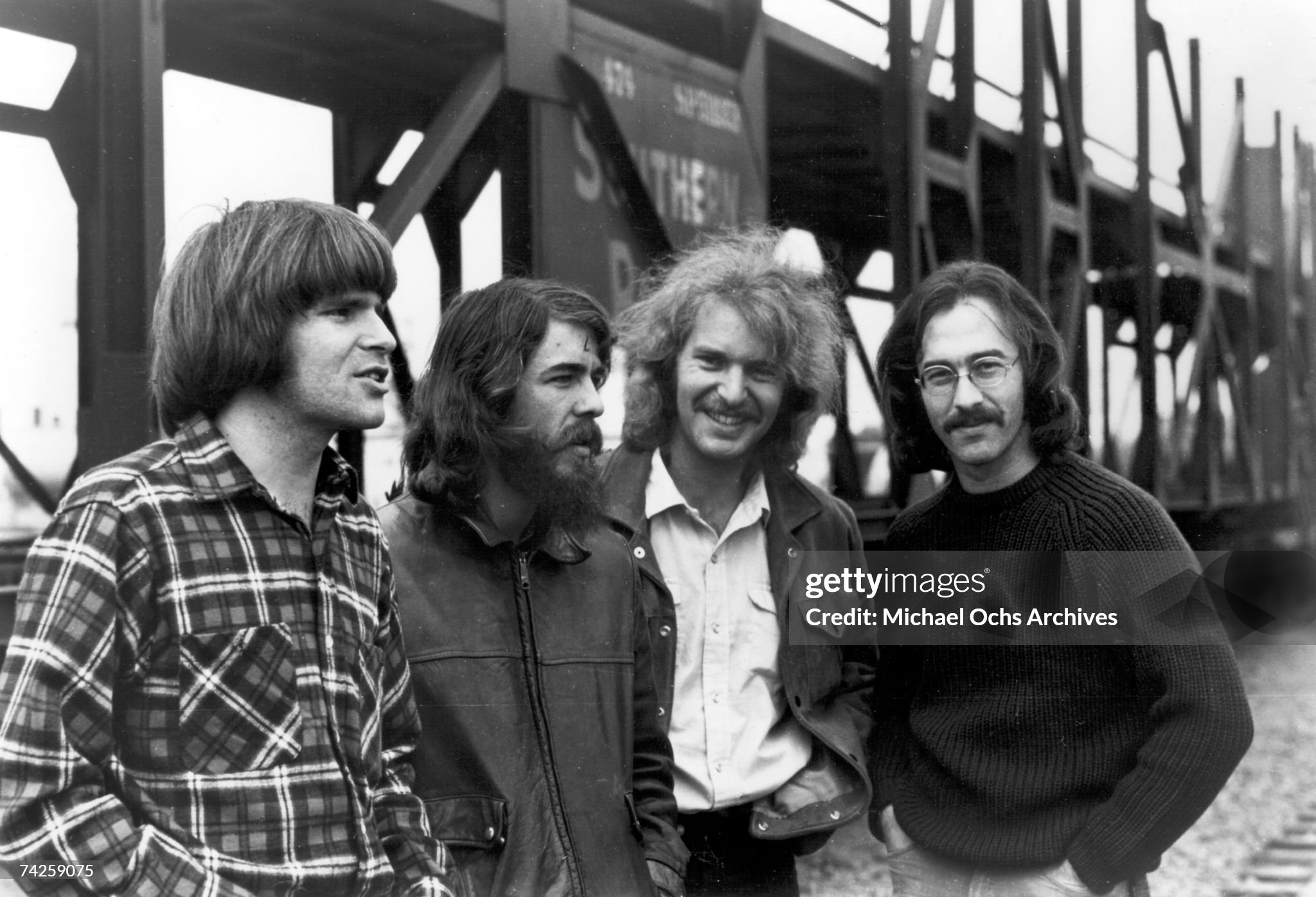
“Keep On Chooglin’” is CCR’s eight-minute midnight sermon—part boogie, part bravado, part survival mantra—where the groove keeps moving even when life doesn’t.
If Creedence Clearwater Revival ever had a track that felt like the band locking the doors, turning the amps up, and letting the night run long, it’s “Keep On Chooglin’”—the final cut on Bayou Country, released January 15, 1969 on Fantasy Records, produced by John Fogerty. For anyone who grew up with albums as worlds—not playlists—this one hits with a special satisfaction: it’s the moment the record stops behaving like a tidy set of songs and becomes a lived-in scene, sweaty and unhurried, like the last dance at a bar that doesn’t want to close.
The important chart story belongs to the album, because “Keep On Chooglin’” wasn’t released as a stand-alone hit single. Bayou Country climbed to No. 7 on the Billboard 200, and it also delivered the band’s first major breakthrough single, “Proud Mary,” which reached No. 2 on the singles chart. In other words: this was the moment CCR stopped being a promising regional force and became a national fact—yet “Keep On Chooglin’” remains the kind of song you discover, not the one the radio insists you know. That’s exactly why it still feels personal decades later.
On paper, it’s straightforward: written by John Fogerty, recorded October 1968, and running 7:43—long by pop standards of the day, and proudly so. But the “story behind” it is more revealing than the specs. Fogerty has said he began developing “Keep On Chooglin’” (along with “Born on the Bayou” and “Proud Mary”) while he was in the U.S. Army Reserves, and later he tied these songs together as part of a self-made “swamp bayou myth”—a kind of imagined Louisiana that the band could inhabit musically, even though they weren’t actually from the backwoods. It’s one of rock’s great acts of convincing storytelling: a California band conjuring humid Southern night air so vividly you can almost smell the riverbank.
Musically, “Keep On Chooglin’” is designed like a slow build to ecstasy. The opening riff is simple—almost blunt—but it’s the point: it gives the band a sturdy floor to dance on while Fogerty varies the guitar figure, drives the boogie forward, and breaks out the harmonica like a shout in the middle of a crowded room. Critics and biographers have described it as an “energetic rave,” and what’s striking is how physical the parts are made to feel: the pounding drums, the thumping bass, the slashing rhythm guitar. You don’t just hear it—you feel it in the shoulders.
Then there’s the word itself: “chooglin’.” The song is often credited with popularizing the term, which may even have been invented by Fogerty. And what does it mean? The beauty is that it’s both obvious and elusive—exactly like good slang. Fogerty described chooglin’ as what happens when “you got to ball and have a good time,” while bandmate Stu Cook saw it as a metaphor for sex; others argued it’s less about potency than sheer vigor—movement, life-force, getting on with it. That ambiguity is the song’s secret engine. It can be dirty, sure. It can also be uplifting. It can mean pleasure. It can mean perseverance. It can mean: keep your feet under you when the world turns strange.
And if you want the clearest proof of what CCR thought they’d made, it’s how they used it: “Keep On Chooglin’” frequently closed their concerts, sometimes stretching far beyond the studio length—turning into a long, communal ride-out where the band could test how far a groove could carry a room. That’s the real afterlife of the track: not as a chart statistic, but as a ritual—an ending that doesn’t “end,” just fades with sweat and smiles and the last stubborn insistence that the music, like the spirit, should keep going.
So the meaning of “Keep On Chooglin’” finally lands somewhere deeper than innuendo or jam-band showmanship. It’s a philosophy disguised as a party: a reminder that even when the days feel heavy, there’s still power in motion—one more step, one more laugh, one more turn of the record. Keep on.