
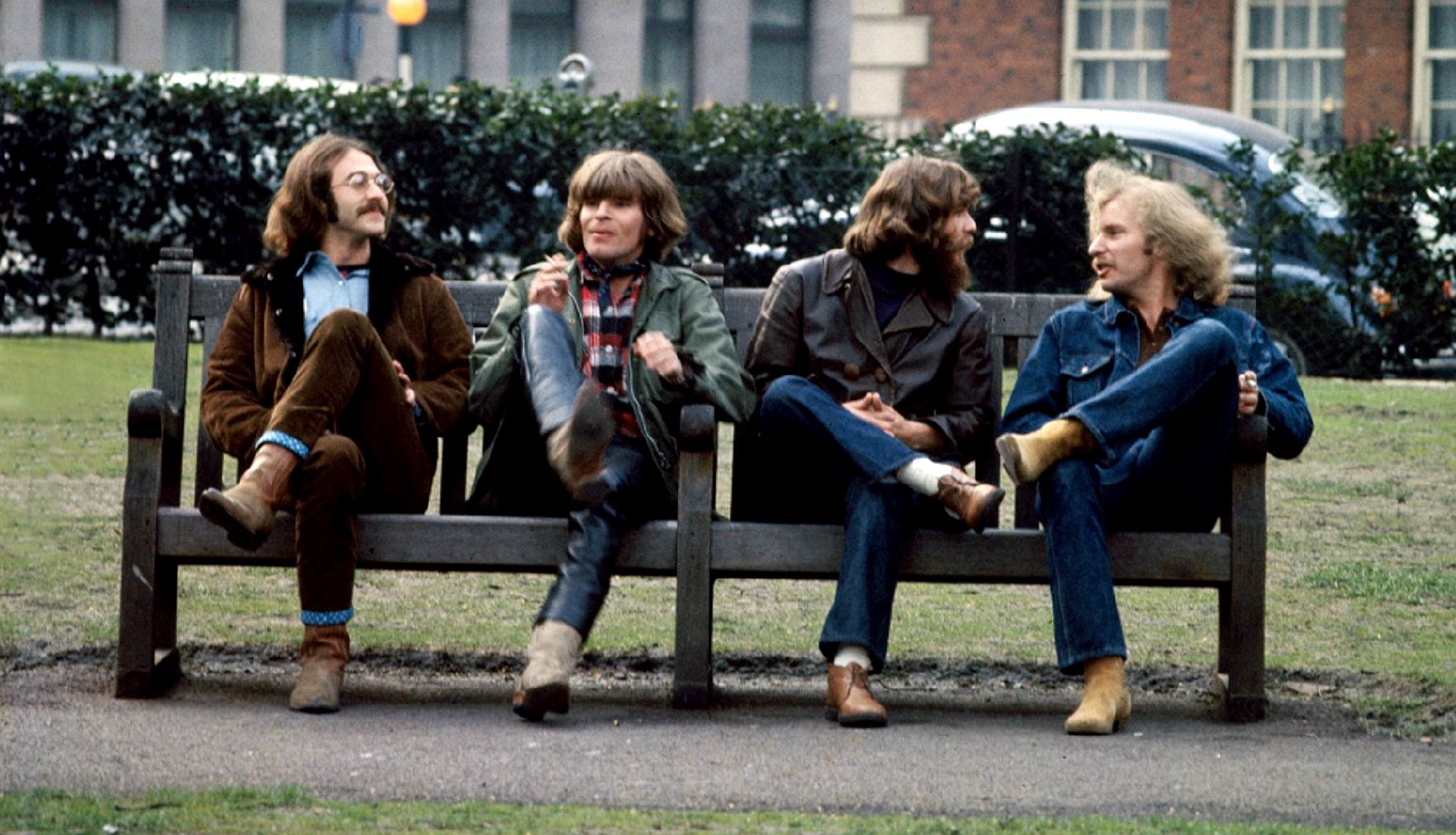
“Crazy Otto (Live at The Fillmore)” catches Creedence Clearwater Revival before the legend fully hardened—loose, heavy, half-psychedelic, and gloriously unpolished, like a band still testing how far its swamp-rock pulse could stretch in the dark.
One of the most important facts to place right at the beginning is that “Crazy Otto (Live at The Fillmore)” is not one of CCR’s familiar hit titles from the original LPs, but an archival live instrumental jam later issued as a bonus track on the expanded 2008 edition of Bayou Country. The performance was recorded at Fillmore West in San Francisco on March 14, 1969, and later digital listings place the track at about 8:48–8:49 in length. That alone tells you what kind of piece this is: not a concise radio song, not a chart single, but a long, exploratory club-stage performance from the band’s early ascent.
That context matters enormously, because Creedence Clearwater Revival are often remembered as the most economical of great American rock bands. Their classic singles waste nothing. “Bad Moon Rising,” “Green River,” “Proud Mary,” “Travelin’ Band”—all of them strike fast, say what they came to say, and leave. “Crazy Otto,” by contrast, lets us hear another side of the group: the live bar-band instinct still alive inside the machine. It reminds us that before CCR became a greatest-hits monument, they were a working band playing long, earthy, audience-facing performances in rooms where songs could breathe, sprawl, and turn into mood more than structure.
The title itself is curious and slightly misleading if one expects a fully formed CCR composition in the usual sense. What survives under the name “Crazy Otto” is best understood as a live instrumental blues-rock workout rather than a standard canonical song with a famous lyric or a separate chart history. One source tied to detailed CCR song documentation even identifies it as a “psychedelic jam” and credits it to John C. Fogerty, while noting that it was drawn from the Fillmore West performance and later added to the anniversary release. That is the right way to hear it: as a document of atmosphere, momentum, and band chemistry rather than as a polished studio statement.
And that is exactly why the track is so interesting. In 1969, CCR were on the edge of becoming enormous, but they had not yet been frozen into the public imagination as the kings of compact swamp-rock singles. A live piece like “Crazy Otto” preserves the old club-room elasticity. The groove settles in. The band leans into repetition. The performance feels less like narrative and more like immersion. This is music for smoke, volume, and instinct. It carries a little of the late-1960s ballroom spirit without ever losing the hard, muscular directness that made Creedence different from the more self-consciously psychedelic bands around them.
That contrast gives the track its meaning. “Crazy Otto” is not important because it rewrites the CCR story. It is important because it widens it. It shows that the band could stretch out when the setting invited it, and that beneath John Fogerty’s discipline as a songwriter there was still a live-wire pleasure in groove and feel. The title may sound odd, almost throwaway, but the performance itself reveals a band willing to get dirtier, looser, and more hypnotic than the singles usually allowed. In that sense, the track is less about destination than motion. It is about a band finding its own pulse in public.
There is also something especially attractive in the fact that this performance remained outside the main CCR legend for so long. Because it was issued later as an archival bonus track rather than as part of the original album-era narrative, “Crazy Otto (Live at The Fillmore)” still feels like a side door into the group’s history. It is the sort of recording that makes a well-known band human again. Not every moment is sculpted for radio immortality. Some moments are just four musicians locking into a groove and letting the night decide how long it should last.
So “Crazy Otto (Live at The Fillmore)” deserves to be heard as one of the most revealing archival glimpses of early Creedence Clearwater Revival: a March 14, 1969 Fillmore West performance, later released on the 2008 expanded Bayou Country, and preserved as an 8-minute-plus instrumental jam rather than a conventional song. What lingers most, though, is the feeling of hearing CCR before the edges were fully trimmed—raw, repetitive, slightly mysterious, and alive in that old live-room way that studio legends sometimes hide.