
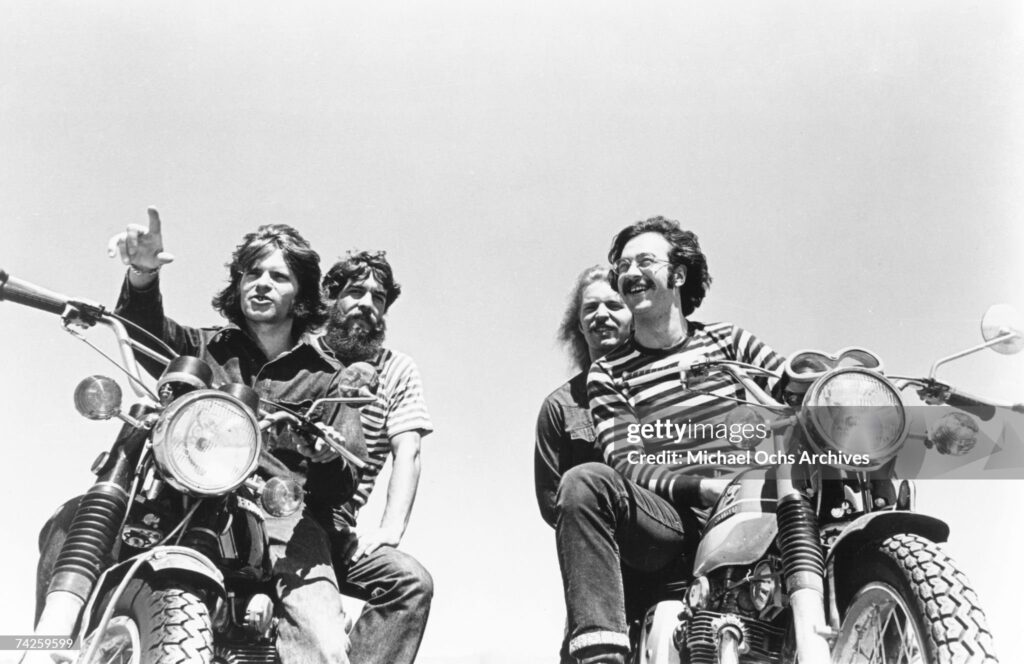
“Have You Ever Seen the Rain” is the sound of success turning bittersweet—sunlight on the surface, heartbreak falling quietly through it.
Released as a single in January 1971, “Have You Ever Seen the Rain” arrived credited to Creedence Clearwater Revival, written and produced by John Fogerty, and issued on Fantasy Records as a double-sided single with “Hey Tonight.” The song had the gentle immediacy of a radio lullaby—2:39 of plainspoken melody—but it carried an ache that listeners felt before they could name. On the charts, that tenderness didn’t soften its impact: it reached No. 8 on the Billboard Hot 100, and it did so quickly, hitting its Hot 100 peak in March 1971. In the UK it peaked at No. 36 (notably on the chart dated 3 April 1971). And in Canada, it went all the way to No. 1 on the RPM 100 in March 1971, a reminder that sometimes a song’s emotional weather matches a country’s mood perfectly.
It belongs to Pendulum—CCR’s sixth studio album—released on December 9, 1970. That date matters, because Pendulum is often heard as a hinge in the band’s story: the sound is fuller, more reflective, and—beneath the craft—more strained. In the background, pressure had begun to build. By the time the single appeared, the world still saw Creedence Clearwater Revival as a hit machine, but inside the room, the atmosphere was changing. The band would ultimately break up in October 1972, yet the emotional forecast was already written into this chorus.
The legend around “Have You Ever Seen the Rain” persists because it carries two truths at once, like the very image it sings: rain falling in bright daylight. One widely discussed reading frames the song as a metaphor for the fading of 1960s idealism as the era darkened into violence, disillusionment, and political shock. But Fogerty has also been direct about the more personal storm at its center: the tensions within CCR and the sense that something precious was about to fracture—especially as his brother Tom Fogerty neared departure. In that light, the line about a “sunny day” isn’t naïve at all—it’s almost cruelly realistic. You can be standing at the peak of your life, applauded from every direction, and still feel the chill of endings in the air.
Musically, that is exactly what makes the song so enduring. It doesn’t dramatize; it accepts. The melody moves with a calm, steady gait—no theatrical leaps, no desperate pleading—while the lyric slips in like a private confession shared over the hum of an engine. The opening suggests that familiar folk wisdom (“there’s a calm before the storm”), yet the chorus refuses tidy prophecy and asks for recognition instead: have you seen it too, this impossible overlap—joy and sorrow occupying the same sky?
And perhaps that’s why “Have You Ever Seen the Rain” has outlived the moment that birthed it. It doesn’t lock itself to one headline or one argument. It lives in the way memory works: bright scenes revisited with the knowledge of what came next. It’s the kind of song that turns up years later and doesn’t merely entertain—it returns something. A feeling you thought you’d put away. A season you didn’t realize still had a scent.
By the end, the genius is almost disarming: Creedence Clearwater Revival made a soft-rock hymn that sounds comforting even as it admits discomfort. “Have You Ever Seen the Rain” doesn’t shout about loss—it simply lets the weather happen, and in doing so, it makes room for the listener to breathe, to remember, and to quietly nod along as the sunlight keeps shining through the falling rain.