
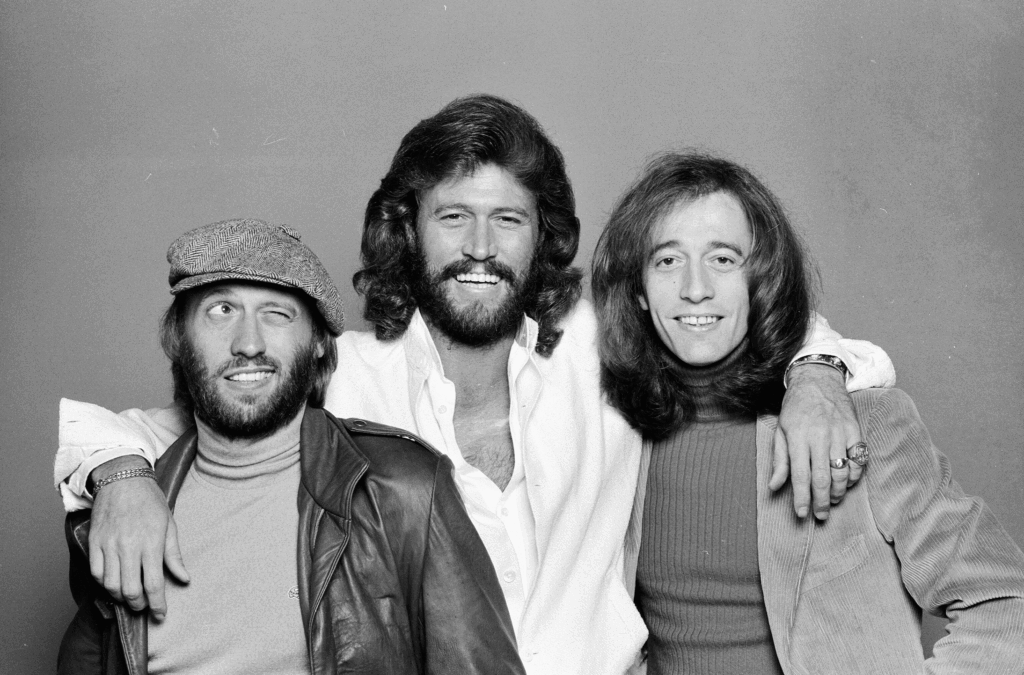
“World” is the Bee Gees pausing in the middle of pop stardom to ask a larger, quieter question: what is a life for, once the applause fades and you’re alone with your thoughts?
Released in November 1967, “World” arrived as a single at a moment when the Bee Gees were learning how to sound both youthful and strangely philosophical at the same time. The record came out on Polydor in the UK, backed with the non-album B-side “Sir Geoffrey Saved the World,” and it carried a running time of 3:20—short by the clock, but expansive in mood. In Britain, it entered the Official Singles Chart on 28/11/1967 at No. 30, then climbed to a peak of No. 9 (hitting that peak on 12/12/1967 and again on 19/12/1967) and stayed on the chart for 16 weeks in total. Those numbers matter because they show how the song worked its way into people’s lives: not as a sudden explosion, but as a slow, persuasive spell.
What makes “World” especially poignant is how its success carried a kind of geographical irony. It was a substantial hit across Europe and beyond—reaching No. 1 in Germany and the Netherlands, for example—but it did not become a U.S. single at the time. Atco Records chose not to issue it in the United States, having just released another single from Bee Gees’ 1st (“Holiday”). So for many listeners, “World” is one of those records that feels like a secret kept by a different hemisphere: hugely meaningful “over there,” almost hidden “over here,” the way certain memories belong to specific streets and seasons.
The song’s creation story also has that intimate, almost accidental magic that great records sometimes carry. “World” was recorded at IBC Studios in London, with sessions on 3 October 1967 and 28 October 1967. It began with a band-only approach—planned with no orchestra—and was laid down on four tracks with Maurice on piano and Robin on organ. Then the vision changed: an orchestra was added later, forcing the original band tracks to be mixed down and leaving a famously compromised stereo image until the strings arrive near the end. Even that technical “imperfection” feels somehow appropriate. The record itself seems to drift between two states—private and grand, intimate and cinematic—like a mind wavering between ordinary life and the sudden, overwhelming scale of existence.
In sound, “World” sits comfortably inside late-’60s psychedelic pop, but it doesn’t chase the era’s wildest colors. Instead, it glows from within—melancholy wrapped in harmony, the melody moving with a gentle inevitability. Barry Gibb carries most of the lead vocal, while Robin slips into the choruses like a second conscience, echoing the thought until it feels unavoidable. One recollection preserved in the song’s documentation is disarmingly simple: Barry described it as something they “came up with in the studio… everyone just having fun,” while guitarist Vince Melouney remembered the idea of playing the melody high on the guitar behind the chorus. That contrast—fun in the making, seriousness in the meaning—is part of why the track still feels human. Sometimes the deepest songs are born not from a grand plan, but from musicians following a feeling in the room.
Lyrically, “World” does what few pop singles dare to do: it quietly questions the singer’s purpose in life. It doesn’t preach. It doesn’t announce itself as “important.” It simply circles that restless thought most people know too well—the sense that the world is vast, time is quick, and the heart wants reassurance that it matters. This is the Bee Gees before disco royalty, before the tight suits and the stadium spotlights—three brothers shaping doubt into melody, giving uncertainty a place to rest.
And perhaps that is the enduring gift of “World.” It offers a kind of companionship for anyone who has ever looked out at a busy street or an empty room and felt both small and awake. The song doesn’t solve the question it asks. It dignifies it. It turns that private, late-night unease into something singable—proof that even when life feels too large, a beautiful harmony can make it feel briefly, tenderly bearable.