
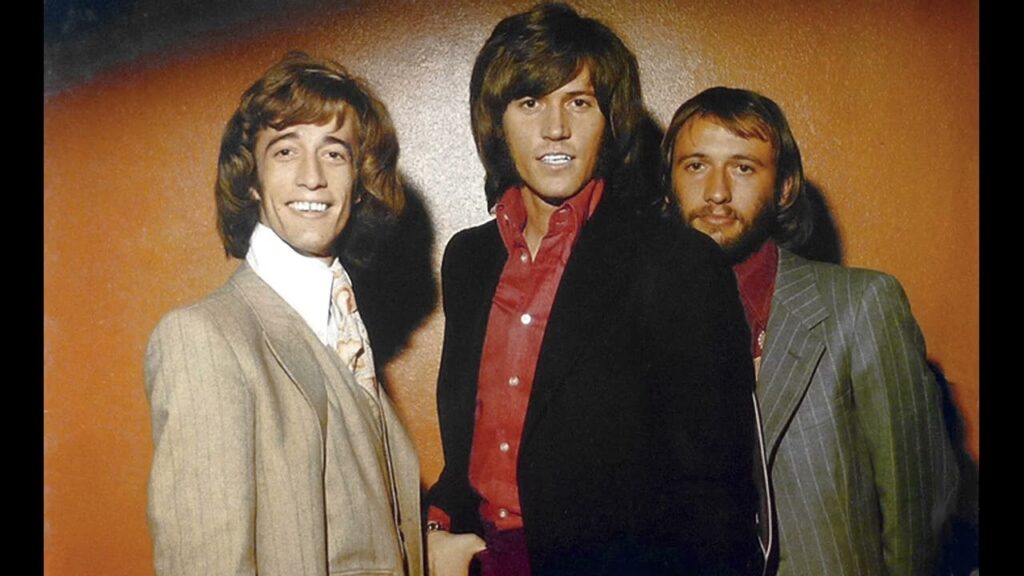
“For Whom the Bell Tolls” is a heartbreak confession dressed as a slow-burning hymn—proof that the hardest goodbyes keep ringing long after the door has closed.
When the Bee Gees released “For Whom the Bell Tolls” on November 15, 1993 as the second single from Size Isn’t Everything, it felt like a reminder written in elegant ink: these three brothers never lost their gift for turning private pain into public melody. And the charts—especially in Britain—caught the echo. On the Official UK Singles Chart, the single’s first chart date was November 27, 1993, it peaked at No. 4, and it stayed on the chart for 14 weeks (including 6 weeks in the Top 10). That peak made it the group’s highest-charting UK single of the 1990s, a rare late-career crest that quietly underlined something bigger: the Bee Gees were still capable of stopping time with a ballad.
The wider album context matters too. Size Isn’t Everything was released in the UK on September 13, 1993 (and later in the U.S.), and in the UK it ultimately reached No. 23 on the Official Albums Chart. There’s a certain poignancy in that timing: by the early ’90s, popular taste was sprinting toward new sounds and new faces, yet the Gibb brothers—Barry, Robin, and Maurice—wrote and produced this single themselves, as if to say: we know exactly who we are.
In the U.S., the story was more restrained—more of a whisper than a headline. The single bubbled under the Hot 100 at No. 109 on March 12, 1994, and it appeared on Billboard’s Adult Contemporary chart with a listed peak of No. 34 (a sign that the song found its home with listeners who still made room for craftsmanship and tenderness). This split reception—Europe embracing it, America barely noticing—only adds to the song’s aura. Some songs don’t “arrive” everywhere at once; they wait to be discovered in the quiet.
And what a quiet it is. “For Whom the Bell Tolls” opens like a man speaking into the dark, not performing—confessing. The lyric names Catherine, and immediately we’re in the intimate wreckage: stumbling at night, reaching for someone who isn’t there “to break my fall.” Later comes the small, modern cruelty of recognition—seeing her “in a magazine,” a picture at a party where she “shouldn’t have been”—the kind of detail that makes heartbreak feel public, unavoidable. It’s not just loss; it’s the humiliation of learning the story continues without you.
What’s striking is how the song refuses to blame only the other person. The narrator admits the blindness, the missed signs, the stubbornness—“I didn’t stop, take a look at myself.” That self-knowledge is the song’s sharpest hook. Plenty of ballads beg to be forgiven; this one is haunted by the fact that forgiveness may not change anything. The bell is already ringing.
Even the title carries a heavier shadow than pop usually allows. “For whom the bell tolls” is a phrase long associated with the old tolling bell of death—an image of mortality and consequence that has traveled through literature and memory for centuries. The Bee Gees borrow that gravity, then turn it inward: in their hands, the “bell” is the moment love dies, and you realize—too late—that it tolls for you. (It’s heartbreak as a kind of funeral, dignified and irreversible.)
Critics at the time heard the spark, too. In Billboard’s January 15, 1994 issue, reviewer Larry Flick praised it as a “no-nonsense romantic ballad,” calling it “arguably the finest” thing they’d done in years—high praise, and tellingly focused on the song’s clarity rather than any fashionable production trick.
In the end, “For Whom the Bell Tolls” endures because it sounds like grown-up love: not the rush of first promises, but the painful wisdom of consequences. It’s the Bee Gees reminding us that melody can be both comfort and verdict—soft enough to hold you, honest enough to wound you. And once you’ve heard that chorus—there’s a hole in my soul—you understand why the bell keeps ringing: some losses don’t end. They simply become part of the music.