
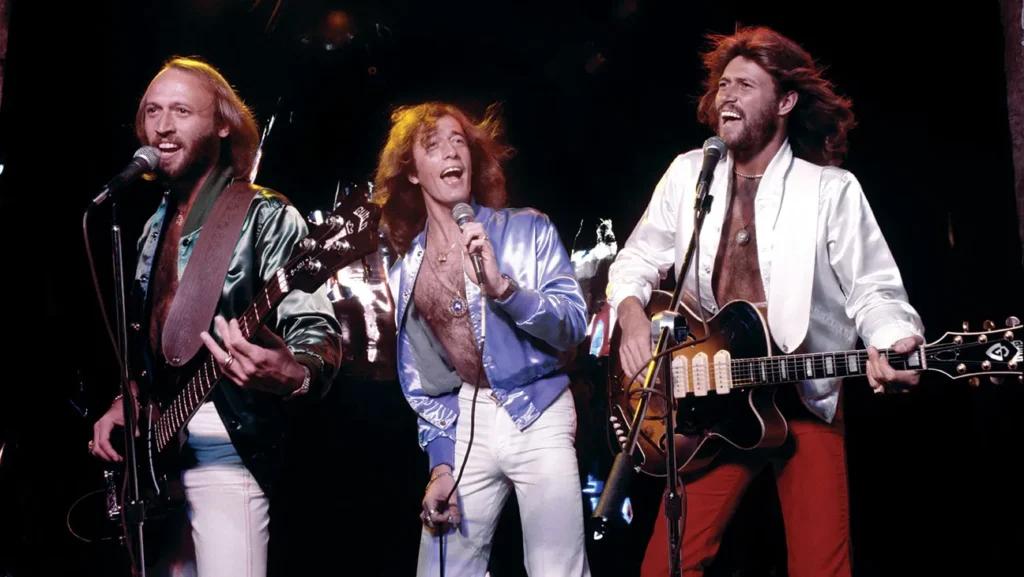
“Love Me” is the Bee Gees’ plea dressed in velvet—sweet, vulnerable, and slightly haunted, as if desire can only be spoken safely once it’s sung.
There’s a special kind of intimacy in “Love Me”—not the stadium-sized certainty the Bee Gees would soon master, but a softer, more human urgency. The song belongs to their 1976 album Children of the World, released on September 13, 1976, right at the moment when their sound was pivoting from sophisticated R&B toward the dance-floor future that would soon define an era.
If you care about “arrival” in cold numbers (and in music history, those numbers often become little timestamps of memory), the album’s U.S. chart entry is remarkably clear: Children of the World debuted at No. 20 on the Billboard 200 (October 2, 1976) and later peaked at No. 8. That debut week matters for another reason too—because “Love Me,” though not issued by the Bee Gees as a major single, was being quietly set free into the world in another voice at almost the same time.
The song itself was written by Barry Gibb and Robin Gibb, and that authorship already hints at its emotional texture: Barry’s melodic steel and Robin’s bruised romanticism working side by side. What makes the Bee Gees’ own recording feel like a small treasure is the lead vocal choice. In the mid-to-late 1970s, Barry often carried the front line, but “Love Me” is a Robin showcase—his unmistakable vibrato leaning into the lyric as if every word costs him something. That decision gives the track a different kind of gravity: it doesn’t swagger; it confesses.
The recording details place it squarely inside that transitional 1976 workshop where the brothers were sharpening their modern sound. “Love Me” was recorded starting March 30, 1976 at Criteria Studios in Miami, and finished April 25, 1976 at Le Studio in Quebec. And yes—the production credits read like the engine room of their next chapter: the Bee Gees themselves alongside Albhy Galuten and Karl Richardson, the team that would help shape their biggest late-’70s triumphs.
But the most poignant “story behind” “Love Me” is how it became, in a sense, a song with two lives. The Bee Gees placed it on Children of the World, yet it was soon “given away” in the old Brill Building spirit—handed to another artist who could carry it into radio. That artist was Yvonne Elliman, an RSO labelmate in the same orbit, and her version turned the song into a genuine pop hit.
Here is the chart moment that feels almost poetic: Elliman’s “Love Me” debuted at No. 85 on the Billboard Hot 100 on October 2, 1976, and eventually climbed to a peak of No. 14. The same date—October 2, 1976—also marks Children of the World entering the Billboard 200. It’s as if the Bee Gees opened one door for themselves and another for their songwriting legacy in the very same week: one record climbing the album chart, another carrying their emotion outward through someone else’s voice.
And that, in the end, is what “Love Me” means in the Bee Gees’ story. It’s not just a request for affection—it’s a portrait of how they worked at their peak: writing songs sturdy enough to survive translation, intimate enough to feel personal no matter who sings them. In Robin’s lead, “Love Me” sounds like a late-night admission you don’t want to make, because making it gives it power. In Elliman’s hands, it becomes a radio confession—more public, more open, but still aching with the same simple hunger.
Sometimes the most enduring Bee Gees moments aren’t the ones that announce themselves with glitter. Sometimes they’re the songs like “Love Me”—half-shadow, half-swoon—where you can hear three brothers standing on the threshold of a new era, still brave enough to sound tender.