
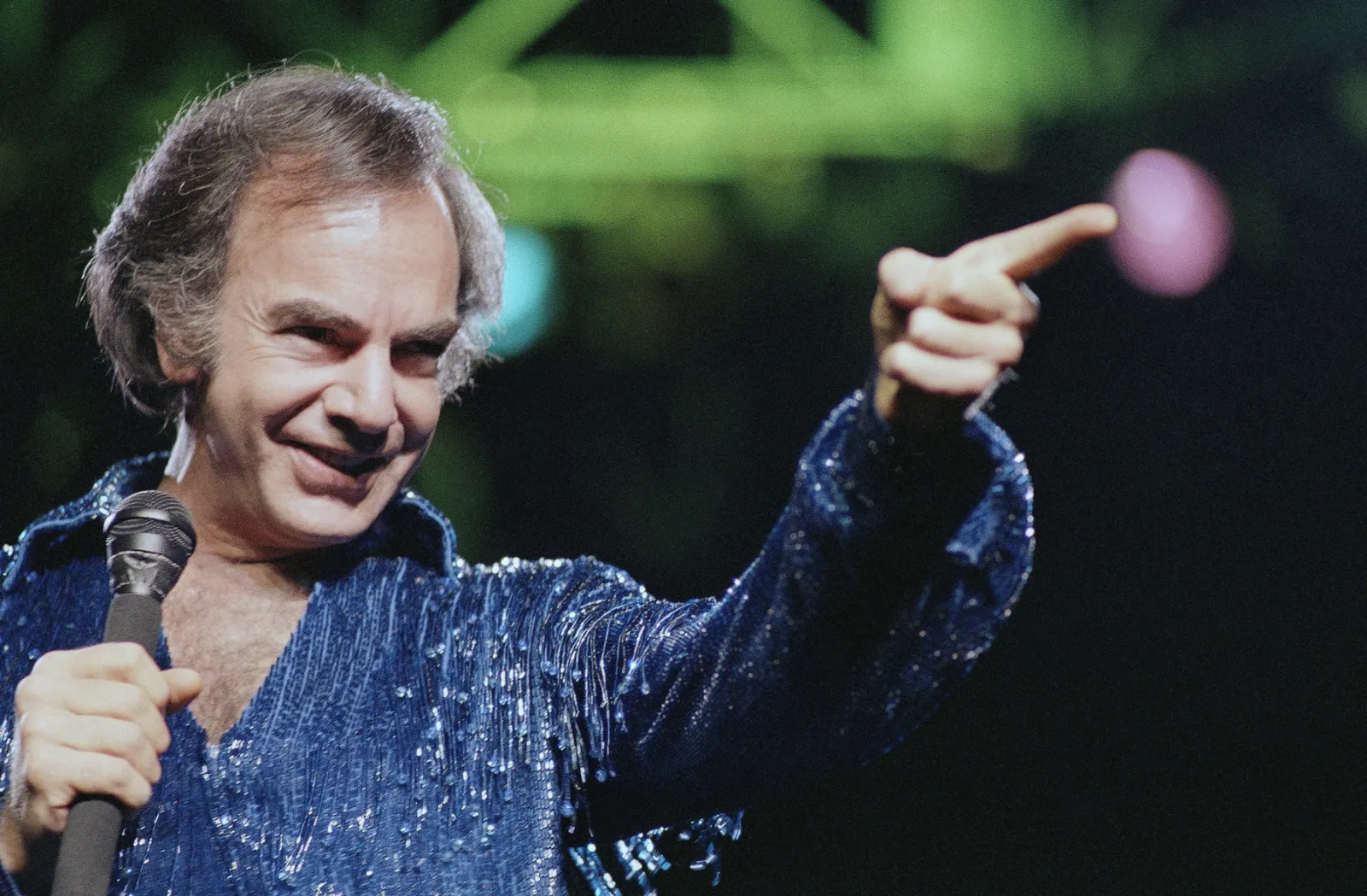
“You Don’t Bring Me Flowers” endures because it turns the smallest signs of love — flowers, songs, conversation — into evidence of a heartbreak far larger: the slow fading of tenderness inside a once-living bond.
The most important fact should come first, because it changes the whole way the song is remembered. “You Don’t Bring Me Flowers” began not as a famous duet, but as a song co-written by Neil Diamond with Alan and Marilyn Bergman for the television sitcom All That Glitters. It was originally meant to serve as that show’s theme, but when the concept changed, the song no longer fit. Rather than abandon it, Diamond expanded the short theme into a full-length ballad, and his solo version first appeared on his 1977 album I’m Glad You’re Here with Me Tonight. A year later, after an extraordinary twist of radio history, the world came to know it above all as the Neil Diamond–Barbra Streisand duet, released in October 1978, which rose to No. 1 on the Billboard Hot 100 in December 1978.
That chart success deserves to be placed near the top because it tells us how powerful the song became once listeners heard it in its final form. The duet reached No. 1 in the United States, also topped the Canadian singles chart, reached No. 5 in the U.K., and helped inspire the 1978 Neil Diamond album You Don’t Bring Me Flowers, issued to capitalize on the single’s success. Yet the strange beauty of this story is that the song did not begin as a carefully plotted blockbuster. It was, in a way, rescued twice — first from television obscurity, then from being “only” a solo recording. That unusual path gives the song part of its mystique. It feels less manufactured than discovered, as if it had to find its true shape by passing through several lives before becoming immortal.
And that is where the real story becomes unforgettable. Barbra Streisand had recorded her own solo version for her 1978 album Songbird, while Neil Diamond’s original solo take was already circulating from I’m Glad You’re Here with Me Tonight. Then radio programmers began doing something inspired and slightly mischievous: they spliced the two separate recordings together, creating an unofficial duet that listeners immediately responded to. The most famous early version came from Louisville radio programmer Gary Guthrie, and the public reaction was so strong that Columbia Records brought Diamond and Streisand into the studio to record an official duet version. Few great hits have ever come to life in quite so accidental, so organic, and so romantic a fashion. It was not just a record-company idea. It was a song the audience itself seemed to summon into being.
What makes “You Don’t Bring Me Flowers” so devastating, however, is not merely the story behind it, but the emotional truth inside it. The lyric does not describe a volcanic breakup or some dramatic betrayal. It is sadder than that. It describes the quiet erosion of love — the little rituals gone missing, the warmth drained from ordinary life, the terrible loneliness of two people still standing in the same room but no longer reaching toward one another. That is why the title remains so haunting. Flowers are not the point. The absence of care is the point. In one simple phrase, the song captures the way relationships often die: not in a single great storm, but in the disappearance of small kindnesses once given freely.
For Neil Diamond, this song revealed one of the most affecting sides of his artistry. He was often celebrated as a commanding singer-songwriter — bold, dramatic, unmistakable — but “You Don’t Bring Me Flowers” shows his gift for emotional understatement. In the solo version, he sounds like a man already standing amid the ruins of intimacy, still calm enough to name what has vanished, but wounded enough to know it may not return. Then, in the duet with Barbra Streisand, the song becomes even more powerful because it ceases to be a solitary lament and turns into a shared reckoning. Suddenly, the heartbreak is not one-sided memory. It is a conversation between two people who can no longer deny what has slipped away. That change is everything. It transforms the song from sadness into tragedy.
There is also something deeply moving about the timing. By 1978, both Neil Diamond and Barbra Streisand were already giants, artists with enormous public identities and unmistakable vocal styles. Yet this duet does not sound like a contest between stars. It sounds intimate, bruised, and startlingly human. That may be one reason it has lasted so strongly with older listeners and serious lovers of popular song: beneath the celebrity sheen, it speaks to a familiar private grief. Many songs celebrate the beginning of love. Far fewer dare to inhabit its slow cooling with such honesty. “You Don’t Bring Me Flowers” does not merely ask where romance went. It asks whether tenderness, once neglected, can ever truly be restored.
In the end, Neil Diamond’s “You Don’t Bring Me Flowers” remains one of the great adult love songs of its era because it understands something painful and universal: love is sustained not only by passion, but by attention. When attention dies, love begins to wither in silence. Whether heard in Diamond’s 1977 solo version or in the famous 1978 duet with Barbra Streisand, the song carries that truth with unusual grace. It is elegant, melancholy, and piercingly observant. And perhaps that is why it still lingers after all these years — not because it shouts, but because it notices what has stopped being said, stopped being done, and stopped being given. Sometimes the greatest heartbreak in music is not a slammed door. It is the sound of a door still opening, and no one bringing flowers anymore.