
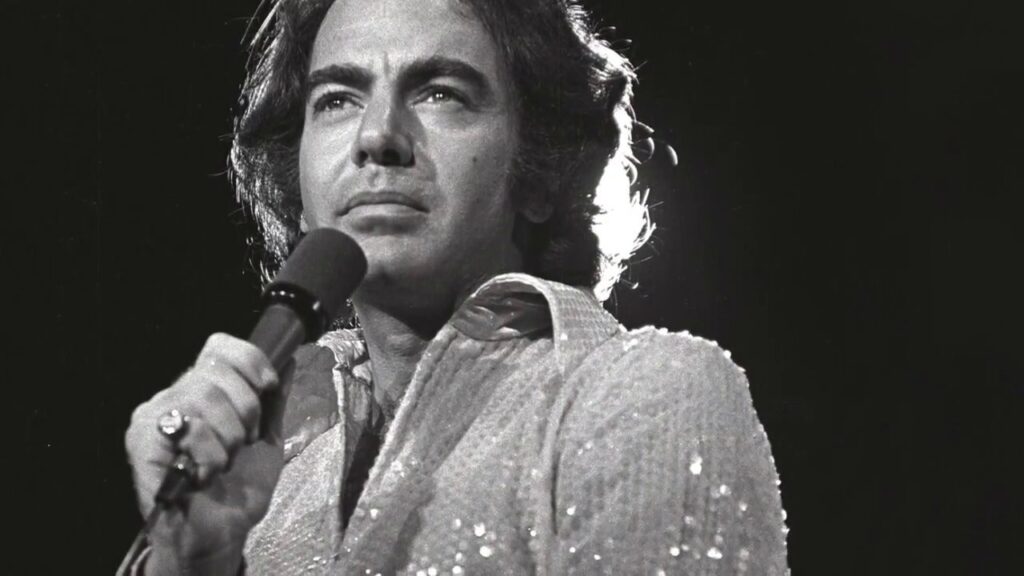
“Mr. Bojangles” becomes, in Neil Diamond’s reading, a small lantern in a dark room—an ode to dignity that survives poverty, loss, and the long night of forgetting.
If you’re looking for the clearest coordinates first: Neil Diamond recorded “Mr. Bojangles” for his 1969 album Touching You, Touching Me, where it appears as track 2 and runs 4:53. The album was released on November 14, 1969 on Uni Records, and it marked a notable shift in his early catalog because it blended his own originals with carefully chosen outside material. On the Billboard 200, Touching You, Touching Me debuted on December 13, 1969 (debut position No. 188) and went on to peak at No. 30. That chart footprint matters: it tells you this wasn’t a one-off curiosity, but part of a period when Diamond was widening his palette—learning how to inhabit other writers’ truths without losing his own voice.
And “Mr. Bojangles” is, in many ways, the perfect test of that skill. The song was written and first recorded by Jerry Jeff Walker (released in 1968), inspired by a night Walker spent in a New Orleans jail where he met a homeless street performer who called himself “Mr. Bojangles.” The story Walker told later is almost unbearably vivid: the man spoke of a performing dog he’d loved and lost, and when the cell grew heavy with sadness, he tried to lift the air by tap-dancing. That’s the song’s heartbeat—tragedy and grace sharing the same cramped space, the way life actually does.
What Neil Diamond adds is not spectacle, but attention. His version doesn’t wink at the character or romanticize his hardship. Instead, Diamond sings as if he’s sitting close enough to hear the scuff of worn shoes on a hard floor. The arrangement, held in a gentle 6/8 sway, feels like memory rocking back and forth—steady, almost soothing—while the lyric quietly opens its wounds. You can sense why this track belonged on Touching You, Touching Me, an album that also included reflective covers like “Everybody’s Talkin’” and “Both Sides Now”: Diamond was curating songs about people who keep going when the world gives them very little to hold.
The meaning of “Mr. Bojangles” is often misunderstood as simple nostalgia—an “old-time entertainer” tale. But in truth, it’s a song about the human instinct to create light inside a place that offers none. The performer in the lyric is not famous, not safe, not secure. He is, at best, tolerated—arrested, overlooked, reduced to whatever label makes him easiest to move along. And still, he dances. That detail is everything. It suggests a kind of spiritual defiance: not the loud defiance of slogans, but the quiet defiance of continuing to make beauty when beauty won’t pay the rent.
Diamond’s voice—already capable of tenderness beneath its power—treats that defiance with reverence. He doesn’t sing like a journalist reporting a scene; he sings like a witness who has been changed by what he saw. There’s a particular hush in his phrasing on this track, a sense that he knows the “story” isn’t entertainment at all—it’s a confession overheard in the wrong place at the right time. And because he recorded it in 1969, his cover arrives before the song’s most mainstream pop breakthrough (the Nitty Gritty Dirt Band’s hit version would come later), which makes Diamond’s choice feel even more personal: he wasn’t chasing a proven chart winner; he was choosing a song that simply mattered.
So when you return to “Mr. Bojangles” through Neil Diamond, what lingers isn’t the tap dance itself—it’s what the tap dance represents: the refusal to let sorrow have the last word. It’s a reminder that sometimes the most moving performances don’t happen under spotlights. They happen in the margins—behind county bars, in holding cells, in the thin space where a tired man gathers himself, lifts his heels, and offers the room one last, fragile gift: a moment of joy that doesn’t erase pain, but stands beside it, brave enough to be seen.