
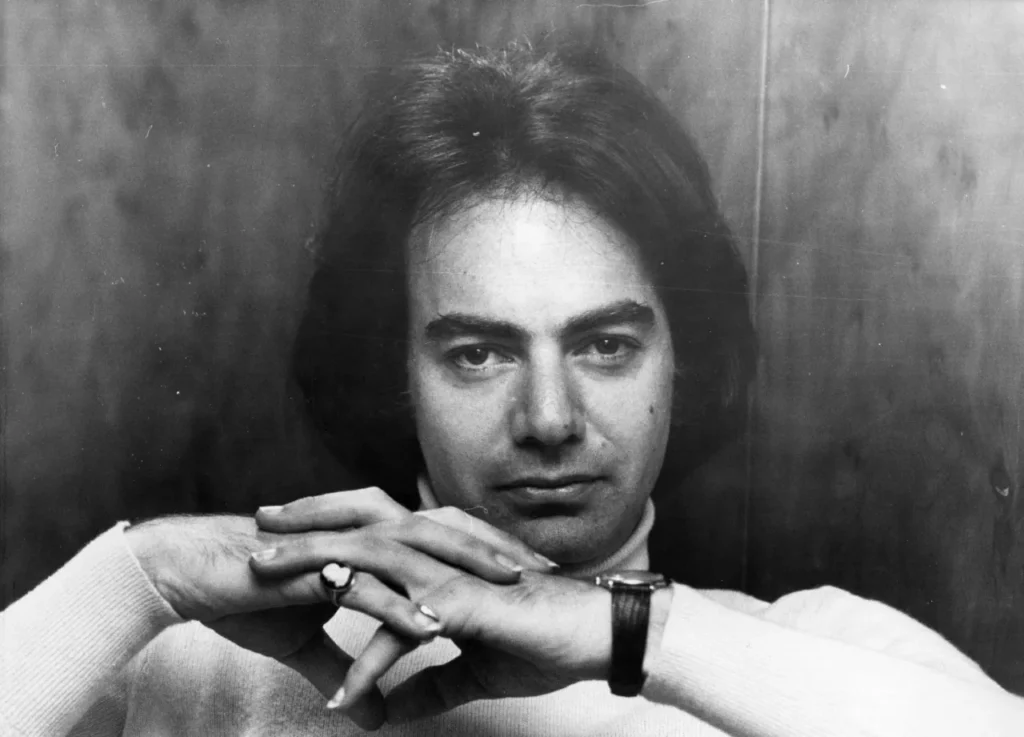
“And the Grass Won’t Pay No Mind” is Neil Diamond at his most tender and almost spiritual—an invitation to step out of the noisy world and into a private, sunlit moment where even nature looks away.
The important context comes first, because it explains why this song feels like a secret you’re allowed to keep. “And the Grass Won’t Pay No Mind” was recorded in 1969 and released on Neil Diamond’s fourth studio album, Brother Love’s Travelling Salvation Show, which came out on April 4, 1969. On the album it appears as track 6, tucked mid-sequence like a quiet clearing in the woods. Unlike Diamond’s blockbuster singles of the era, this song didn’t arrive as a major U.S. chart hit under his own name; its “debut ranking” is best described honestly: Diamond’s original was issued as a single in Australia in 1970 and reached No. 92 on the Kent Music Report. The tune’s bigger chart moment came indirectly, when Mark Lindsay (formerly of Paul Revere & the Raiders) released his version in September 1970, taking it to No. 44 on the Billboard Hot 100 and a striking No. 5 on Billboard’s Adult Contemporary chart.
Yet chart arithmetic can’t explain the song’s true power—because “And the Grass Won’t Pay No Mind” isn’t written to conquer a room. It’s written to soften one.
From its opening image—bare feet by a stream, the hush of something sacred in the air—the lyric feels like a hymn that has fallen in love with a human body. You can hear Diamond leaning into a kind of pastoral mysticism: God calling, hair falling, sunlight “baking down,” kisses answered with gentle hands. And then that refrain—“And the time will be our time / And the grass won’t pay no mind”—which may be one of Diamond’s most quietly profound lines. It suggests a world where judgment is suspended, where the earth itself refuses to gossip. Grass is indifferent; it doesn’t scold, it doesn’t remember, it simply grows. In that indifference, the lovers find mercy.
There’s an emotional sleight of hand here that only great songwriters manage: the lyric is intensely physical, yet never cheap. It doesn’t leer. It listens. It treats intimacy as something almost holy, as if closeness might be a doorway into the divine rather than a distraction from it. That’s why the song lands with such calm authority—Diamond isn’t selling romance, he’s naming a kind of peace.
The song’s afterlife also says a lot about its craftsmanship. Elvis Presley recorded “And the Grass Won’t Pay No Mind” on February 17, 1969, during his Memphis sessions, and it later appeared on his LP Back in Memphis (part of the From Memphis to Vegas / From Vegas to Memphis set). When Elvis—who could choose almost anything—gravitates toward a Diamond song, it’s usually because the lyric contains a cinematic clarity that suits his own longing. And Diamond himself kept returning to it in performance: the song appears on his famed live album Hot August Night, where it’s presented not as a forgotten deep cut, but as a moment the audience is meant to sink into.
So what does “And the Grass Won’t Pay No Mind” ultimately mean, beyond its beautiful images?
It’s a song about permission—the permission to step outside the roles we play and the noise we inherit. It’s about claiming a small corner of time and saying: This moment is real. This moment is now. (The lyric even insists on the immediacy of it—“The moment we’re living is now”—like a gentle hand turning your face back toward the present.) And the older you get, the more that feels like wisdom rather than romance: the understanding that peace is rarely delivered to your door; you have to choose it, protect it, and sometimes run away with it.
In the end, Neil Diamond didn’t need this song to be a No. 1 single for it to matter. “And the Grass Won’t Pay No Mind” has lasted because it offers something rarer than a hook: a place to rest. It’s the sound of sunlight, water, breath, and two people deciding—if only for a few minutes—that the world can wait outside, and the grass, kind and silent, will never tell.