
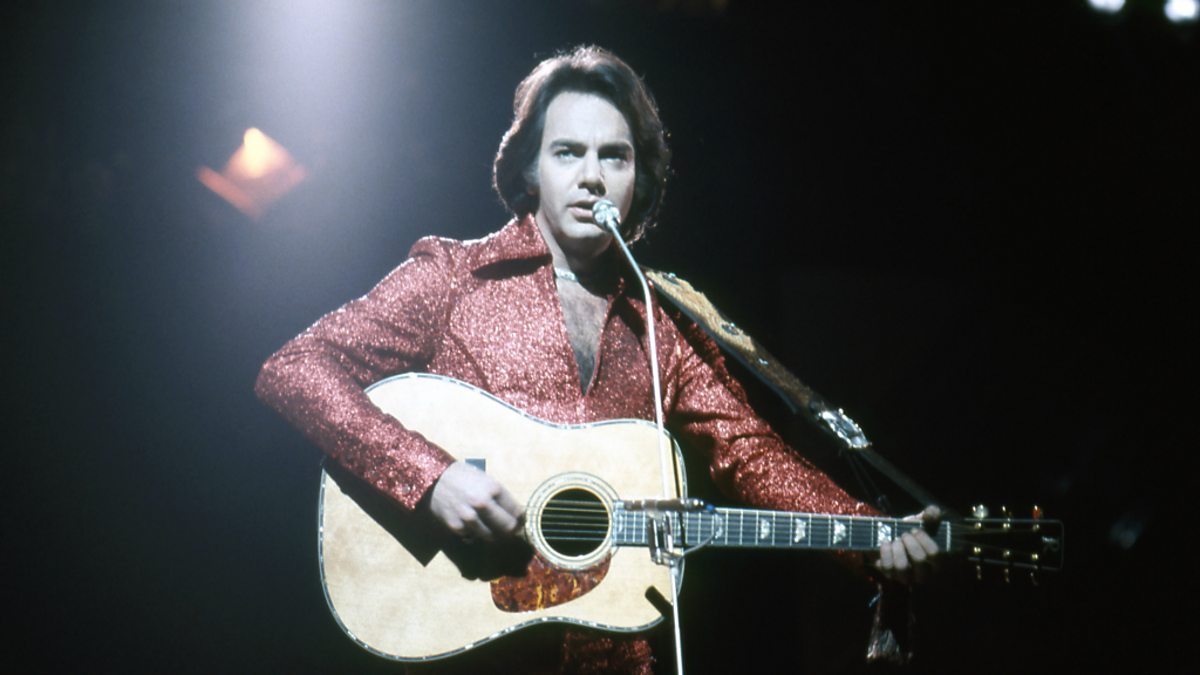
“Play Me” is one of Neil Diamond’s most intimate invitations—less a performance than a surrender, where love, desire, and music seem to dissolve into one another until the song itself feels like touch.
Released in 1972 as the first single from Moods, “Play Me” arrived during one of the richest stretches of Neil Diamond’s early-1970s run. Moods was issued that same year and became his first Top 5 album on the Billboard 200, peaking at No. 5, while “Play Me” climbed to No. 11 on the Billboard Hot 100, reached No. 3 on Billboard’s Easy Listening/Adult Contemporary chart, and also crossed into the UK Top 75, peaking at No. 51. Those numbers place the song just below his biggest blockbuster hits, but they do not tell the whole story. Some songs arrive as chart events; others settle more deeply into an artist’s identity. “Play Me” belongs to the second kind. It may not have been his highest-charting single, but it became one of the most unmistakably Neil Diamond songs of all—one of those recordings whose emotional climate is so distinct that after a few lines, it could belong to no one else.
What makes the song so memorable is that it speaks in the language of romance, but it is really about something even more intimate than romance: mutual completion. The famous lyrical images—“You are the sun, I am the moon / You are the words, I am the tune”—carry the old poetic dream that two separate beings can briefly become one living harmony. This is why “Play Me” has always felt more sensual than sentimental. It does not plead, accuse, or mourn. It offers itself. The title itself is daring in its softness. To say “play me” is to ask to be understood, awakened, and brought fully to life by another person. In Diamond’s hands, love is not merely affection; it is resonance. The self becomes an instrument waiting for the right hands.
That emotional idea helps explain why the song has lasted so long in memory. There are love songs that decorate feeling, and there are love songs that seem to uncover it. “Play Me” belongs to the latter. Its grace lies in how naturally it joins body, emotion, and melody. The song moves like a slow confession, almost like a waltz overheard in half-light, and that 3/4 lilt gives it a swaying, close-held character that suits the lyric perfectly. Rather than driving forward, it leans, circles, lingers. One does not listen to “Play Me” so much as drift into it. And that drifting is part of its meaning. It is a song about yielding—yielding to beauty, to longing, to the possibility that being known by someone else can feel as mysterious as music itself.
The larger album context matters too. Moods was not a minor stop in Diamond’s career but a major statement, the studio record that carried “Song Sung Blue” and helped define the fuller, more emotionally expansive sound he would soon bring into Hot August Night and the rest of his 1970s peak. Billboard later looked back on Moods as his first Top 5 album, a meaningful milestone in his ascent. So “Play Me” was born not in an accidental moment, but in a period when Neil Diamond was refining the balance that made him so enduring: the songwriter’s instinct for simple but potent imagery, the singer’s dramatic warmth, and the performer’s ability to make private feeling sound arena-sized without emptying it of tenderness.
There is another reason the song remains so beloved: it became a concert song, a song people did not merely hear but awaited. A New Yorker piece from 1992, tellingly titled “Spiel Mich”—German for “Play Me”—captured the peculiar devotion surrounding Diamond and his audience, emphasizing the deeply personal attachment listeners felt to him and his songs. That title choice alone says much. “Play Me” had by then become more than a single from 1972; it had become a kind of emblem, shorthand for the romantic and emotional spell Diamond could cast over a room. The song was never just about melody. It was about presence. About the charged little distance between a singer and the people who felt he was somehow singing directly to them.
And perhaps that is the deepest meaning of “Play Me.” Beneath its sensual polish lies a vulnerable truth: all love asks to be heard correctly. All love hopes not merely to be seen, but to be interpreted with care. Diamond wrapped that truth in one of his most elegant melodies and gave it the warmth of a late-night confession. The song does not sound young in the careless sense; it sounds timeless in the human sense. It understands that closeness is never only passion. It is recognition. It is the miracle of discovering that another soul can touch what is silent in us and make it sing.
So when we return to “Play Me,” we are returning not just to a 1972 hit from Moods, not just to a No. 11 single with a long afterlife, but to one of Neil Diamond’s most revealing love songs. It still shimmers with the old magic because it speaks to something people never quite outgrow: the longing to be answered, the longing to be completed, and the longing—so beautifully expressed here—to become music in someone else’s hands.