
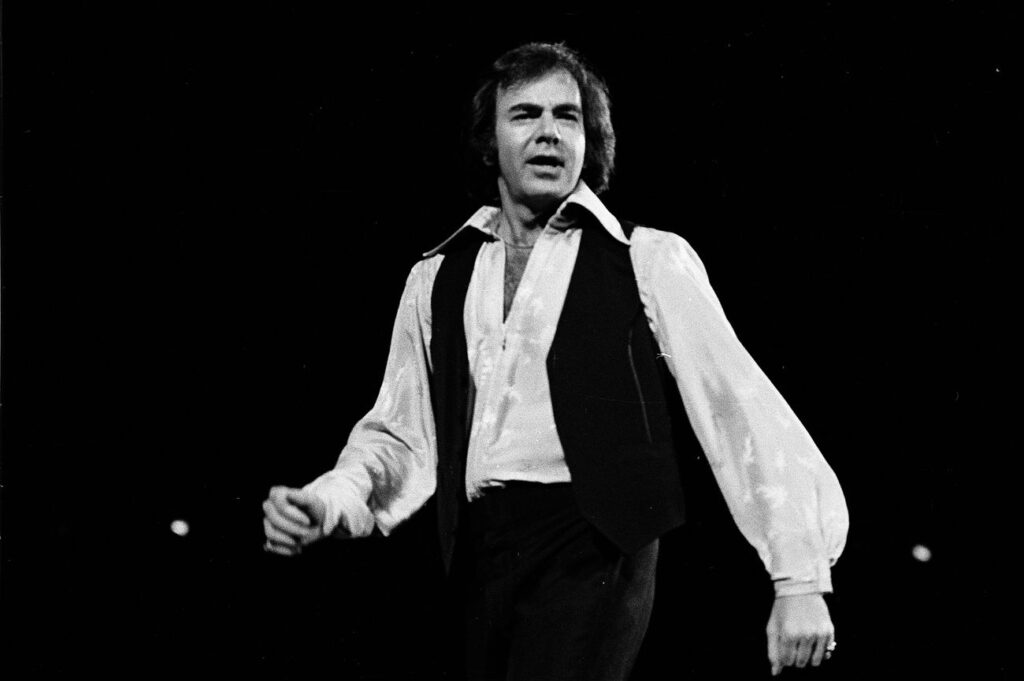
“Walk On Water” is Neil Diamond turning doubt into momentum—starting in a whisper, then rising like a gospel-tinted surge of courage, as if faith itself has to be sung into existence.
Neil Diamond released “Walk On Water” as the third single from his 1972 album Moods, and it became a telling kind of hit: not his biggest, but one that reveals how boldly he was expanding his sound at the time. On the Billboard Hot 100, the song debuted on November 11, 1972 (entering at No. 85) and ultimately peaked at No. 17, with 8 weeks on the chart—its peak showing on the December 30, 1972 Hot 100 listing. It also performed even more strongly with adult listeners, reaching No. 2 on Billboard’s Adult Contemporary chart (a detail repeatedly reflected in standard discography references).
Those numbers place “Walk On Water” in a very specific moment: Moods was the record where Diamond’s “signature sound” began to harden into something unmistakable—pop craftsmanship braided with gospel lift and theatrical pacing. The album entered Billboard in mid-July 1972 and rose as high as No. 5. And as later retrospectives have noted, “Walk On Water” also effectively closed a chapter: it was his last single release on the Uni label before the corporate reshuffle that folded Uni into MCA.
Yet charts and labels only explain the surface. The deeper life of “Walk On Water” is in how it moves—emotionally and musically—like someone gathering strength mid-sentence. It begins with restraint, almost conversational, as if the narrator is speaking from the edge of uncertainty. Then the arrangement grows in layers until it blooms into something that feels communal: a chorus you don’t just hear, you join. That structural “rise” is the meaning. The song behaves like a person who starts out afraid to hope, then slowly gives in to the brave act of believing.
Diamond wrote the song himself—like all tracks on Moods—and it carries his talent for double-meanings: spiritual imagery that can still read as romance, devotion that can still feel earthly. Decades later, when asked directly what it was “exactly about,” Diamond himself sidestepped any tidy explanation, joking that perhaps a psychiatrist could say whether it was about his mother—an answer that is both humorous and revealing. He leaves the door open on purpose, as if the song’s power depends on not pinning it down. That openness is why “Walk On Water” keeps finding listeners in different seasons of life: it can be faith, it can be love, it can be the stubborn will to keep going when you don’t feel strong enough.
Contemporary trade press heard its stylistic reach, too. Moods is often noted for its “diversified” material, and the era’s single reviews even compared “Walk on Water” to the singer-songwriter sensibility of Cat Stevens, while praising it as one of Diamond’s more interesting records of the period. That comparison makes sense: the song isn’t all showbiz sparkle. It has that early-’70s sincerity—warm, earnest, slightly searching—like a man trying to talk himself into a better life.
And maybe that’s the most moving thing about it. “Walk On Water” does not pretend the miracle comes easily. It doesn’t sound like certainty; it sounds like effort. The verses feel grounded, human, imperfect. The chorus feels like the moment the room fills with light anyway. It’s the kind of record that reminds you how music used to function on the radio: not merely as entertainment, but as companionship—three minutes that could steady the hands on the steering wheel, or soften the loneliness of a kitchen after midnight.
So if you’re returning to Neil Diamond here, you’re not just revisiting a 1972 chart entry. You’re stepping back into a time when a pop single could carry a spiritual ache without embarrassment—when a voice could start small, then grow into a choir of its own making, and leave you feeling, somehow, a little more capable of crossing whatever waits ahead.