
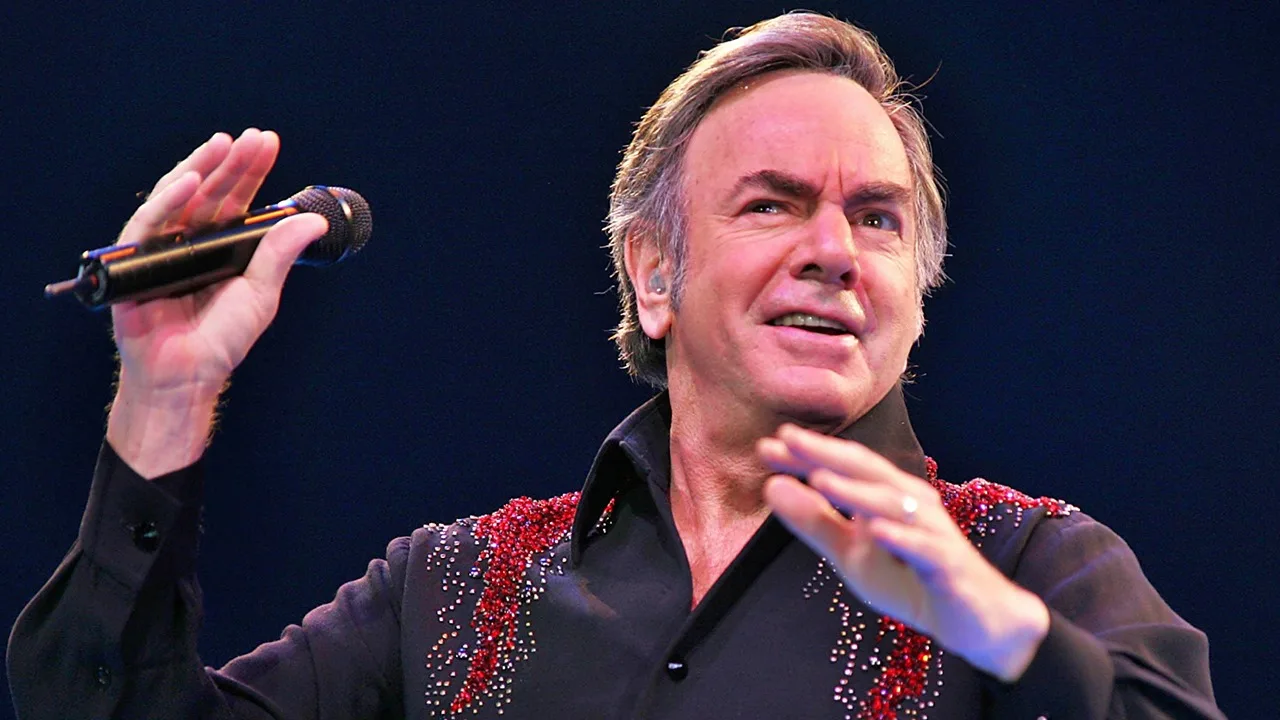
“Husbands and Wives” is a quiet, bruised waltz about how love doesn’t always collapse from lack of feeling—sometimes it collapses from pride, the slow poison that turns two people into strangers under the same roof.
Neil Diamond’s recording of “Husbands and Wives” is not an original Diamond composition—it’s a cover of a Roger Miller song, and that fact is part of its sting. Diamond included it as track 3 on his album Stones, released November 5, 1971 on Uni, produced by Tom Catalano. The album performed strongly on release, peaking at No. 11 on the Billboard 200 (Billboard’s chart history lists the album’s peak and peak date), and in the UK it reached No. 17 on the Official Albums Chart.
It’s worth being precise about “ranking at launch,” because this song’s chart story is indirect. Diamond did not release “Husbands and Wives” as a major chart single—its “arrival” is best measured through Stones and its album-chart performance. The original single story belongs to Roger Miller, who wrote the song and first recorded it. Miller released “Husbands and Wives” as a single in February 1966, and it became a crossover hit: No. 5 on US Country, No. 2 on Adult Contemporary, and No. 26 on the Billboard Hot 100.
So why would Neil Diamond—already capable of writing huge, emotionally direct songs of his own—choose to sing this particular Miller waltz in 1971?
Because “Husbands and Wives” is one of those rare songs that doesn’t just describe heartbreak; it diagnoses it. The lyric watches a relationship dying in plain sight—“two broken hearts… like houses where nobody lives”—and then lands on its bitter thesis: pride is “the chief cause in the decline / in the number of husbands and wives.” That is a brutally adult thought, the kind you don’t tend to believe when you’re young and in love, and the kind you recognize with a slow nod once you’ve seen enough doors close—sometimes softly, sometimes forever.
Diamond’s voice, in this era, had a particular dramatic gravity: warm baritone, but with a searching edge—like a man who could sell you joy and then, in the next breath, admit the loneliness behind it. On Stones, he was balancing deeply personal originals (like “I Am… I Said”) with carefully chosen covers—songs he could inhabit, reshape, and use as mirrors. When he sings “Husbands and Wives,” the lyric stops feeling like an outside observation and starts feeling like a confession overheard. Not necessarily autobiographical in plot—but truthful in emotional weather.
And the waltz tempo matters. A waltz moves in circles. It returns to the same step again and again—beautiful, formal, almost polite. That’s exactly how pride operates inside a relationship: the same argument reappears in a new outfit; the same silence repeats with slightly different words left unsaid. The melody doesn’t storm the gates. It just keeps turning—like time. Like habit. Like two people who once promised forever, now reduced to careful distance.
There’s also something quietly devastating about hearing this song inside the early-’70s Diamond arc. Stones itself was a successful album—Top 20 in the UK and Top 20 in the U.S.—but it’s an album that often feels like it’s staring at adulthood without blinking. When Diamond chooses a Roger Miller lyric that blames the slow decay on pride, he’s choosing the kind of truth that doesn’t flatter anyone. It doesn’t let either lover play hero. It suggests that the real villain is often something small and ordinary: ego, stubbornness, the need to be right when what you needed was to be kind.
In the end, “Husbands and Wives” endures because it doesn’t try to make heartbreak glamorous. It makes it familiar. It sounds like the quiet part of a conversation you can’t take back—the moment you realize that love may still be present, but tenderness has been mislaid, and pride has taken its place at the table. And when Neil Diamond sings that truth from within Stones—an album that climbed to No. 11 in America and No. 17 in Britain—he turns an already-classic song into something even more haunting: a reminder that some endings don’t arrive with a bang, but with a long, slow closing of the heart.