
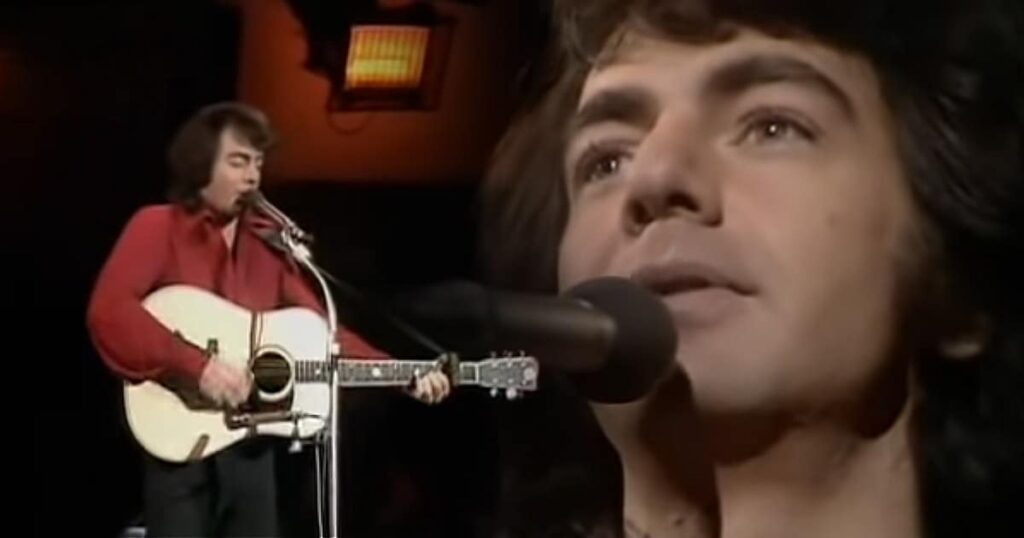
“Be” is a quiet hymn to becoming yourself—an ascent through doubt and gravity, until the spirit finally remembers it was meant to fly.
In October 1973, Neil Diamond released “Be” as a single from his film-soundtrack project Jonathan Livingston Seagull—and it entered the Billboard Hot 100 at No. 73 (chart date: October 27, 1973) before rising to a peak of No. 34. For listeners who followed Diamond through the early ’70s, that Top 40 climb felt less like a conventional pop campaign and more like the public slowly leaning in, week by week, to something unusually reflective. The song also found a natural home on softer radio, reaching No. 11 on Billboard’s Adult Contemporary chart.
Those numbers matter, but the context matters more. Jonathan Livingston Seagull—released October 19, 1973, produced by Tom Catalano—was Diamond’s return to Columbia Records, and the album ultimately peaked at No. 2 on the Billboard 200 while winning the 1974 Grammy for Best Original Score Written for a Motion Picture or a Television Special. In other words: “Be” wasn’t born inside the usual three-minute, radio-single world. It came from a larger canvas—an orchestral, narrative suite where Diamond wasn’t merely writing songs, but scoring a spiritual parable in sound.
If you’ve ever known the story of Jonathan Livingston Seagull—the solitary bird who refuses to live only for food and safety, who insists on the poetry of flight—then you can feel why “Be” had to exist. On the soundtrack’s own track notes, “Be” is described as the “Introduction of Jonathan – his flight and fall.” That phrase alone contains the whole ache of the song: the first leap, the first failure, and the stubborn decision to rise anyway. Diamond sings it like someone standing at the edge of a life change—equal parts frightened and certain—asking not for applause, but for permission to become.
Musically, “Be” is striking because it carries Diamond’s familiar melodic gift into a more cinematic language. The recording credits on the soundtrack highlight Lee Holdridge as orchestral arranger and conductor, which helps explain that sweeping, airborne feeling—the way the chords seem to widen like sky. You can hear how the orchestra doesn’t simply decorate the vocal; it answers it, like wind answering a wing. The result is a ballad that feels less like a pop confession and more like a ceremony—softly lit, almost reverent, as if the listener has walked into a sanctuary built out of strings and breath.
And what is the meaning of “Be”, when we step away from the film and let the song stand alone? At its heart, it’s a meditation on identity—on the difficult, sometimes lonely work of becoming real. Not the “real” that wins arguments or gathers trophies, but the real that quietly survives disappointment. The song understands that every genuine transformation has its bruises: the fall is not proof you were wrong to try; it’s part of learning how high you can go. That idea—so simple it’s almost dangerous—lands differently as years pass. The older we get, the more we recognize how many times we have started over in small ways: changing our minds, letting go of old selves, forgiving what once seemed unforgivable. “Be” doesn’t dramatize that struggle; it dignifies it.
There is also something deeply moving in how “Be” sits inside the larger Jonathan Livingston Seagull suite Diamond performed live—returning to it as a recurring theme, as if repeating the word “be” could steady the heart. That repetition feels true to life: we rarely learn the lesson once. We circle it. We revisit it. We need the reminder again, and again—especially on nights when courage runs thin.
So yes, “Be” charted—No. 73 debut, No. 34 peak—but its real achievement is quieter. It gives the listener a place to stand when the world insists you shrink. It speaks for the part of us that still believes a life can be wider than fear. And it does so in Neil Diamond’s most tender language: melody, longing, and the stubborn light of hope that refuses to go out.