
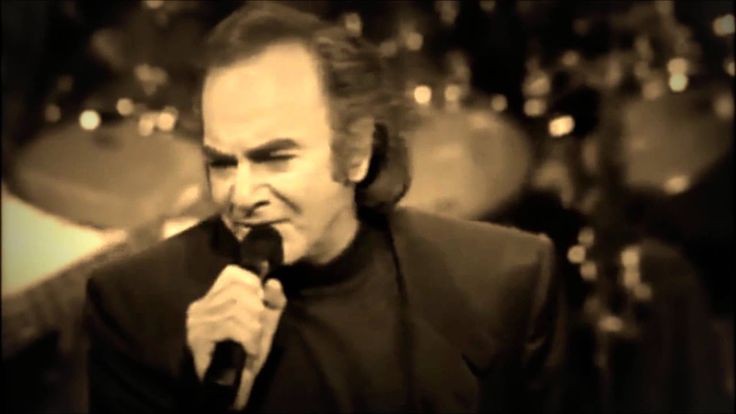
“Save Me a Saturday Night” is a gentle, late-hour promise—love asked for not with fireworks, but with the quiet urgency of someone who knows how quickly a week can swallow a life.
“Save Me a Saturday Night” belongs to a very specific turning point in Neil Diamond’s long career: the moment he stepped away from big-pop production and let his songwriting breathe in a simpler room. The track appears as song No. 5 on 12 Songs, released November 8, 2005, an album produced by Rick Rubin and made up entirely of songs written by Neil Diamond. In commercial terms, the album arrived with real force—debuting at No. 4 on the Billboard 200, Diamond’s highest-peaking studio set in decades. And yet, for all that success, “Save Me a Saturday Night” wasn’t the kind of track that marched out as a major chart single. Its power is more private—more like a note left on the table than a headline in lights.
The story behind 12 Songs matters, because it explains why “Save Me a Saturday Night” feels the way it does. According to the album’s documented history, Diamond began writing after retreating to his Colorado cabin, where he found himself snowed in and started shaping new material. Soon after, he met Rick Rubin, who encouraged him to keep writing for about a year before committing to studio recording, ultimately steering Diamond toward a more stripped, intimate approach and even pushing him to play guitar himself in the sessions. This isn’t the sound of a man trying to chase the next trend. It’s the sound of a writer returning to the plain wood of the instrument, trusting the grain.
In that setting, “Save Me a Saturday Night” reads like a small romance with big emotional truth tucked inside it. Saturday night, in popular music, is usually portrayed as the loudest part of the week—the neon hour, the crowded room, the promise of escape. Diamond flips that familiar symbol into something more tender and personal. To “save” a Saturday night is to reserve it, to protect it from routine, to say: don’t let this week end without us. There’s a sweetness in the request, but also a faint ache—because you only ask someone to save you a night when you’re afraid time is slipping by unclaimed.
And isn’t that one of Diamond’s oldest gifts? He can make the most ordinary phrase sound like it has history behind it. Here, the title alone suggests a life lived long enough to understand that romance doesn’t always fail because love dies; sometimes it fails because the calendar wins. Workdays pile up. Conversations get delayed. The weeks keep coming, and suddenly what you meant to say “later” becomes what you never said at all. “Save Me a Saturday Night” stands against that erosion. It’s not desperate in a theatrical way—it’s desperate in the human way: the desire to feel chosen again, to be the plan, not the afterthought.
12 Songs also has a telling public footprint that frames this track’s significance. While “Save Me a Saturday Night” itself wasn’t the big chart vehicle, “Delirious Love” (especially a later version featuring Brian Wilson) did receive single treatment and charted on Billboard’s Adult Contemporary listing. That contrast is illuminating: the album offered radio an entry point, but it gave listeners something deeper—songs like “Save Me a Saturday Night” that felt written for the space between people rather than the space between speakers.
So when you listen to Neil Diamond singing “Save Me a Saturday Night,” try hearing it as a late-career love song that refuses cynicism. It doesn’t pretend that time is endless. It doesn’t pretend that longing is youthful. Instead, it offers a warm, steady hand and says: give me one night we can call ours. And in that simple request—set inside the quiet confidence of 12 Songs, the record that proved Diamond could still arrive at No. 4 without shouting—there’s a kind of grace that only years can teach.