
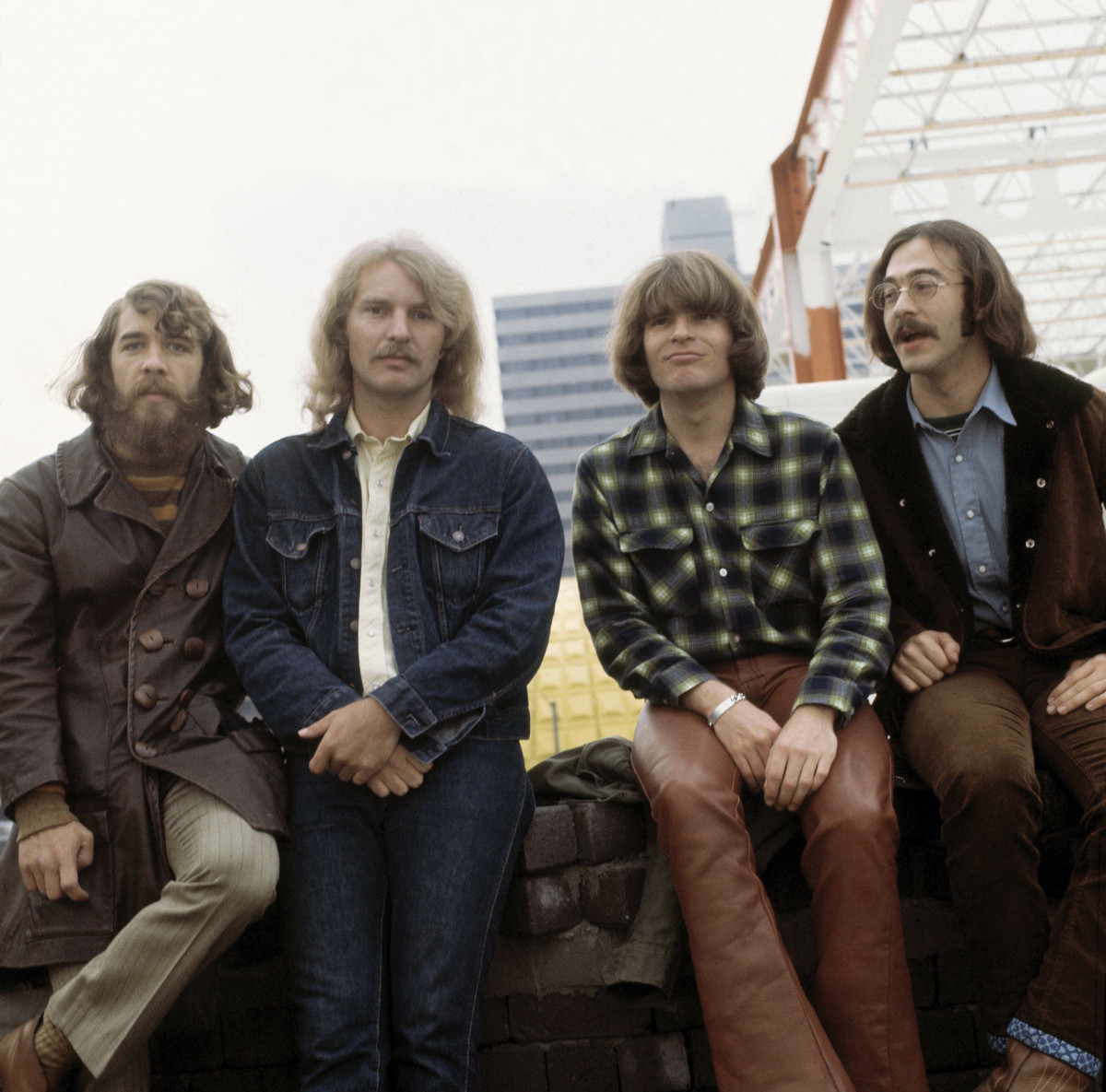
“Up Around the Bend” is CCR’s invitation to hope—an engine-bright promise that something better is waiting just beyond the next curve, if you’re willing to keep driving.
There’s a special kind of freedom in Creedence Clearwater Revival—not the glamorous freedom of limousines and spotlights, but the everyday kind: windows down, sleeves rolled, a road that doesn’t ask your résumé. “Up Around the Bend” arrived in April 1970 as a double-sided single with “Run Through the Jungle”, and it sounded like America catching its breath for two minutes and forty-one seconds.
Commercially, it landed exactly where CCR so often seemed to live in that era: near the very top, without ever needing to shout about it. The record climbed to No. 4 on the Billboard Hot 100 in the spring of 1970. In the UK, it became an even bigger event—first charting on June 20, 1970, and peaking at No. 3 on the Official Singles Chart. And time has only strengthened its footprint: the song has been recognized with RIAA 2× Platinum certification in the United States (2 million units, under modern certification rules).
Yet if you’re honest, the numbers are only the paperwork. What you remember is the feeling—that first, bright guitar figure like a flash of chrome in sunlight, and John Fogerty singing as if he’s leaning out of the driver’s window calling to you personally: Come on. Get in. There’s something up ahead. It’s not a complex story. It doesn’t need one. This is a song built from the oldest human fuel: curiosity, motion, and the stubborn belief that the best part of the day might still be waiting for you.
The timing of its creation makes the song even more vivid. Fogerty reportedly wrote and recorded “Up Around the Bend” just days before CCR’s April 1970 European tour, as if the upcoming miles demanded a fresh anthem. That urgency is embedded in the track’s body language—nothing lazy, nothing ornamental, just a band snapping into a groove that moves like a well-tuned machine. CCR never sounded drugged-out or dreamy; they sounded awake. Their magic was discipline disguised as ease.
A few months later, the song took its place on Cosmo’s Factory, released July 8, 1970—an album that would sit at No. 1 on the Billboard 200 for nine consecutive weeks, a feat that still reads like a kind of musical weather system: unavoidable, everywhere at once. “Up Around the Bend” appears there as the first track on side two, like a second wind in the middle of a long, great record.
But the deeper story—the one that keeps the song warm for decades—is what it means. “Up Around the Bend” isn’t merely about a destination. It’s about a mindset: the refusal to let the road behind you define the road ahead. The lyric points toward a gathering—something “up around the bend”—and that image is beautifully democratic. It could be a dance, a party, a reunion, a new job, a new love, a fresh start. It could even be something quieter: a porch light left on, a kitchen table waiting, a sense of being welcomed back into your own life. Fogerty doesn’t specify because he doesn’t have to. The bend is whatever you need it to be.
And there’s an emotional honesty in that vagueness. When life has been heavy—when the news has been loud, when the days have been long—hope rarely arrives as a philosophical argument. It arrives as a simple sentence: Just keep going. CCR understood that. They gave it a riff you could hum while you worked, and a beat sturdy enough to carry you across an entire afternoon.
It also matters that this song shared its single with “Run Through the Jungle.” One side offered invitation and light; the other side carried menace and warning. That pairing feels like a complete portrait of 1970: fear and joy printed back-to-back on the same piece of vinyl. And perhaps that’s why “Up Around the Bend” still feels so necessary. It isn’t naïve. It’s chosen. It’s the sound of people deciding—despite everything—that they will still show up for the good moment when it comes.
In the end, Creedence Clearwater Revival didn’t write “Up Around the Bend” to be profound. They wrote it to move—like wheels, like time, like a heart that refuses to stall. And if you’ve ever needed a song that doesn’t explain your life, but simply helps you carry it a little farther, you already know why this one keeps returning: because somewhere, always, something is waiting… up around the bend.